

Armies
Tanoris: moving rations
A convoy Line connects reserves to the movement of people and animals.
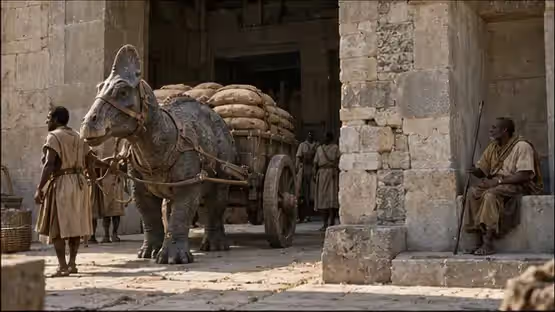
Transport is a responsibility
Sarnor’s Tanoris handles rationing and convoys. It does not own grain: it holds the right to move it. Keeping a reserve and organising a delivery are separate functions. The name on a convoy therefore does not identify the owner of everything it carries.
A ration has a destination
Sarnor supplies fodder to Urnok roads. Draught animals need water, food and care; their route must meet those resources. Relays and fodder are conditions of imperial power. Logistics does not end at loading: it includes the place where the animal and crew can actually resume work.
Two Tanoris, two entries
Another Tanoris exists in Orlantis, where it provides bark tannins. The register keeps the two entries separate. Naming their duchy and product avoids a false genealogy. A register can accommodate identical names; responsibility belongs to the precise link, not merely to the sound of a name.
The convoy office
The right to move grain is sold at the convoy office of the Tanoris Line, at the crossroads of the duchy’s roads. A silo or merchant wishing to ship a lot pays a fee calculated by the tonne and by the league; in return the office sets the route, the escort and the halts, and issues the papers without which no relay lets a grain load through. The office’s scribes keep the register of departures and that of arrivals, and it is the gap between the two that occupies them most.
The office chooses neither who buys nor who eats: it only says whether a lot may leave, by which road and when. This power looks modest. Yet it is enough to slow a city, squeeze a market or keep a duchy waiting, and complaints about a delay at the Tanoris office regularly reach the judges of Sarnor.
The legions’ ration
When the army takes the road, part of the grain the Tanoris move becomes the soldiers’ ration. The bread of relays and barracks is a loaf scored into twelve equal parts, which can be shared without scales: it is called twelfth-bread. On long campaigns the legions receive mostly grain, ground as close to the camps as possible. Soldiers are also issued pulses, salted meat from retired hadrosaurs, the only meat the register lets circulate freely, and part of their pay in fodder spirit aged in a silo.
The human ration and the animal ration travel neither in the same sacks nor under the same seals. A war column carries at least two sets of accounts, and stewards who mix them to gain a day sooner or later find themselves facing animals fed on the men’s grain, or men waiting for bread left behind in a fodder depot.
When the commissariat requisitions
In war the Tanoris’ right comes under the authority of the imperial commissariat. Requisition does not take their registers away: it imposes a destination on them. Convoys head for the campaign depots, escorted by the Silo Pikemen, and the Tanoris scribes go on keeping the accounts, because no one else knows as well the grain roads, the halts that hold and those that lack water.
This continuity has a reason. An Urnok army can change generals in a day; it cannot replace in a season everyone who knows how to make a ration travel. On long campaigns the Tanoris send the armies their best convoy chiefs, and prudent generals keep them close to their staff.
The convoy people
In Sarnor the Tanoris are recognised by their road tablets and their habit of speaking in leagues rather than days. They readily marry into the Lines of the relays and the cartwrights, because a convoy depends on sound axles and safe halts as much as on grain. They are respected without being much loved: merchants resent their fees, the silos their slowness, the cities their delays. Their answer is that the grain arrives.
A saying of the duchy sums up their place: the grain belongs to the silos, the road to the Tanoris. It is quoted as a reminder that a full sack feeds no one until it has reached those who wait for it, and that between the silo and the table there is always someone who answers for the way.