

Creatures
Urnok relays: feeding before departure
A movement network rests on stops where water, fodder, inspection and rest are genuinely available.
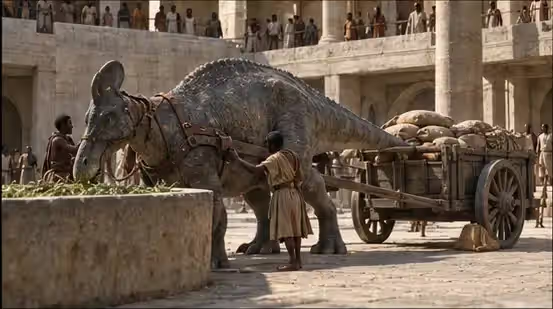
The giant depends on a stop
Construction, siege and transport sauropods depend on roads, fodder and relays. An equipped stop gives them resources needed for their next movement. Animal availability must be checked alongside the road and crew: great traction power is insufficient when a passage, ration or water point is missing.
Slots for great bodies
Urnok movement involves slots for great bodies, stops, water, fodder, inspection and cleaning. A great animal triggers closures, ground crews and human diversions. Small passages bypass load-bearing routes. A relay is therefore not an enlarged inn: its uses follow the animal’s body and needs.
Between two jobs
Stops provide access to care, buffer enclosures and routes for waste and carcasses. Watering places, fodder stations and adapted feeders prepare the onward journey. Inspection concerns both animal and equipment condition; rest meets the animal’s needs before it takes another load.
The animal table
At the gate of every relay hangs a table that every convoy master can read: what each animal needs for a day on the road. A draught hadrosaur is allotted about a hundred and twenty-five kilos of fodder and some two hundred litres of water; an iguanodon slightly more fodder for the same water; an escort stegosaur two hundred kilos of fern; a brachiosaur nearly a tonne of branches and fodder cakes, with two to three thousand litres of water. The relay master orders his stores according to this table and to the convoys announced.
The table is not a courtesy. An animal that leaves without its full ration manages the next stage, rarely the third, and the road’s incident book records the convoys that tried to save on a halt. Chancellery inspectors compare the quantities served with those on the table every season; a relay that serves less than it bills, or sells wet fodder cakes, loses its lease. Experienced convoy masters check the bale and the trough themselves, and on the roads they say that “a convoy is judged at the manger”.
The colossus stations
The corridors of the great sauropods have their own halts, heavier and more widely spaced than ordinary relays: a station roughly every twelve leagues. They have fodder hoppers mounted on wooden towers, troughs at neck height, deep basins fed by channels or wheel wells, and the heaps of gizzard stones the titans swallow to grind their food. Compacted fodder cakes are stacked there by the tonne; a single one feeds a marching titan for a day.
A very large animal does not halt like a hadrosaur. It needs a night and a morning to drink, eat, rest and go through the foot inspection, and the station organises its work around that long stretch: the washing teams go first, then the veterinarians, then the harness-makers. Stations employ dozens of people, often whole families settled there for generations, and their everyday name almost always comes from a colossus that once halted there and has not been forgotten.
What the animals leave behind
A relay receives animals, and it receives what they leave behind. A draught hadrosaur returns a good part of what it eats every day; a titan, several hundred kilos. Relay yards therefore have their muckers, who gather the droppings by shovel and cart, heap them under cover and sell them to neighbouring farms as manure. On the great corridors this dung is a revenue in its own right, and the whole Empire speaks of “Titan’s brown gold”.
Carcasses follow another rule. An animal that dies at a relay is declared before it is moved: a titan returns to the Crown, with its bones, tendons and plates, and the relay must keep it intact until the Crown’s agents arrive; a hadrosaur goes to the cull-meat salters on certificate. The exits for carcasses and droppings are placed opposite the troughs, downwind, and a relay that mixes them is recognised from afar by the smell, and then by the sickness register of its animals.
Night at the relay
The relay never quite sleeps. Convoy animals spend the night in the resting pens, the largest apart, and a guard walks the fences with a lamp. Predators know the relays as well as travellers do: a yard full of hadrosaurs draws night hunters from far off, and the fires lit at the corners serve as much to keep them away as to light the yard. In the marches the guard is doubled and the small gates are shut at sunset.
Night is also the time for care. Keepers go through the pens, see which animals have lain down and which remain standing, listen to their breathing and note those that have not finished their ration. An animal limping in the morning does not leave without an examination, and the relay master may hold back a convoy whose animals are not ready. Convoy masters know it, and many prefer to sleep near their animals rather than in the common room: what one notices at night spares bad surprises at departure.
A road feeds no one by itself
Imperial roads alone are not enough to move a living creature. They must meet fodder stations, water points, rest spaces and people able to inspect a load. A journey becomes possible because a relay is prepared; the presence of a great animal replaces neither its need to drink nor the time needed to resume effort.
Postponing is a care decision
When ration, water, fastening or passage is missing, departure may be delayed. This limit gives a public role to rationers, harness inspectors and relay keepers. They make visible what must be repaired or supplied before asking for another journey.