

Creatures
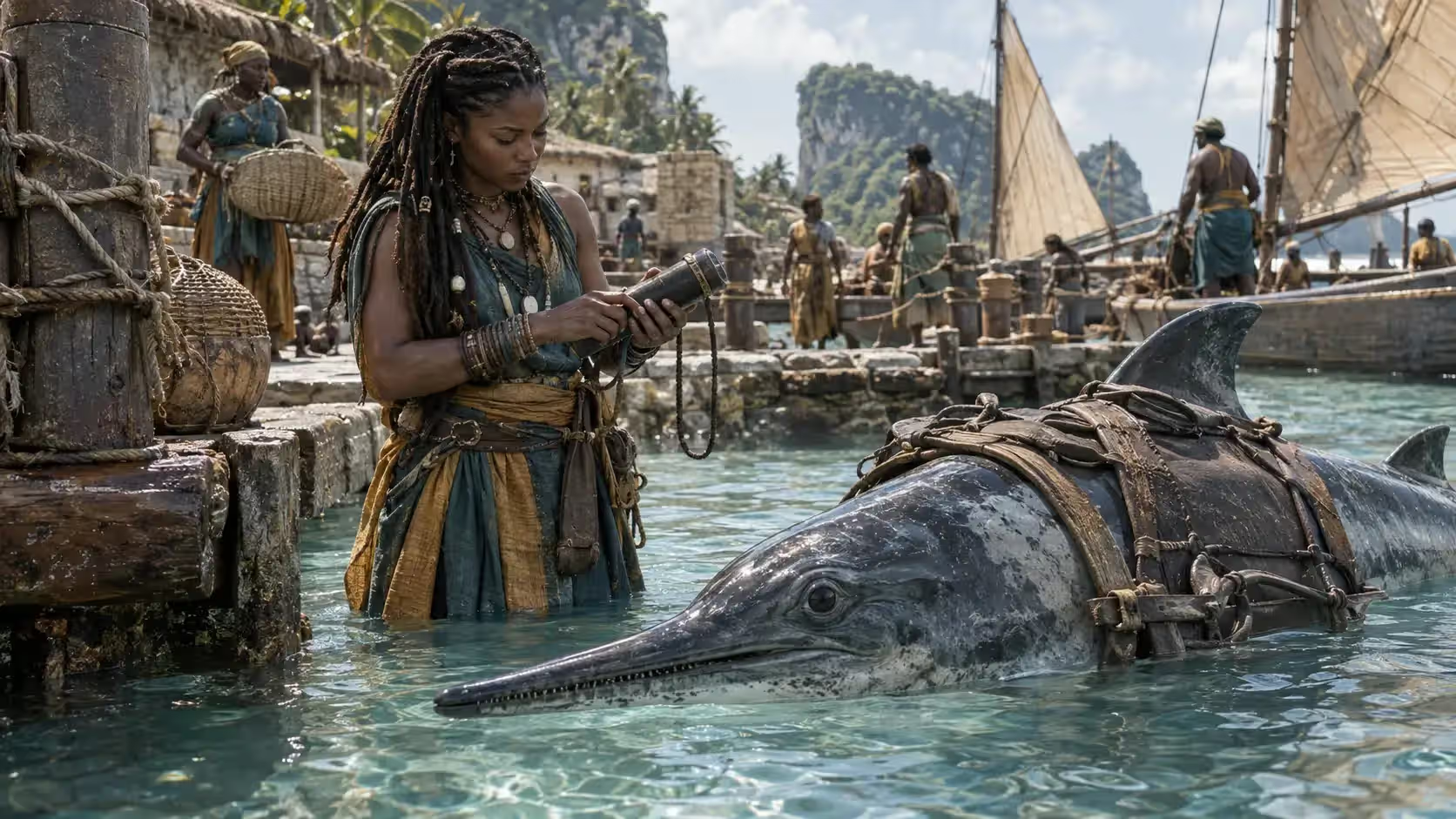
Ichthyosaurs
Fast marine reptiles, mounts of Volonia’s foam riders: reconnaissance, messages, pursuit and rescue.
The foam riders’ mounts
Fast ichthyosaurs provide reconnaissance, messages, pursuit and rescue. Foam riders ride them with harnesses and carry a lance, bow or harpoon depending on the mission. Their speed lets them observe or pass on intelligence before a heavier ship arrives.
These marine reptiles offer neither the stores nor the workshops of a hull: their service depends on relays, upkeep and the skill of their riders.
Breeds and uses in the bestiary
Volonia uses the Icthylame, a scouting ichthyosaur, for underwater reconnaissance and fast mail, from the Hautes Îles and along the Calystrëa routes. The Œil-de-Nuit, a large-eyed ophthalmosaur, runs dark patrols for night watch and discreet escort, notably on the routes towards Arkhan.
Reptiles built for speed
Ichthyosaurs are fish-shaped sea reptiles: a streamlined body, a long toothed snout, a dorsal fin, a crescent tail that drives them forward, and reduced front flippers that serve as rudders. They breathe air and must surface regularly, but they swim faster than any other animal in Volonian waters and hold a steady pace for hours. They live and hunt in bands, and readily follow ships.
The Icthylame, the most widely used form, is an animal of about four hundred kilos, strong enough to carry a light rider strapped in behind the head. The Œil-de-Nuit, an ophthalmosaur, has enormous eyes that let it hunt in low light, in deep water, at dusk or in fog; it is the one Volonia uses for night watch. Like plesiosaurs, ichthyosaurs give birth to live young, born in the water, and lay no eggs.
Breeding and training
Bands of trained ichthyosaurs live in the tethering basins of ports and islands, often open to the sea through a pass that is closed at night. The young are born in these basins and grow up in contact with people; wild animals are captured too, but they are harder to settle. A young animal first learns to come back to a horn call and to accept a hand on its snout, then the harness, then the rider. It is fed fresh fish and fine fish meal, richer than that given to towing animals.
The bond between animal and rider is at the heart of the trade. Foam riders are chosen young among the best swimmers and spend years with their mount before going on missions; it is said the two end up breathing together. An ichthyosaur does not obey just anyone: it knows its rider’s voice, weight and gestures, and a mount that loses its rider often takes a long time to accept another. The basins keep a few riderless animals, which are entrusted to pupils.
In the service of the ports
Foam mail is the Icthylames’ everyday work. A letter rolled in a watertight case goes from one island to another in a day, in weather in which no ship would put out; the Senellerie du Sémaphore thus combines Icthylames, small pterosaurs and mirrors to link the archipelagos. Ichthyosaurs also drive shoals towards the fishermen’s nets, and go with the fishing fleets offshore, where their agitation warns of an approaching predator.
At Girvane they serve for rescue. Trained Icthylames wait near the pearl boats, ready to bring up a diver in trouble or carry him back to the bell; their riders are often former divers. These animals also yield a fine, cold oil, Icthylame clear oil, which burns without smoke in cabin lamps, greases delicate mechanisms and goes into the breath-hold balm divers rub into their ears. It is taken only from animals that died of old age or by accident.
At war and elsewhere
In war, ichthyosaurs are the fleet’s scouts. Foam riders go ahead of the squadrons, watch the enemy from the surface of the water, carry orders between ships and pick up survivors after the battle; the Œils-de-Nuit escort by night the ships that must pass unseen, notably on the routes towards Arkhan. They do not fight the great beasts: an ichthyosaur cannot stand up to a pliosaur, and its rider knows it. Their weapon is speed, and their first duty is to come back with what they have seen.
Other peoples know these animals. In the Orlantis estuary, smaller ichthyosaurs drive shoals into nets and tow the fishermen’s boats. The Northern Pirates train theirs to guide boats through the passes, to pick up men who have fallen overboard and to tow boarding boats. But nowhere else is there a corps of riders comparable to Volonia’s, and Volonians draw a quiet pride from it.