

Creatures
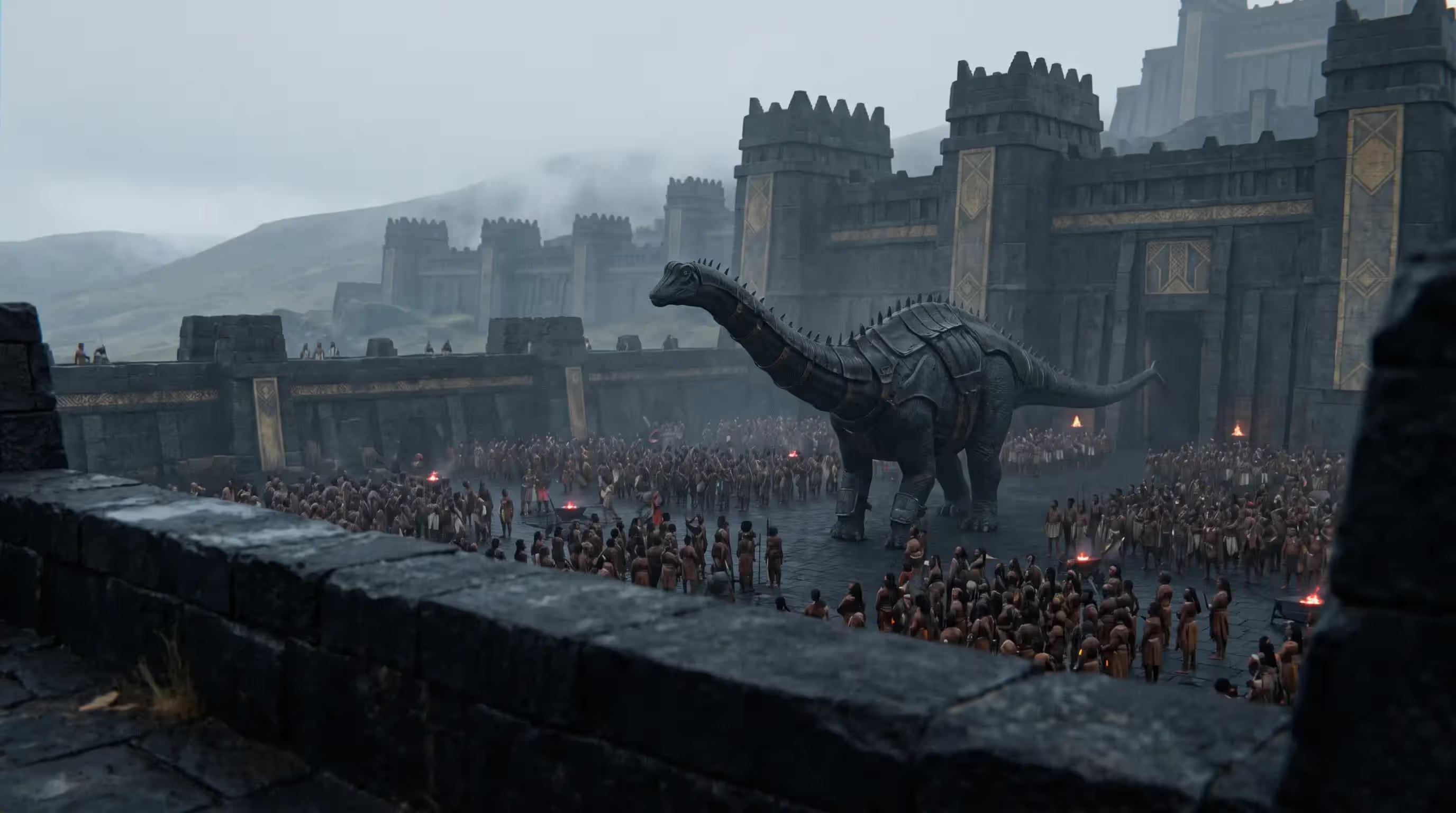
Velmor’s black sauropod
The black Supersaur is tied to the image of Velmor. The archduchy fields black iguanodons and hadrosaurs, archers, ballistae and armoured siege sauropods; it has no stegosaurs, which belong to Orlantis. House Senn-Zarnith’s emblem is the black iguanodon or hadrosaur and the siege sauropod.
A black diplodocid
The Black Supersaur is a sauropod of the diplodocid family, a cousin of the Diplodocus of the Order founded by Marjory, but much larger: an adult measures more than thirty metres from head to tail tip and weighs some forty tonnes. It carries its long neck almost horizontally, in line with its back, rather than raised like a brachiosaur’s, and its tail, longer still than its neck, tapers into a whip that can crack dozens of paces away. Its legs are columns; its slow, heavy tread is heard before it is seen.
Its coat is the mark of Velmor. The archduchy’s stud farms have selected, generation after generation, the darkest-skinned animals, so that Velmor’s supersaurs are coal black, deeper on the back and neck, barely greyed under the belly. The keepers maintain this coat with oil, which gives it a dull gleam in the sun. A low dorsal crest runs along the spine. Seen from afar, against the black stone of the Velmor massif, a supersaur looks like a piece of mountain that has started to walk.
The archduchy’s titan stud farms
Velmor maintains some twenty black supersaurs, entered in the Empire’s register of titans. Like all military titans, they belong legally to the Crown, even when the archduchy breeds, feeds and employs them; their carcass, bones, tendons and plates will return to the Crown at their death. The birth of the very large is reserved for the great approved Houses, and House Senn-Zarnith is one of them: its titan stud farms, outside the walls of the capital, at the start of the black road, keep the breeders, the brooding females and the young.
A supersaur reaches adulthood only at around eighteen and can serve for well over half a century. Every clutch is counted before witnesses, every egg candled by lamplight and entered as lineage seed under the Crown’s protection, and the young grow up in closed meadows, far from the roads, before being led for the first time beneath the walls of Fort-Cendre. Training a titan takes years and mobilises whole teams of trainers, keepers and drivers; in Velmor these trades have passed down within the same families for centuries.
The black cuirass
A supersaur is not taken to war bare. The Living Armouries, the tolerated house that has its seat in Velmor and works under state contract, make its barding: plates of dark cuirass on the breast, throat and nape, where shafts and pikes strike first, mounted on padding of the archduchy’s black leather and edged with dulled gold. These pieces depend on Velmor’s black stone, from which the plate moulds are made, and on rivets and chains from Korath, which arrive by the black road. A complete titan barding is counted in months of work.
On its back, depending on the mission, the animal carries a platform for shooters, reserves of water and shafts, or dismountable barricades that are unloaded to close a breach. The most prestigious animals receive a command cuirass, a rare piece from the archduchy’s most secret workshops, which absorbs shocks and carries a staff platform. A supersaur so equipped is no longer just an animal: it is a fortress that walks.
The siege titan
In war, the black supersaur is a siege and shock sauropod. It carries the weight of Velmor’s army, behind the heavy cavalry of black iguanodons and the archers mounted on hadrosaurs: a shooting platform that dominates the field, a mobile wall planted before a gate, a living barricade during long sieges. Its tail is its most feared weapon. Swung in an arc, it cracks like a siege whip and breaks close ranks even before contact, and foot soldiers who have heard that crack once never forget it.
It also has weaknesses that its drivers know. It is slow to manoeuvre, slow to turn, and vulnerable at close quarters when numerous pikemen manage to get under its belly. It needs space, water in quantity and a fodder Velmor does not produce alone: the titans’ silage comes from Sarnor. An army that takes its supersaurs along takes whole convoys to feed them, and the price of their presence can be read in the registers long before it can be read on the battlefield.
The emblem of Velmor
The Black Supersaur is the emblem of House Senn-Zarnith and of the archduchy, as the Silo Dreadnoughtus is Sarnor’s and the amargasaur that of the march of Qor Zaï. It is seen everywhere in Velmor: carved in black stone above the gates of Fort-Cendre, embroidered on the banners of the regiments, engraved on the seals of the archducal chancery, painted on the guards’ shields. For Velmorians it stands for the wealth of the black stone, the pride of an old Crown and the cuirass the archduchy supplies to the Empire.
The other duchies speak of it with a respect mixed with irritation. In Calaron it is said that Velmor marches “at the supersaur’s pace”, that is, slowly, heavily and without asking the way. In Velmor itself the soldiers have a prouder saying, which they repeat when they see the black titans pass beneath the walls: as long as the supersaur walks, the black stone holds.
Part of this article covers events of season 1. Turn spoilers on in the menu to read it.