

Creatures
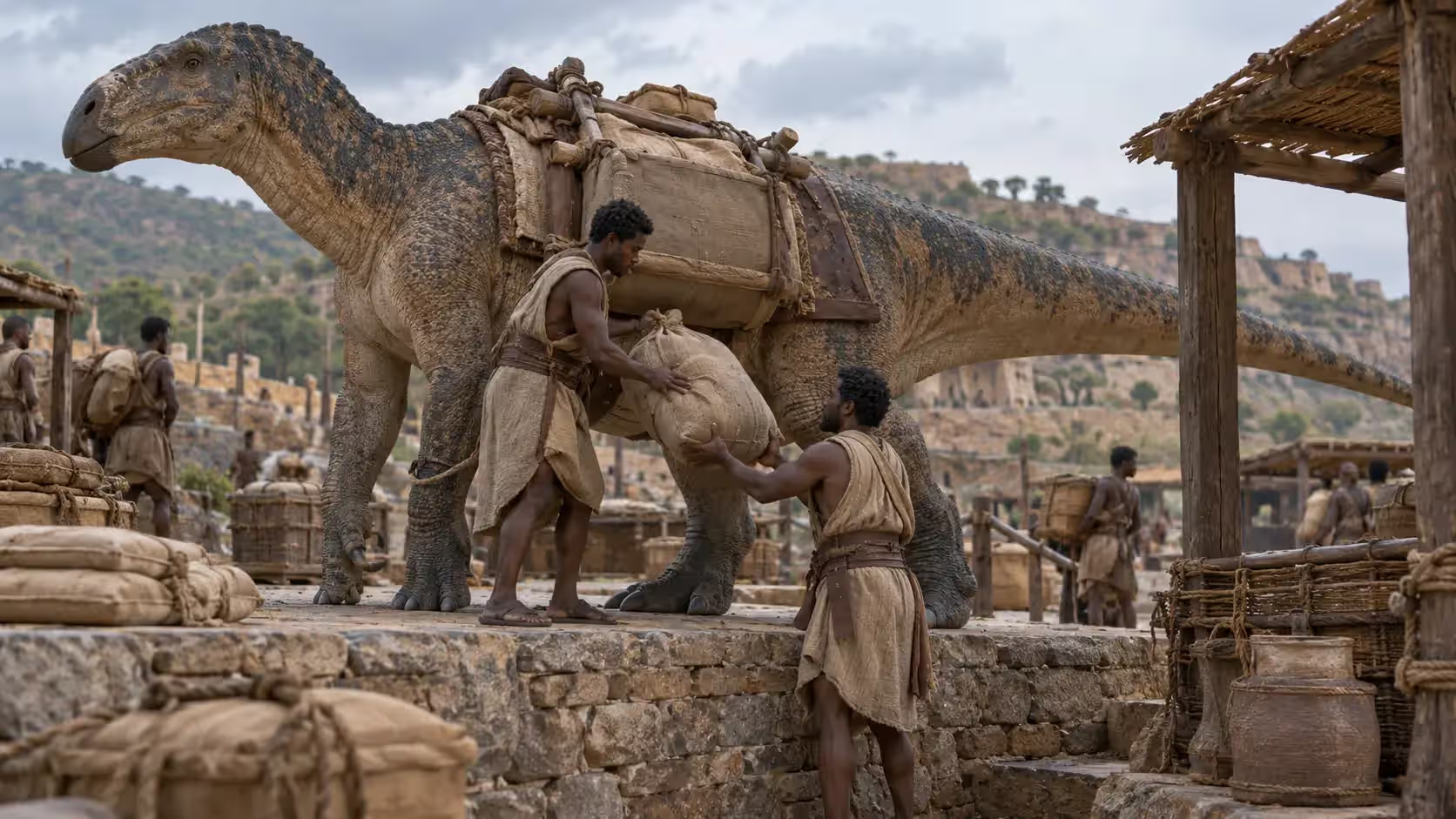
Iguanodons
Ornithopods of the harness, patrols and light haulage: the everyday beasts of the Empire of Urnok.
A beast of ordinary trades
Iguanodons work alongside hadrosaurs on farms, at relays, in convoys and in haulage. They handle harness work, patrols and light haulage. Smaller ornithopods, associated with dryosaurs, hypsilophodonts or thescelosaurs, have their place in the quiet trades that link homes, workshops and fields.
Vus d’en haut, plusieurs ouranosaures à haute crête dorsale traversent des terrasses de grain moissonnées.
Farm beasts, scouting mounts and convoy animals meet different needs, even when they belong to related groups: each use has its own equipment and handlers.
Patrols and black lineages
In imperial Qor Zaï, harnessed iguanodons serve for patrols and haulage, while the amargasaur holds the military domain. Velmor breeds black iguanodons; its army also brings together archers, ballistae and sauropods. House Tewolde-Baran, a house of procedure and council, bears the tablet and the iguanodon as its emblem; that of the Triple Harnesses of Qor Zaï, makers of harnesses and saddles, is the harnessed iguanodon.
Ishtir’s gardens and the long trails
Outside Urnok, the iguanodon has other uses. In Ishtir, the Garden iguanodon, with a spur thumb and a calm gait, gently guards the orchards and pulls farm loads in the Verger des Halcyons; the ouranosaur of the Terrasses d’Auréon, an iguanodont with a dorsal sail that catches the sun, carries irrigation water and light sacred convoys. Among Arkhan’s Longs-Os, the Pied d’Os, with broad feet and a heavy pack, carries the loads of migrations and long trails.
Thumb and beak
The iguanodon is a large ornithopod some ten metres long and weighing about three and a half tonnes. It usually walks on all fours, head low, but rises onto its hind legs to run a short distance, reach a branch or look over an obstacle. Its hand has five fingers, including a thumb turned into a conical spur as long as a man’s hand, and a small mobile finger it uses to grasp. Its muzzle ends in a horny beak, behind which rows of teeth grind ferns, horsetails and foliage, about a hundred and fifty kilos a day.
It grows fast: an iguanodon is adult at about five and can work for some thirty years. A female lays ten to sixteen eggs, which hatch after about three and a half months, and the studs produce enough of them for the iguanodon to be, with the hadrosaur, the most widespread animal in the Empire. It drinks nearly two hundred litres a day and copes badly with long thirst; in the desert of Qor Zaï, patrols carry its water as they carry the men’s.
Capstans, winches and ploughs
Off the roads, the iguanodon is the capstan animal. Harnessed to a six-metre arm, it walks round an axle and winds the cable of a winch: a mine cage or a hoist loaded with a tonne and a half rises thirty metres in three minutes this way, and one animal makes sixty to eighty lifts a day, relieved every two hours. A wooden pawl stops the load running back down if the animal halts. The capstan man who leads it never makes it trot: an animal set trotting round a capstan ends up breaking the arm or the rope.
In the villages the working iguanodon pulls the plough, carries faggots, stones and sacks, and works on the building sites of small communes where a sauropod would cost too much. It is often the second animal a family buys after a hadrosaur, and the first it lends to its neighbours. The travelling clerks of House Tewolde-Baran, who go from village to village with their tablets, also ride iguanodons, and their arrival is recognised by the painted case of their tablet before the man himself.
Riding an iguanodon
The saddle sits behind the shoulders, where the back stays steady when the animal shifts from four legs to two. At a walk and on patrol the iguanodon goes on all fours; for a short sprint it rears up, and the rider must then lean forward, thighs tight in the saddle straps. The imperial army’s iguanodon scouts learn this change of gait before anything else: they are the army’s eye, never its fist, and their worth lies in what they see and report, not in what they strike.
The thumb matters in war. An iguanodon threatened at close quarters strikes with its spur, at the height of a man’s chest or a raptor’s neck, and patrol riders learn not to hinder the movement. Velmor has taken this further: its black iguanodons, ridden by pikemen and lancers, wear a bronze sheath on the thumb that turns it into a weapon. In the march of Qor Zaï, the Triple Harnesses fit the strapped iguanodons with anti-raptor straps reinforced with bone under the belly and around the limbs, so that a claw does not bring down the rider together with his mount.
Studs, lineages and prices
The Empire breeds several iguanodon lineages. The working iguanodon, sturdy and sure-footed, is the animal of villages and capstans; the strapped iguanodon, livelier, that of patrols and march couriers; Velmor’s black lineages, dark-coated, those of the archduchy’s regiments. A working iguanodon sells for a few hundred Dracos, a black regimental animal for nearly twice as much, and the register follows each animal from its declaration to its retirement.
Unlike the very large, the iguanodon is freely sold, bought and inherited, on the sole condition that it is declared. Its eggs are mostly seed eggs reserved for the studs, but certified surplus clutches may pass as table eggs. At its death its hide, tendons and bones go to the workshops and its meat to the cull-meat salters. In the countryside they say that “an iguanodon is not worth a titan, but it comes when called”, and that is the compliment paid to everyday animals.
Gallery2 images
The Qor Zaï mine: harnessed iguanodons and an amargasaur. Salt pans, wind towers and pack iguanodons on the causeway.