

Institutions
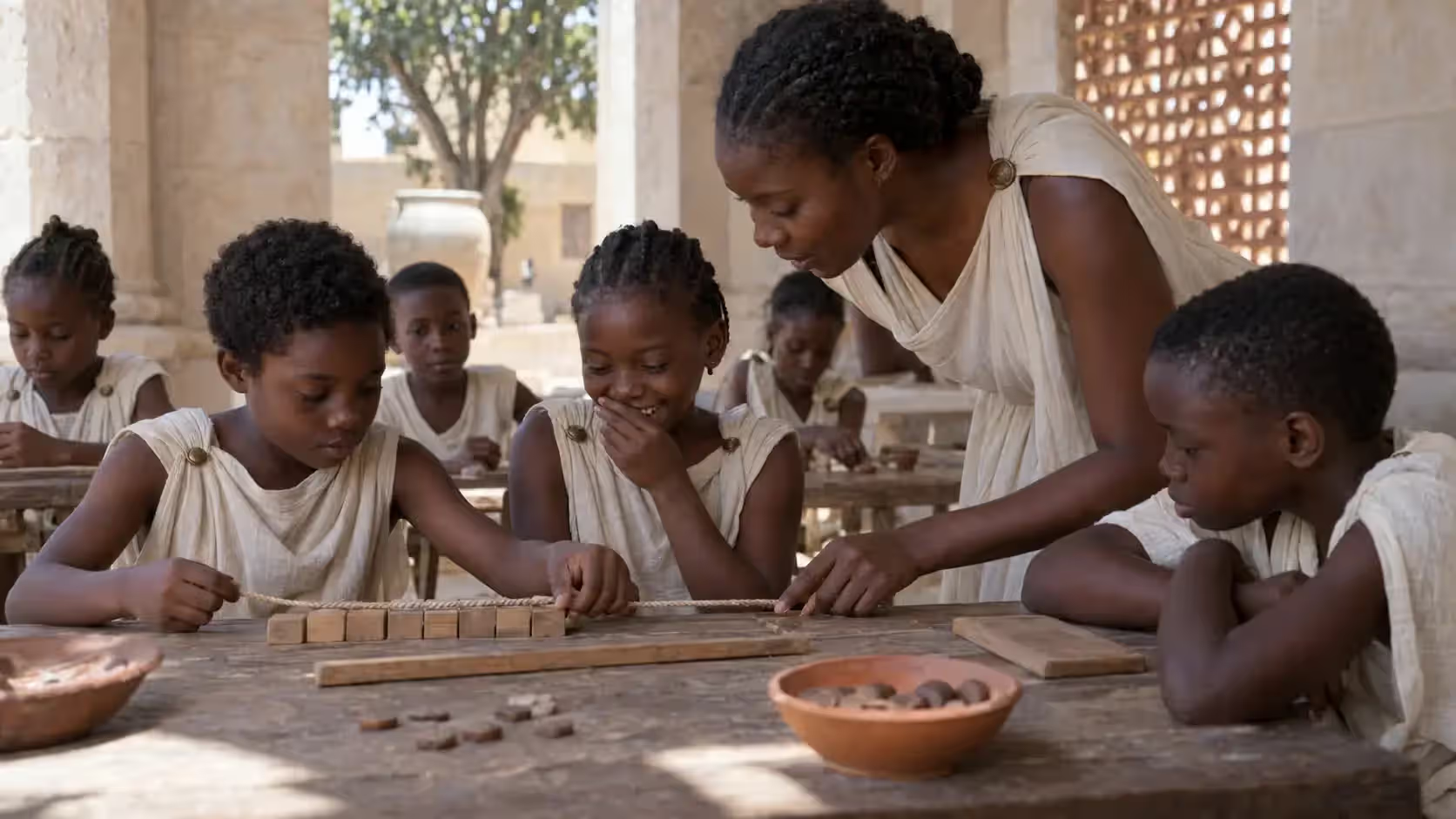
The Bronze rank
The rank of every child in Ishtir and of the country’s productive majority. Bronze feeds, irrigates, tends, teaches and holds the marches, with every fundamental right guaranteed.
Bronze by right
Every child in Ishtir is Bronze from birth to adulthood. This is not an absence of rank: it is the shared rank of childhood, the same for all, whatever the Weighing later decides.
At eighteen, the First Weighing keeps a person in Bronze or raises them to Silver, or even Gold. Later Weighings, every seven years, can still raise a Bronze or bring an adult of higher rank back to Bronze. One is Bronze by assignment, never by descent.
The productive majority
Bronze gathers Ishtir’s productive, technical and local majority: farming, herding, irrigation, maintenance, everyday care, teaching, the movement of resources and the defence of the marches. It is not a poor class. A Bronze holds every fundamental right, from food to retirement; they can become highly skilled, gather certifications and hold important grades without changing rank.
The rank has its own adult orders: the Plaines Brontes for farming, herding and the great living stocks, the Canaux Clairs for water and irrigation, the Mains Blanches for care, collective education and childhood cohorts. Bronze has no national grand master: its local councils lead collectively.
Eight weeks
The Respiration gives Bronze eight weeks a year: the shared week of the Great Respiration and seven personal or spread-out weeks. It is the rank that travels longest; some keep four weeks for the Islands of the Rising Sun alone.
That time changes what a promotion means. Rising to Silver also means losing the long yearly journey with one’s friends and part of one’s social life. A Bronze can sincerely grant that a Gold stands above them in the solar order, and still think first of their eight weeks.
The local councils
Bronze has no national grand master, and that is a choice. Its leadership is local and collegial: every quarter, every plain, every water sector has its council, made up of Bronze chosen for one Weighing cycle from among those with recognised responsibilities, herd chiefs, water masters, cohort keepers, workshop heads.
The councils run the life of the towns, share out common tasks, settle neighbourhood quarrels and raise the quarter defences when a threat approaches. Their strength is immense in numbers and small in reach: no council speaks for all of Bronze, and each answers only for its own place.
Bronze at war
Bronze supplies the mass infantry, the march garrisons, the porters, the threshold guards and everything that keeps an army on the move alive. Its line is white: quilted linen tunics, patinated bronze breastplates for those entitled to them, great whitewashed shields that throw the sun back into the enemy’s eyes. It advances straight and strikes head-on; stepping back at a slant counts as a fault of doctrine as much as of discipline. The Gate Keepers, pikes planted at the threshold, hold the bottlenecks. In front of the line, skirmishers recruited from the lower terraces harass the enemy before the clash, with bundles of javelins whose heads carry a slip of matt gold engraved with a ray.
Doctrine does not ask Bronze to stop great invaders on its own. It asks it to hold, to evacuate and to feed, until Silver arrives.
Rising without changing rank
Staying Bronze does not mean not rising. The rank has its grades and responsibilities, earned between two Weighings: team leader, herd chief, water master, workshop head, cohort keeper, quarter head. A Bronze can accumulate certifications to the point of knowing more in their field than many Silver, and every region can name herd chiefs or water masters whom Silver consults before deciding.
Many make no effort to build a Silver file. They love their trade, their quarter and their eight weeks, and they know what a rise would cost them.
Proud to be Bronze
Bronze has its pride, and it is a cheerful one. It rests on fed land, clear water, children raised and marches held. Quarter songs happily mock the hurried Silver, who count their weeks, and the exhausted Gold, who have only one; a Bronze can tell a Gold undone by three days of festival: “You should try eight weeks.”
Bronze knows it is indispensable and says so without bitterness. On the Plains as on the Canals people repeat that Ishtir prays with Gold, commands with Silver and eats with Bronze, and nobody, in any rank, thinks the saying wrong.
A Bronze quarter
A Bronze quarter smells of grain, clean animals and canal water. Its households are packed around a distribution hall that doubles as a refectory, a fountain, a square where the Weighing is held every seven years and a market in a common zone where one meets the other ranks. Cull ceratops, young classroom animals and harnessed troughs are part of the scenery.
Life there is lived in everyone’s sight, and that is intended. The quarter witnesses the rises and the falls, applauds the former, accompanies the latter, and meets again in the evening at the same tables. Those who leave it for Silver often say that this noise is what they miss first.
Bronze’s animals
Bronze lives with its animals. On the farms, the qerik, small ploughing ceratopsians without large horns, pull light ploughs and garden carts; the centrosaurs of the Brontes do the heavy ploughing and march with the Bronze columns in war. Signal pterosaurs carry the quarters’ mail, and on the quays and channels a few draught hadrosaurs bought from Urnok carry the loads.
Each animal has its right of use, assigned to a team or a household. A cull ceratops can thus end its life against the warm wall of a kitchen on the Plains, eating the peelings of a household that kept it “until it could be placed elsewhere”.
Part of this article covers events of season 1. Turn spoilers on in the menu to read it.