

Places and landscapes
The monuments of Urnok
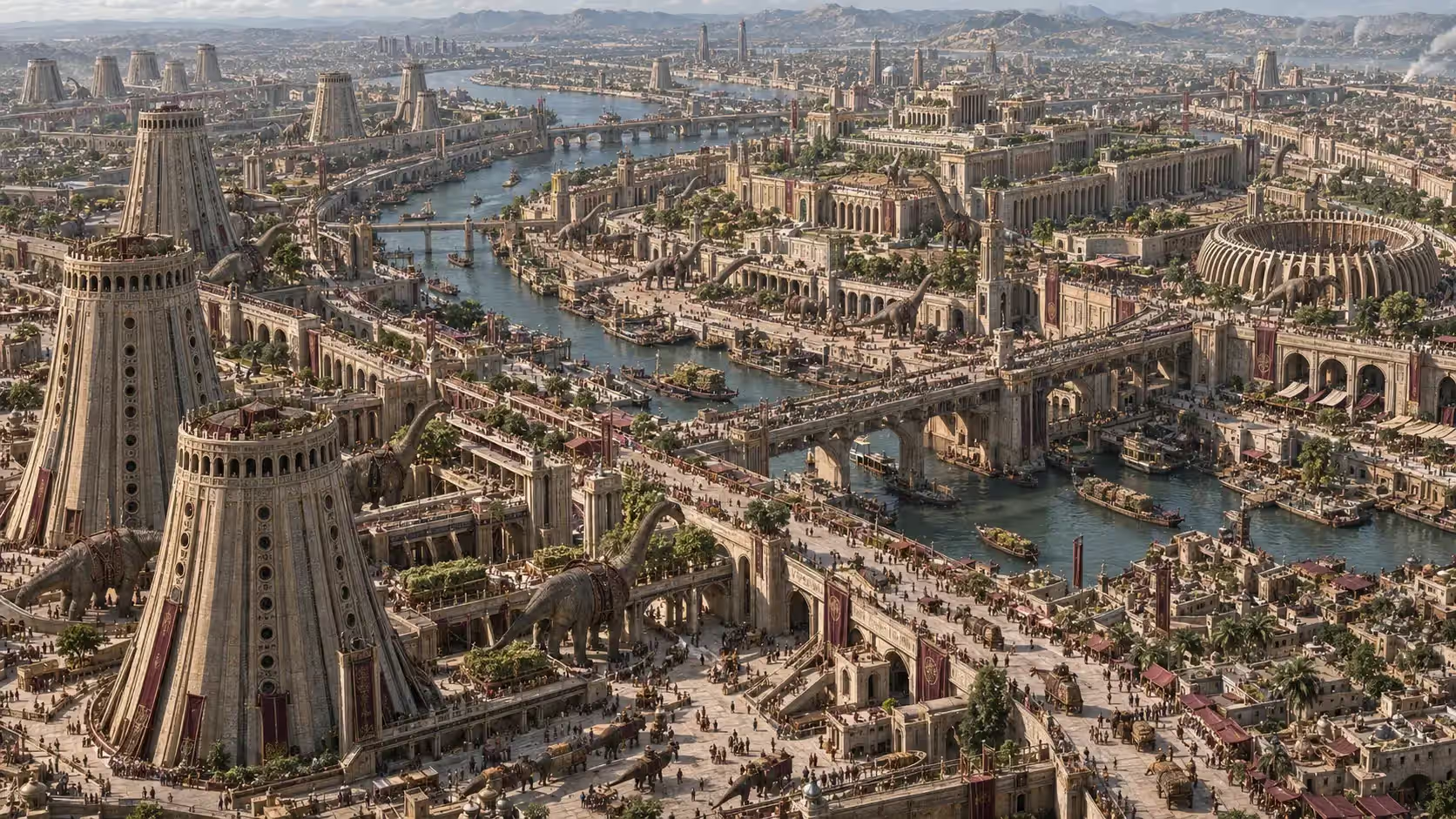
In Urnok, a monument is first a work that feeds, waters, lets through or counts. Cathedral granaries, trough aqueducts, vertebra avenues and animal statuary make visible the resources on which power depends.
Monuments that work
Imperial monuments pair a function with a spectacular scale. A cathedral granary stores grain and fodder in graduated, ventilated towers; a trough aqueduct carries the city’s water and waters the great animals; a vertebra avenue takes convoys, parades and withdrawals. Each serves a purpose first, and its scale then shows what the Empire is able to feed and move.
One principle links them: power is a capacity to feed, and sovereignty is read in the reserve. The Empire honours function more than heroes: its statuary depicts brachiosaurs, ultrasaurs and diplodocus.
An architecture born of hunger
The Empire was born of a famine. Some ten thousand years ago, starving Arkhans settled in the fertile plains of the centre and swore it would never happen again. The cathedral granaries, the fodder posts, the currency backed by stocks and the Great Treasury of the Granaries all descend from that oath. Where Arkhan answered hunger with predation, Urnok answered with storage, registers and roads.
The idea that whoever holds the living holds power descends from an older conviction: whoever held the grain survived. The great reserve monuments are the built memory of that hunger.
One material per duchy
The built landscape changes from one duchy to the next. Bralnor’s volumes of stone, Orlantis’s fine timber and resins, Sarnor’s agricultural reserves and Velmor’s black stone give each territory recognisable materials. Courtyards, routes and workshops are built around local activities and the size of the animals that use them; in Orlantis, for instance, walls and prestige avenues keep forbidden zones within reach of the stegosaurids’ tails.
The great works
The main types of monument each have their own article: the cathedral granaries, including Sarnor’s Gué-Long; the trough aqueducts and their vertical troughs; the vertebra avenues; the animal statuary. The capital also has the imperial arena, whose protocol is held by House Calaris, and the Vael-Orûn palace of the imperial family. In Orlantis, walls, gates and thermal gardens form a regional grammar of the stegosaurid duchy.
Who builds and who maintains
The Empire’s great monuments are state works. The Crown or a duchy commissions them, the Imperial Bank of Scales and Roads finances them, often through grain credits pledged on declared reserves, and Karûm-Brakh builds them with its hired sauropods, its templates and its crews drawn from many Lines. The High Chancellery of Living Ways then checks that whatever must carry, water or let pass is up to standard.
Each work receives a works register, kept in the archives: who commissioned it, who built it, with what stone and what timber, who answers for its upkeep. This register follows the monument for centuries. When a vault cracks or a basin leaks, it is opened to find out whose duty the repair is, and a Line may still be paying for a work its ancestor built badly.
The capital’s monuments
The capital gathers the Empire’s most famous works, and each has its use. The High Cistern takes in the waters of the northern heights and feeds the city’s cascading basins, from the height of a titan’s neck down to the hadrosaurs’ troughs. The Vertical Feeder, tallest of the feeding towers, feeds the beasts at three heights, and the titans eat there at neck height in full view of the city. The First Vertebrae, the oldest avenue, serve for parades. The Issuing Seal strikes the Golden Scale under the guard of the Bank’s trustee; the Examination Halls of the Synod receive thousands of candidates every year; the Office of Roads keeps the maps of every way in the Empire.
None of these monuments is a palace. Even the Vael-Orûn palace counts for less, in the residents’ pride, than the Cistern or the Feeder, because those are what keep the city alive every morning.
Maintaining rather than inaugurating
Urnok inaugurates little and maintains a great deal. A new monument is rarely celebrated with a great festival; what is celebrated instead, every year, is the day its restoration was completed. The names painted on the works are not those of their patrons but those of the crews that keep them, repainted at every change of watch, and a quarter is judged by the state of its basins and slabs rather than by the height of its towers.
A monument that no longer serves loses its rank. Old silos grown too small are emptied, reinforced and turned into archives or seed granaries; avenues that are too narrow become covered markets; the stones of demolished works go off to neighbouring building sites, often with their old inscriptions turned inwards. So in the capital’s walls one finds fragments of accounts several thousand years old.
No triumphal arches
The Empire raises no triumphal arches. A victorious campaign leaves behind a campaign stela, set up on a square in the capital or in the duchy that waged it: carved on it are the roads opened, the rations issued, the bridges thrown, the beasts committed and those that came back, then the number of the dead. The generals’ names appear only at the end, in small letters. Foreigners find these stelae austere; Urnokians read in them the true measure of a war.
Ordinary monuments are military works too. Silos and cisterns are the first targets of an enemy who wants to starve a region; avenues serve as parade grounds; silo bells and cadence towers carry the alarm from one quarter to the next. Defending an Urnokian city means first of all defending what feeds it and gives it water.