

Creatures
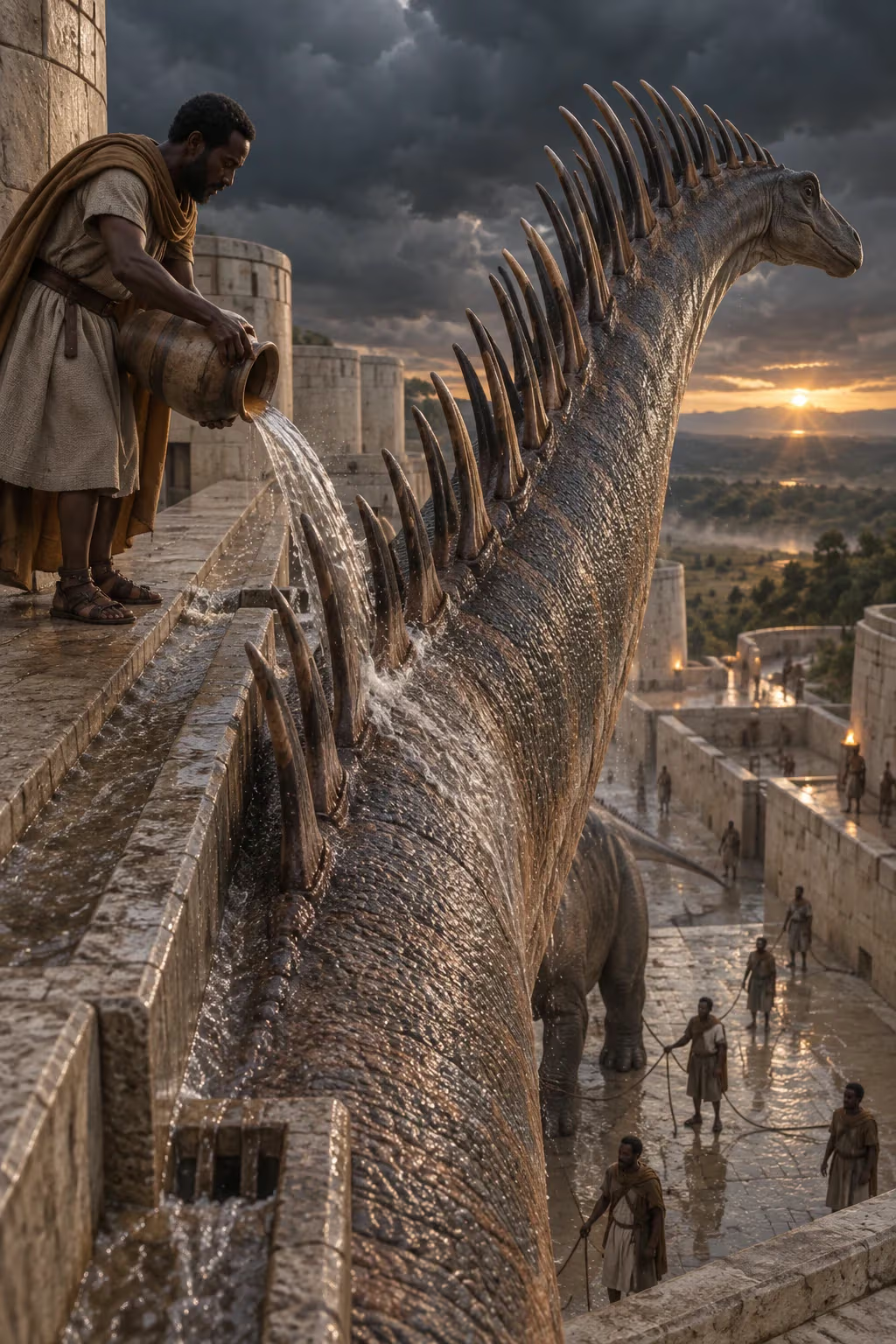
The sauropod of the march
Imperial Qor Zaï is the south-eastern march duchy, held by House Drakeris, whose emblem is the amargasaur. The duchy opens towards Arkhan and the Black Mountains; it runs the anti-raptor forts, march relays, bone customs and counter-tracking trades. The march amargasaur belongs to its military domain, while harnessed iguanodons serve for patrols and haulage.
Un amargasaure aux deux rangées d’épines cervicales traverse une formation d’infanterie qui abaisse ses lances à son passage.
The Triple Harnesses of Qor Zaï make heavy harnesses, military saddles and straps suited to frontier risks. The imperial duchy must not be confused with Arkhan’s Qor Zaï, the bone metropolis on the other side of the border.
A small frontier sauropod
Compared with the Empire’s titans, the march amargasaur is a small sauropod. An adult measures about twelve metres and weighs some three tonnes, barely more than a large hadrosaur. Its neck is short for a sauropod, and yet that neck is what makes it famous: two parallel rows of long spines run from nape to shoulders, the tallest longer than an arm. Sheathed in horn, they clatter together when the animal shakes its head, with a dry sound that carries far in the desert air. Its grey-ochre hide blends into the dust of the tracks.
The amargasaur browses low. It crops the tough shrubs, tufts and thorn bushes of the dry plateaus and copes with heat and thirst better than its lowland cousins; an adult makes do with about a hundred and twenty kilos of fodder a day, which matters in a duchy where everything has to be hauled in. It is also the liveliest of the imperial sauropods. Without ever running, it keeps up the long stride of an iguanodon patrol for half a day, and it reaches adult size at about seven, far earlier than the great titans.
What the spines protect
In the march, the spines are explained by raptors. A predator that leaps at a sauropod’s throat meets a hedge of points on the amargasaur, and patrollers tell of finding broken spines in the carcasses of raptors fallen at their animals’ feet. Arkhan’s packs have learned to aim elsewhere: the hocks, the belly, the rider. That is why an amargasaur never goes out without its escort of strapped iguanodons and without guards able to protect its legs.
The spines are also a way of being seen. An uneasy animal raises and spreads them, and a whole row in a pen can bristle at once, with a clatter the fort lookouts know how to recognise at night. Harness-makers have to work around them. The saddle sits at the withers, behind the last spine, and the straps pass under the neck without ever rubbing the base of the points; for parades, the Triple Harnesses of Qor Zaï supply sheaths of studded leather and dull gold that cap the tallest ones. A broken spine grows back badly, and an animal that has lost several keeps a veteran’s neck for life.
Life at the fort
The duchy keeps about a hundred amargasaurs, spread among the march’s anti-raptor forts. Each fort keeps two to six, housed in a closed yard at the foot of the tower, near the cisterns. In the morning the animals go out with the day’s patrol: the strapped iguanodons ride ahead and on the flanks, the amargasaur follows in the centre, taller than they are, with a lookout seated at its withers who sees over the bushes and scree. It also carries the patrol’s water skins and reserve, which earns it the soldiers’ nickname of “spined cistern”.
On the march road, amargasaurs escort the convoys passing through the bone customs. Their presence is often enough to discourage small bands; against a real pack they serve as an anchor around which the patrol closes up. Nothing comes easily to a fort: fodder arrives from Sarnor in pressed bricks, water is counted by the cistern, and a sick amargasaur is treated where it stands, since it cannot be sent back. The fort registers keep the animals’ names beside the soldiers’, and a fort that loses an amargasaur reports it as it would report a fallen man.
The House stud
Amargasaurs are born in the studs of the House of Qor Zaï and nowhere else: no breeding animal leaves the march, and the House only releases trained animals assigned to service. A female lays four to eight eggs, which are buried in the warm sand of the nesting pits; they hatch after six or seven months. The young grow up in a closed valley guarded day and night, because a young sauropod is prey that raptors spot from far away.
Training begins at about three. The young animal is first accustomed to the noises of the fort, to drums, signal fires and the smell of raptors, by being shown hides and old harness taken on the tracks. Then come the saddle, the water skins, and patrol marches beside a seasoned animal. An amargasaur only goes out as lead animal after seven or eight years, and it can serve thirty more. Within the House a rule holds that a Drakeris only rides an amargasaur after leading an iguanodon patrol: the emblem animal must be earned.
The emblem of the oldest House
The House of Qor Zaï, the oldest lineage in the Empire, flies the amargasaur on its banners, spines raised. The choice says something about the march: neither the mass of the titans nor the speed of raptors, but an animal that keeps watch and bristles when danger draws near. The forts carve its silhouette above their gates, the customs officers carry it on their seals, and the Drakeris branch has it embroidered on its cadets’ cloaks when they return from the outposts.
The speech of the march has kept expressions from it. People say “raise the spines” for being on one’s guard, and “sleep with spines down” for a night without alarm, the only kind the garrisons wish one another. The Arkhan caravaneers who pass through the bone customs know the animal too: in their tales the amargasaur is the creature that announces a fort before its walls come into view, because its clatter carries further than horns.
Gallery1 image
The Qor Zaï mine: harnessed iguanodons and an amargasaur.