

Places and landscapes
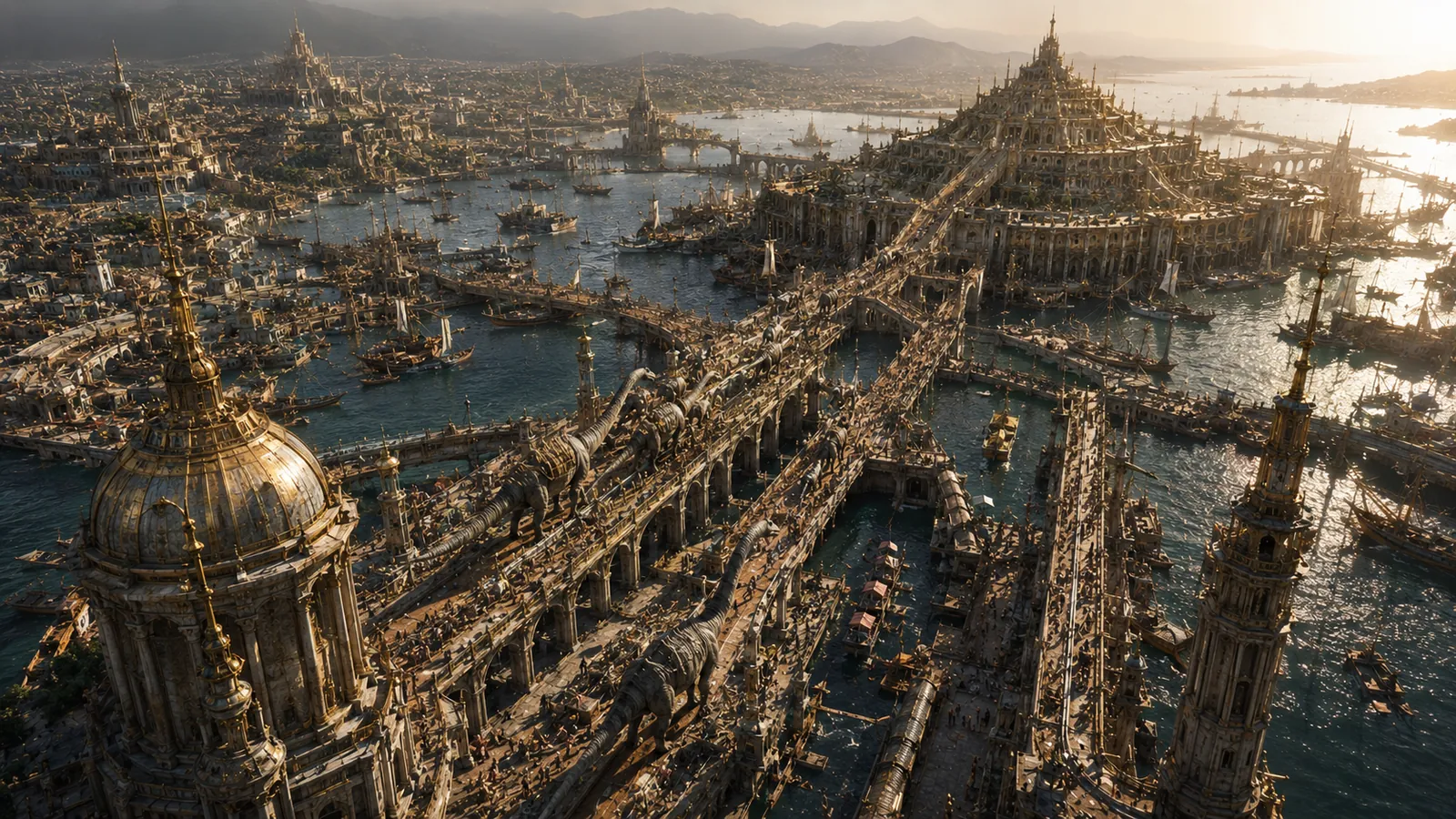
Urnok: life in the capital
Within historic Calaron, the imperial city receives people, reserves and living masses.
The centre among the basins
Urnok is the imperial capital, within the historic duchy of Calaron. The administrative centre belongs to a territory organised around basins, rivers, passes and load-bearing roads. Its streets receive the effects of that geography: a reserve, a cargo or an order must cross a network of places before reaching the centre.
A street has its hour of mass
In Urnok circulation, a large animal requires closures, ground crews and diversions for people. Water, fodder, inspection and cleaning accompany its time slot. Small human passages bypass load-bearing roads: living in the capital also means knowing the routes that let daily activity continue while a living mass occupies the street.
Seeing the titan in fragments
From the street, a titan appears in fragments; a high viewpoint makes the whole body visible. Height thus makes rank tangible in the act of looking. At ground level, the city is understood through closer flows: food, dung, water, eggs, animals and responsibility. Monumentality rests on this daily work.
Rings that do not make a circle
Urnok grew in irregular rings. Merged historic districts, traffic flows and quarantines draw their limits: the city is never a geometric circle, and the round, radial shape of old maps does not fit it. The Empire’s highest level of mobilisation is called the “Opening of the Rings”: the last defence of the imperial heart, almost never used.
A capital of this size gathers several grammars at once: different periods, species, classes and functions remain visible, with their contradictions. It also has its ill-suited, old, humiliating or broken-down places, like any city lived in for centuries.
River, canals and troughs
Urnok lives by a hydraulic metabolism. A river network and man-made canals, shared with Sarnor and Orlantis, bring in grain, fodder and water and carry away waste; barges and hadrosaurs work them as far as the inland ports. At the river port, towing and customs carry the roads on into the cargoes.
In the city, the aqueduct-troughs serve water supply, towing, drainage and provisioning at once. Troughs and feeders are tiered: the largest sauropods eat at neck height, mid-sized beasts at mid-level, small ones on the ground. Every morning, feeding sets the rhythm of the capital.
Places in the capital
Calaron concentrates the Crown, the administration, the universities, the legions, the arenas and the law. The capital houses the imperial palace and its wings, the archives, the banks, the Grand Collège impérial and the Haute Chancellerie des Voies Vivantes and the schools of the Road.
The Nahara ramps serve as a high-level landing for Sahina’s mount. In the lower city, the Croc Fendu tavern gathers the common people. Silo-cathedrals, vertebra avenues, aqueduct-troughs and brachiosaur statues give the whole its monumental scale.
More than a million souls
The city of Urnok has more than a million inhabitants, and the country around it holds almost as many again; it is one of the largest cities in the known world. People live packed together: in the mezzanine quarters and around the avenues, tiered tenements each house some forty families, with people at the top, beasts on the middle level, water and waste at the bottom, just like the city itself.
The capital draws people from all six duchies. One hears the Sarnor accent among the fodder men, Bralnor’s among the stonecutters, Orlantis’s among the carpenters and the clerks of trading houses; the Synod’s students come from everywhere, often on foot. Volonian merchants, agents of Korath’s forges and the delegations of the other powers have their residences in the diplomatic quarters, at the foot of the heights.
A day in Urnok
The day begins before dawn, when the sluice-masters open the High Cistern’s water, quarter by quarter. At daybreak comes the feeding: at the Vertical Feeder, tallest of the feeding towers, the titans eat at neck height in full view of the city, while hadrosaurs and small mounts are served lower down. The first convoys then leave, and the avenues close one after another according to their slots.
Midday belongs to offices, courts and markets; the afternoon to building sites and schools. In the evening the taverns read aloud the sheets of the Petit Fourrage, the capital’s chronicle, and news from the duchies passes from table to table. Night does not stop the city: some ways change direction for heavy convoys, watchmen keep guard over the fodder stations, and thousands of lamps stay lit on the terraces.
The city’s small beasts
The colossi make the capital’s reputation, but it is the small beasts that keep it moving. Thousands of dryosaurs, small running ornithopods, serve as mounts for messengers, quarter guards and hurried clerks; they get through where a hadrosaur would be too wide, and they can be seen tethered by the dozen in front of the offices. Cure lambeosaurs carry inspectors and the mail, draught hadrosaurs pull the market carts, labouring iguanodons work on the building sites.
All these beasts have their rules. Each carries on its harness a bronze token that refers to its register; the city guard’s dryosaurs are stabled in the quarter posts; no mount may be left without water for more than half a day on the public way, and the guards seize any that are abandoned.
When the capital mobilises
When the Empire mobilises, the capital is the first to see it. The barracks of the Guard and the legions fill up, the arsenals work day and night, and the forges of the lower quarters light fires that can be seen from the terraces. The Crown’s stables gather the designated great beasts, and the Living Silos are loaded with water, grain, grease and medicines on the convoy squares.
The city changes its rhythm. Avenue slots go first to the army, civilian convoys wait or take the night ways, and the price of fodder rises in the halls before war is even proclaimed. The residents know how to read these signs: in Urnok it is said that war announces itself by the queues outside the saddleries and the silence of the beast markets.
What people say of the capital
Provincials say Urnok smells of ink and dung, and they are not wrong: the upper city lives on registers, the lower on beasts, and the two smells meet at the level of the avenues. Capital folk retort that the provinces smell of fodder, which comes to the same thing. It is also said that in Urnok even the colossi queue, because no beast, however large, passes outside its slot.
Foreigners judge it by what they come looking for. Volonian merchants find it slow and procedural, but safe: a contract signed in Urnok is carried out. Envoys from Korath admire its bridges and its registers, and complain about the dust. All agree on one thing: the capital is never seen whole, neither from below nor from above.
Part of this article covers events of season 1. Turn spoilers on in the menu to read it.
Gallery1 image
Calaron by night: a procession of lantern-bearing sauropods.