

People
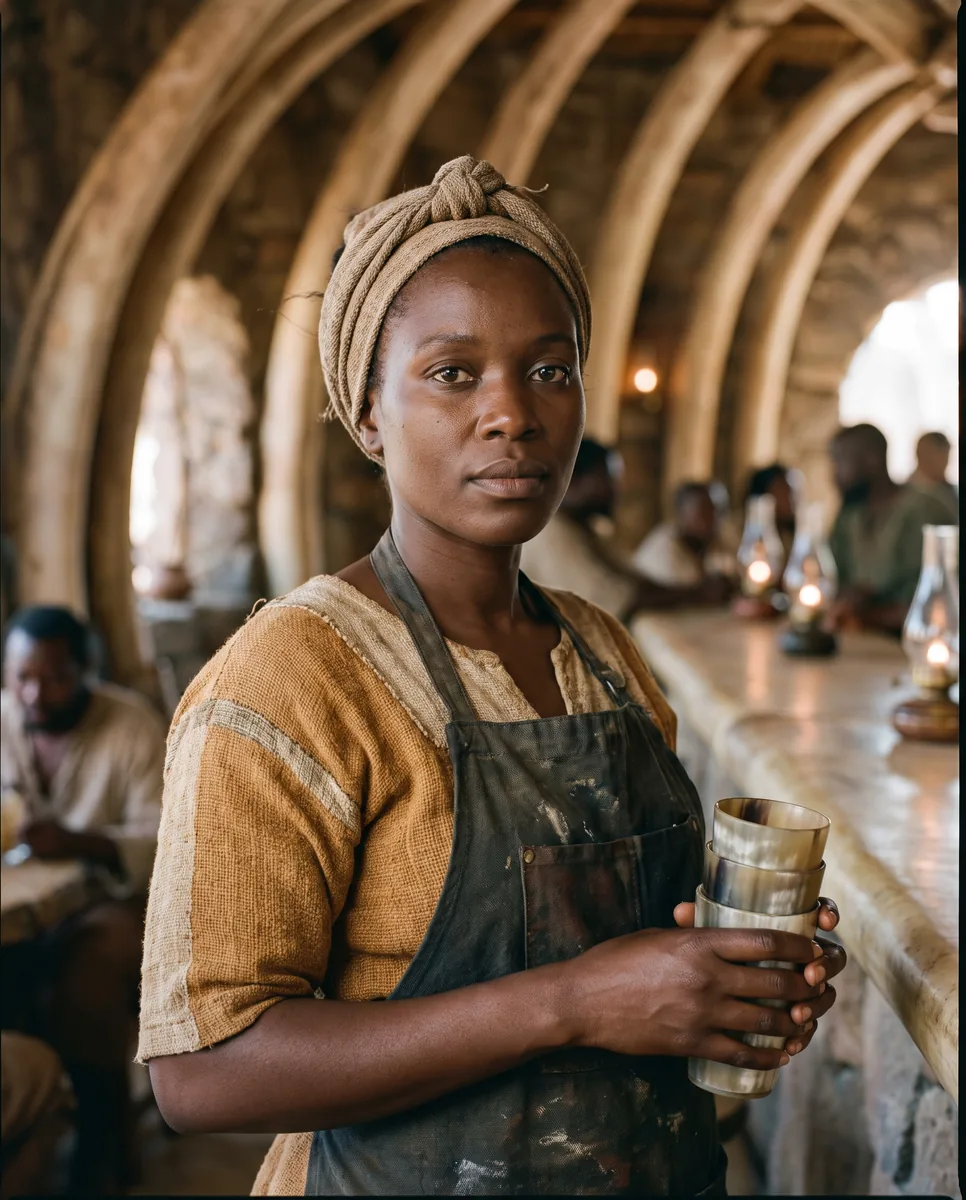
Elyra Noss
The hands and memory of the Croc Fendu’s room.
Keeping the room running
Elyra works at the Croc Fendu beside Mako. Service keeps her moving between tables and regulars: busy hands, attentive ears and a memory for needs. Her role exists through this work, without requiring noble rank or an exceptional destiny.
Tidying before answering
Elyra turns and stacks empty mugs before answering. Tidying continues during conversation. Her words accompany her work: she can listen to a question while clearing tables and answer while preparing the next service.
The habits of a room
Elyra knows the habits of the place and the people who settle there. Beside Mako, the server’s memory complements the tavern keeper’s. An order, an occupied table, mugs to collect: her attention first concerns what lets the room keep living.
A day at the Croc Fendu
Elyra’s day begins before opening time. She rinses the previous night’s tankards in service water, scrapes the soot from the oil lamps, puts the benches back and counts the barrels Mako will have replaced during the morning. The room then fills in waves, following the shifts: the night road crews in the morning, the clerks at midday, the soldiers and relay hands in the evening. Each wave has its habits, its drinks and its tables.
Elyra is about twenty-eight and has done this work long enough to recognise a shift by the noise it makes on the stairs. She serves, takes the money, gives change, separates two customers before they fight and, at closing time, lets Bouchon, Mako’s delivery hadrosaur, take its place in front of the door, where it lies down every night. In the neighbourhood they say the tavern has two doorkeepers: the animal for those who want to get in, Elyra for those who would like to stay.
Two hands and a good memory
Mako gives himself the air of a man who has seen nothing; Elyra remembers. She knows who owes how much, who has promised to pay at the next pay day, which table broke a tankard and who drinks to forget what. She keeps the house’s debt slate, a blackened board on which credit is written in chalk and wiped off on payment, and she keeps it better than many scribes keep a register.
That memory makes her her employer’s counterweight. She names what he pretends to forget, and the tension between them is useful: one protects the room through amnesia, the other through accuracy. A line is attributed to her, addressed to customers who are too curious: “He saw nothing. I have two hands and a good memory. Choose who you talk to.” The regulars know it is not a threat but a warning.
The regulars and the rules
Elyra knows every regular and his place in the room. Iryem Sada, the neighbourhood go-between, is her accomplice at the tables: he teases her, she makes him pay for his rounds in coins she checks one by one. Nala Vey, the healer from N’Goro, doses her remedies in a corner, and Elyra keeps a table for her when the wounded soldiers come in. Nérian, the Synod student, comes to boast about his exams; she serves him rolling her eyes, but never lets him leave hungry.
She also enforces the rules Mako never states. No knives on the tables, no debt beyond one pay day, no regimental quarrels under the roof; people may talk about the court, but not too loudly. Customers who break them are not thrown out by the owner but by her, with a word or a tankard taken away. In a house where soldiers of every unit pass through, that authority is worth more than a guard.
A woman of the lower city
Elyra belongs to the lower levels of the capital, those of the canals, the dirty workshops and the services that keep the heights standing. She neither complains about it nor boasts of it. She knows the ramps down which the heavy road crews’ tipcarts come, the hours when the great animals pass along the avenues above and set the crockery trembling, the price of lamp oil and the price of bread.
This neighbourhood knowledge makes her useful well beyond the room. People ask her where to find lodgings, a public letter-writer, a healer or night work; she answers, or sends them to someone. Her humour is dry and quick, seldom unkind. She mocks the powerful with the words of those who pay for their decisions, like Mako, but without his detours: where he makes a joke, she quotes a price.