
A battle within a war
The Three Waves belong to a seven-army war: three Arkhan armies against four Urnok armies, across several theatres. Orgaï’s mission is to slow and divert the Urnok army, cut its supplies and help lock down three cities so that Urnok cannot come to Ishtir’s aid. He then commands under the authority of the Supreme Khan Zarsalaï, who is leading another operation and wins a major victory in Ishtir at the same time.
N’Goro, already at war with Urnok in the south on a frozen front, detaches thirty thousand fighters to Arkhan. Unable to break the southern border, the former N’Goro power seeks to pin down part of the imperial capacity elsewhere. This contingent holds the Arkhan left, facing Marjory’s right.
Two commanders
Marjory is twenty-one. A captain at sixteen and first of her class, she has held the third of the Three Seats of imperial command for a year and four months. The successive deaths of the two officers above her make her Generalissimo through the established succession: the Three Waves are her first battle at the head of the whole. Still the natural heir of Velmor and not yet betrothed to Orûs, she rides Nahara’s mother, an exceptionally agile Diplodocus with whom she forms a fused pair. She forbids her younger sister Maelyra, already a captain at about sixteen, from taking part in the battle.
Orgaï is between twenty-nine and thirty-four. A former officer of the north-west and the Red Lands, born of great clans, he is Arkhan’s second- or third-ranking military leader, not yet Supreme Khan. Meticulous, patient and thoroughly prepared, he already rides Morg-Khaï, the Apex of Qor Zaï, still young. Both commanders fight in person from their mounts, relying on distributed staffs.
The forces
Urnok commits one hundred and sixty thousand fighters; Arkhan one hundred and fifteen thousand, joined by N’Goro’s thirty thousand, three hundred and five thousand fighters in all, excluding logistics and the rear. Marjory has one hundred and eighty great living animals, about a quarter of the imperial stock: thirty for heavy long-range artillery, sixty for light artillery and archers, the fifteen Diplodocus of her order, five heavily armoured imperial ultrasaurs carrying neither platform nor archer, and seventy breakthrough animals committed in waves.
The front is wide enough to hold several simultaneous battles. Marjory’s left, firmer ground, suits the stegosaurids of Orlantis; the centre is a great slab that carries the great animals; her right is a plain of canals and clay soils that the N’Goro exploit.
How the battle unfolds
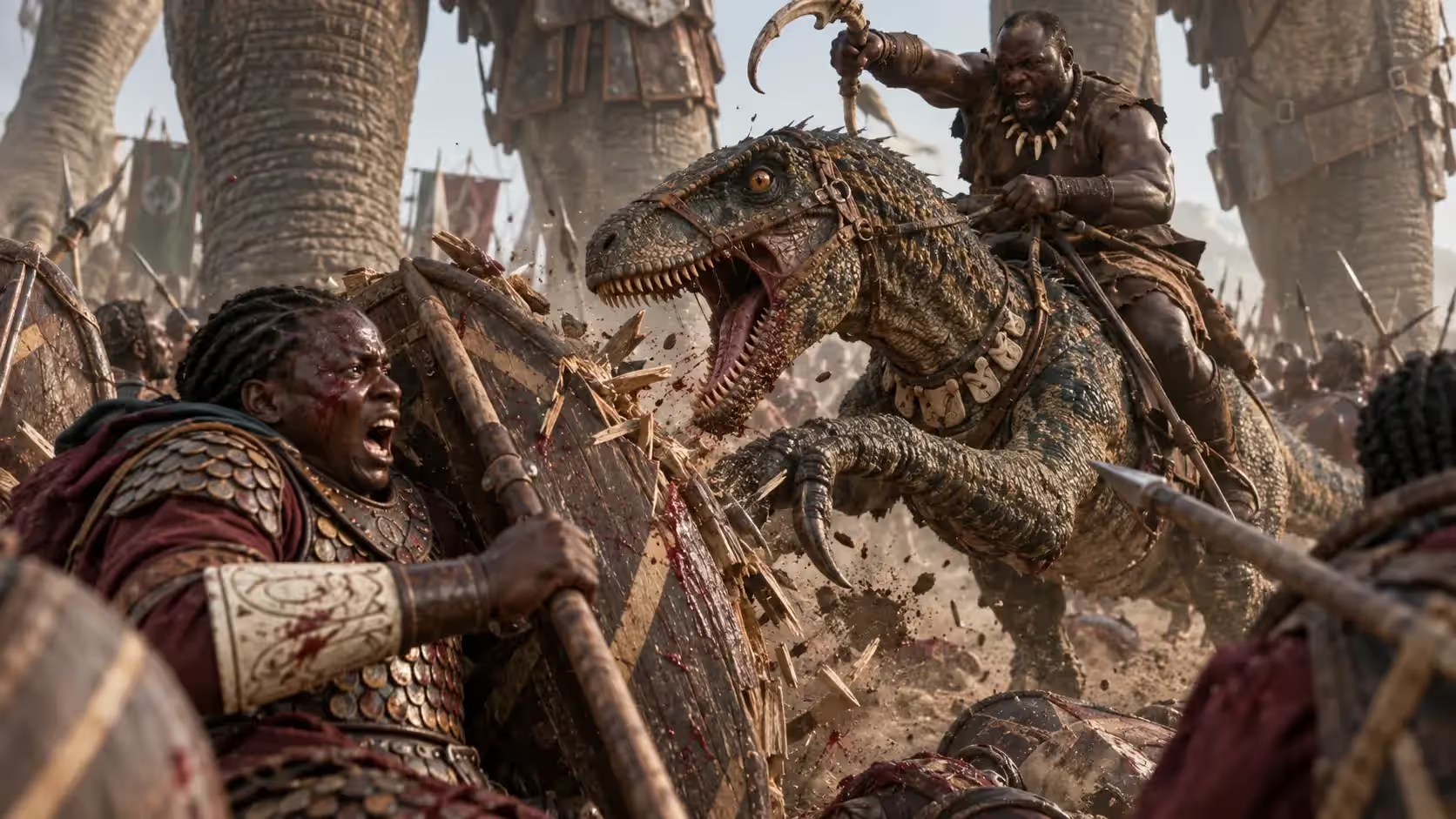
The fighting opens with aerial reconnaissance, N’Goro reshaping of the ground and false clues. The Urnok wall of artillery fires from its platforms; Arkhan refuses a static duel and moves its scorpions. Orgaï pushes fast heavy cavalry onto Marjory’s right, which falls back in echelons, holds the hinge and advances the left. There, the Orlantis comb — Stegosaurus, Dacentrurus, Kentrosaurus — rakes the ground, and the new bards designed by the engineer Zaboka Tanis hold up better than expected. In the centre, the fifteen Diplodocus open the way through sequences of tail strikes: this is the Great Dance, whose central group Marjory leads.
Orgaï then launches four diagonal waves of Apex with distinct functions: question, confirmation, lie and deep blade. The last strikes a joint Marjory believed secure; for the first time in her career, she is surprised. She contains the breach with the Dacentrurus, the depth pikes, the hadrosaurs and the medium batteries. The second surprise comes from below: Arkhan infantry opens corridors, and noasaurids, ridden millipedes and other low units flood the formation, while the N’Goro pin units to the dykes and win crossings. Marjory abandons the continuous front and closes islands around the batteries, the signals and the great animals.
The seventy breakthrough animals go in as successive corps; Orgaï sends his light cavalry against those that, wounded, have lost their human screen. Marjory answers by rebuilding the screens underfoot — guards, short spears, hadrosaurs, Kentrosaurus — and the bleeding stops. Her last fresh great animals then take the corridors Arkhan has opened and spread from the centre towards the wings, with the five ultrasaurs. Orgaï turns palisades, artillery and surviving Apex into delaying lines; the N’Goro pull back towards their canals. Marjory refuses a deep pursuit.
A victory that does not win the war
Urnok holds the ground and prevents a deep invasion of the Empire and of imperial Qor Zaï; Orgaï saves most of his army. The battle lasts several hours, not several days. It does not decide the war: only one of the three targeted cities falls, taken by another army, Zarsalaï wins elsewhere, and no power loses its strategic apparatus.
The Three Waves nonetheless matter in military history. They establish two commanders, reveal the Great Dance, the new bards and the fourfold diagonal, and open a doctrine of simultaneous scales. After the battle, Marjory rereads two reports above all: the one on the diagonal waves and the one on the low attack against the flank. What occupies her is not the casualty figure alone, but the way the enemy twice changed the scale of the problem.
Six commands, a single intention
Marjory divides her hundred and sixty thousand fighters into six commands. The left, thirty-four thousand men, carries the stegosaurids of Orlantis and must advance. The centre, forty thousand, holds the Great Dance and the breakthrough. The right, thirty-six thousand, is mobile and designed to give ground cleanly. The batteries gather eighteen thousand artillery crew, the reserve twenty-six thousand men, and six thousand are devoted to reconnaissance, the sky and liaison.
Beneath her, authority descends by echelons: great wing generals, legion generals of five to ten thousand men, captains of seven hundred to fifteen hundred, lieutenants, unit leaders and squads of eight to fifteen. The order changes language at every step. Marjory commands by intention — “Second withdrawal of the right. The centre does not follow.” — and lets the junior leaders fight the battle. No great general may overturn her order during the action; the commander of a great beast may report a risk, not refuse. If a leader falls, his second takes over at once.
The field measures ten to twelve kilometres of front and six to eight in depth. Survivors speak of five battles fought at the same time: in the sky, on the Orlantis wing, on the great slab of the centre, in the wet wing held by the N’Goro and in the depth.
What a great beast costs
Urnok permanently loses seventeen great beasts out of the hundred and eighty committed; Arkhan loses twenty-two great Apex of high value. The wounded and unavailable animals are far more numerous, and many will never return to service. On the scale of the battle, these figures look modest. Those who know the great animals know they are not.
A great beast is at once an organism, a bloodline, a capital, an infrastructure, a weapon and a symbol. It often serves forty or fifty years in the same unit, longer than the officer who commands it, and a whole community lives around it: drivers, platform archers, handlers, guards. Its harness, its armour and its passageways were made for its exact body. When it falls, the troops feel it as the death of a general, and its carcass reshapes the ground over hundreds of metres.
The law follows it beyond death: in Urnok, military great beasts belong to the Crown, and their carcass returns to it with the bones, tendons, plates, teeth, harness and bloodline secrets. After the Three Waves, the Empire’s breeders had a phrase for the officers that has stayed famous: “You have no idea what has just died.”
Orgaï’s retreat
Orgaï’s defeat is also one of the finest retreats in military history. When the Urnok counter-penetration spreads from the centre towards the wings, he does not try to save the position: he turns his palisades, his batteries and his surviving Apex into delaying lines. Each holds for about ten minutes, then pulls back while the next one takes its place. He abandons machines rather than men.
The N’Goro, on his left, disengage in their own way. They agreed to hold the flank; they refuse to pursue onto the dry slab, where their canals no longer protect them, and withdraw methodically towards the water. “Our mission is over,” their commander is said to have declared. Historians agree with them.
Marjory, for her part, refuses the deep pursuit. She knows that Zarsalaï is manoeuvring elsewhere in the campaign and fears the traps an Arkhan army leaves behind it. She has won the theatre, not the war, and she knows it. Since that day, the Empire’s schools say of Orgaï that he is a master of retreats: you do not beat him, you make him leave.
What is told of the Three Waves
A great battle leaves stories that veterans repeat for the rest of their lives. The story of the absurd order is the best known: an officer of Arkhan light cavalry is ordered to attack the great beasts, asks for the order to be repeated, looks at the animals, then answers “Very well” and goes. People also tell of the dyke on the right wing, which the N’Goro never attacked: they opened a canal behind it, and an hour later the Urnok reinforcements were wading, pinned without having been beaten.
Other stories pass from hand to hand because they are absurd. An Arkhan scorpion whose brake had failed hurtled down the slope, crossed its own line and ended up against the carcass of a carnotaur; its crew turned it round and used it again. Among the N’Goro, people cite the coded ampoules: blue is an irritant, striped blue an antidote, and a crate that fell in the mud stayed there until evening, because nobody touches the blue. Elsewhere, the wind turned and blew the N’Goro smoke back over an Arkhan unit that had not received the order to stop.
The hardest stories are those of courage without a moral: an Arkhan battery that stayed at its piece facing an ultrasaur to buy time for a second palisade, and Urnok pikemen who held three seconds too long beneath their own falling great beast, to save thirty gunners.
The armourers’ lessons
The Three Waves were also a battle of workshops. The new stegosaurid bards were the work of the engineer Zaboka Tanis, who worked for the alliance of Orlantis, Velmor and Karûm-Brakh and did not attend the battle. Her rule fits in a few words: never metal everywhere. Metal heats, chafes, reduces the range of movement and takes hours to fit. An artillery beast is protected at the platform, neck and shoulders; a breakthrough beast at the forearms, joints and chest; a stegosaurid at the hip and the base of the tail, without ever locking the tail.
Opposite, the Arkhan batteries surprised everyone with their precision. Their ballistae combined Arkhan torsion and tendon with a mounting inspired by the Korath recoil patents; they could be recognised by their agility, their control of recoil, the rigidity of the bolt and their penetration. Mounted on two wheels and drawn by runners, the scorpions changed position in a few minutes.
The foot soldiers, for their part, remembered the value of long weapons: the great Urnok pike of five and a half to seven metres, Arkhan lances with a lost head whose point breaks off and stays in the wound. After the battle, the Empire’s schools added a doctrine of the fall to their teaching: knowing where a wounded great beast will fall, getting out of its cone and holding fire.