

Families and social ties
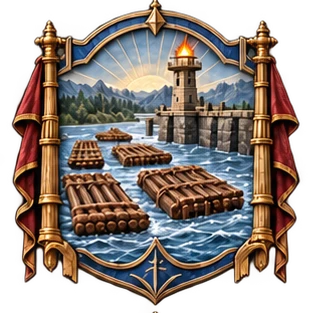
The Marlen Line of Orlantis
Downstream timber floating and inland ports open the forest chain towards Volonia.
Timber takes to the water
Marlen is associated with downstream timber floating and the inland ports of Orlantis. This industry receives timber already involved in the duchy’s forest chains and moves it by water. Ports belong to the continuation of work rather than to a separate setting: the productive forest extends into its outward routes and exchanges.
The Volonian connection
The Marlen Line of Orlantis is close to Volonia and its commercial language. Downstream movement brings those responsible for timber into contact with transport and port workers. Celebrations, rites and alliances can follow supply chains rather than geographical proximity alone. A working neighbour can sometimes be found at the other end of a material’s journey.
Two Marlen in two duchies
Sarnor also has a Marlen Line, associated with mills. The Line system allows identical names in different duchies. Location and function therefore place the name: mills in Sarnor, timber floating and inland ports in Orlantis. These registrations provide two addresses of responsibility in two different chains of work.
The port at the end of the town
The Marlen port occupies the downstream end of the towns of Orlantis, where material arrives after crossing every quarter. It brings together quays of stone and timber, sorting slips for logs, warehouses for resin barrels and coils of rope, weighing halls and register offices. The most important quays are fortified and equipped for hauling, because an inland port is also a crossing point to be defended.
Work there follows the arrivals. Log rafts come down in waves, after floods or great fellings; resin arrives from the Aversin cookeries in sealed barrels; ropes, turned parts and planks come from the upstream quarters. The Marlen sort, weigh, record, store and load. Nothing leaves the port without having been given a Line name and a weight.
Steering the rafts
Downstream floating takes over from the Berlan at a hand-over point fixed by each river’s register. Upstream, the Berlan float single logs and gather them; downstream, the Marlen bind them into great rafts tied with Nalen rope, which crews of pilots steer towards the inland ports and the coast. A raft of good size carries dozens of logs and a small hut for the crew, who live aboard during the descent.
The trade is dangerous. Too strong a flood breaks a raft apart, a sandbank grounds it, a badly placed bridge pier stops it dead. Marlen pilots know their duchy’s rivers channel by channel, and their families hand down the memory of the places where men were lost. At the port, every raft that arrives whole is greeted with three blows struck on the timber of the quay, a custom the pilots say is as old as the port.
Speaking two languages
The Line speaks the language of Orlantis accounts and that of Volonia’s buyers. Its clerks read Volonian contracts, with their insurance clauses and declarations of risk, and know what a cargo is worth once it reaches a port of the Republic. The timber and resin of Orlantis go down towards Volonia; in the other direction come pearls, luxury goods and wares from the sea. The Marlen port is one of the places where the Empire and the Republic talk to each other every day without an ambassador.
That closeness is old. The Volonians descend from the ancients of the Broken Isles, who themselves came from Orlantis, and the duchy still speaks a mother tongue of theirs. An old stereotype calls the Orlantines liars; Marlen clerks reply that they are merely bilingual, and that the Republic has simply learned to have its lies insured.
Barges, shipyards and sénelles
On the coast, the Line also runs shipyards. They build floating rafts, river barges, coasters and single-piece masts cut from the ancestral timber of the high forest, which Volonia buys at a high price for its great ships. The Volonian shipyards of Velasar were born of these Orlantine traditions, and ship carpenters of both countries still recognise each other by the same gestures.
The port lives with its animals. Hundreds of barge hadrosaurs haul rafts and lighters along the banks, on towpaths the Line maintains. Above the quays, sénelles, small coastal pterosaurs trained to fish on the wing, also carry signals from one quay to another. Bills of exchange with Volonia pass through a counting house set up at the port, and Marlen clerks keep the duplicates.
A port in wartime
The inland ports count in the Empire’s wars. The noble timber used for ballista frames, platforms and bridges passes over their quays, as do hauling ropes and site pitch. In times of crisis, imperial stewards can requisition cargoes, set loading priorities and forbid certain shipments abroad. The Marlen then find themselves between their Volonian contracts and the Crown’s orders.
They settle these tensions through the register. A requisitioned cargo is entered, weighed and assigned, and the Line asks the stewardship for a written order that covers it before its buyers. The pilots, for their part, keep coming down the rivers: a war needs timber before it needs soldiers, and the timber does not come down without them.