

Materials and resources
A product that becomes invisible
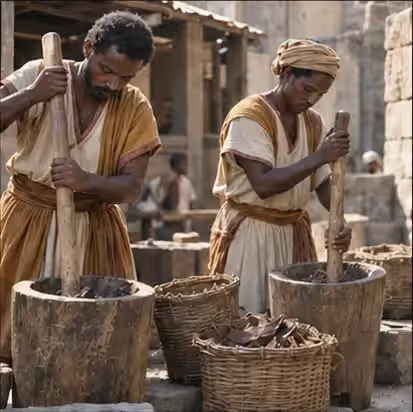
Orlantis Tanoris handles bark tannins. Tanneries and then harnesses depend on this intermediate product. The forest therefore supplies more than beams or hulls: it also contributes to processing hides. This link can remain invisible in finished equipment while still being essential to its production.
Processed hide
Hide and leather differ in treatment, thickness and response to moisture. They are made into tents, saddles, light armour, cages and shields. This is a flexible, vulnerable material rather than universal protection. Tanning quality matters as much as the proclaimed animal origin.
The black harness comes from several places
Orlantis bark becomes tannin, then leather, then Velmor’s black harnesses. Heavy-animal equipment thus brings together the forest and military duchy. This chain does not change Velmor’s species: dark iguanodons and hadrosaurs and sauropods live there, while stegosaurs remain in Orlantis.
Where the hides come from
Orlantis tannin is useless without hides, and the Empire never has enough. Most come from retired hadrosaurs, slaughtered on certificate when they can no longer work; others from dead animals declared in the register, whose carcass reverts to the keeper who sells it to the tanners; others again from the game of the Culorn Line’s hunts. Sauropod leather, an inch thick, is used for collars, soles, straps and plate linings; it is rare and expensive.
To make up the shortfall, the Empire buys hides in Arkhan, the land of bones and hides, through the customs posts of the march of Qor Zaï. Urnokian tanners recognise them by their salting and their clan marks, and treat them separately. Once in the pit, an imported hide follows the same chain as the others, and comes out two years later as an imperial harness.
Two years from tree to harness
The leather chain is slow, and it is counted in seasons. Bark is stripped when the sap rises, dried all summer, ground and set to steep in autumn. The hides received in the meantime are washed, scraped and softened, then go down into the pits, from a weak bath to stronger and stronger ones; a sauropod hide stays there for long months. Then comes the currying, where the leather is beaten, greased and stretched, and, for the harnesses of Velmor, the iron bath that blackens it.
Cutting and sewing take only a few weeks at the end of this long road. A harness ordered today is therefore made of leather whose bark was stripped two years earlier, and the quartermasters who prepare a war know it: a campaign is also decided in the forests of Orlantis, two springs before it is declared.
The black harness workshops
At the end of the chain, the harness workshops of Velmor cut and sew the black leather. A typical workshop brings together about ten harness makers and saddlers, a tanner who checks each batch on arrival and a smith for the buckles and rivets. It makes simple draught harnesses for the carts of the mines, the quarries and the black road, which sell for a few Dracos, and war harnesses reinforced with chains and rivets for the black iguanodons and hadrosaurs of the regiments, worth thirty or so.
Velmor black leather is itself sold by the square metre, a little over two Dracos, and its black does not run, which sets it apart from the dyed leathers found in the markets. Velmor’s harness makers make a point of letting it be known that they do not make their black themselves: it begins, they say, in an Orlantis pit, and they speak of the Tanoris with a respect they deny most people from the west.
Judging a leather
A tanner judges a leather before accepting it. He folds it to see whether it cracks, pulls it to feel its suppleness, smells it to detect a whiff of rot, and above all cuts off a corner: a well-tanned leather has a cut edge of even colour right to the core, whereas a leather taken too early from the pit keeps a pale band in the middle, the “raw heart”, which will rot under sweat. A piece is also soaked in water to see how much it drinks.
A tannin’s defects often show only a year later, when the harness has worked. That is why every batch of leather keeps in the register the name of the tannery and that of the Line that supplied its liquor. The Tanoris of Orlantis care a great deal about their reputation: a harness that fails on campaign through a tanning defect calls them to account before the whole chain, and they sometimes send one of their pit masters to examine the broken leather themselves.