
Creatures
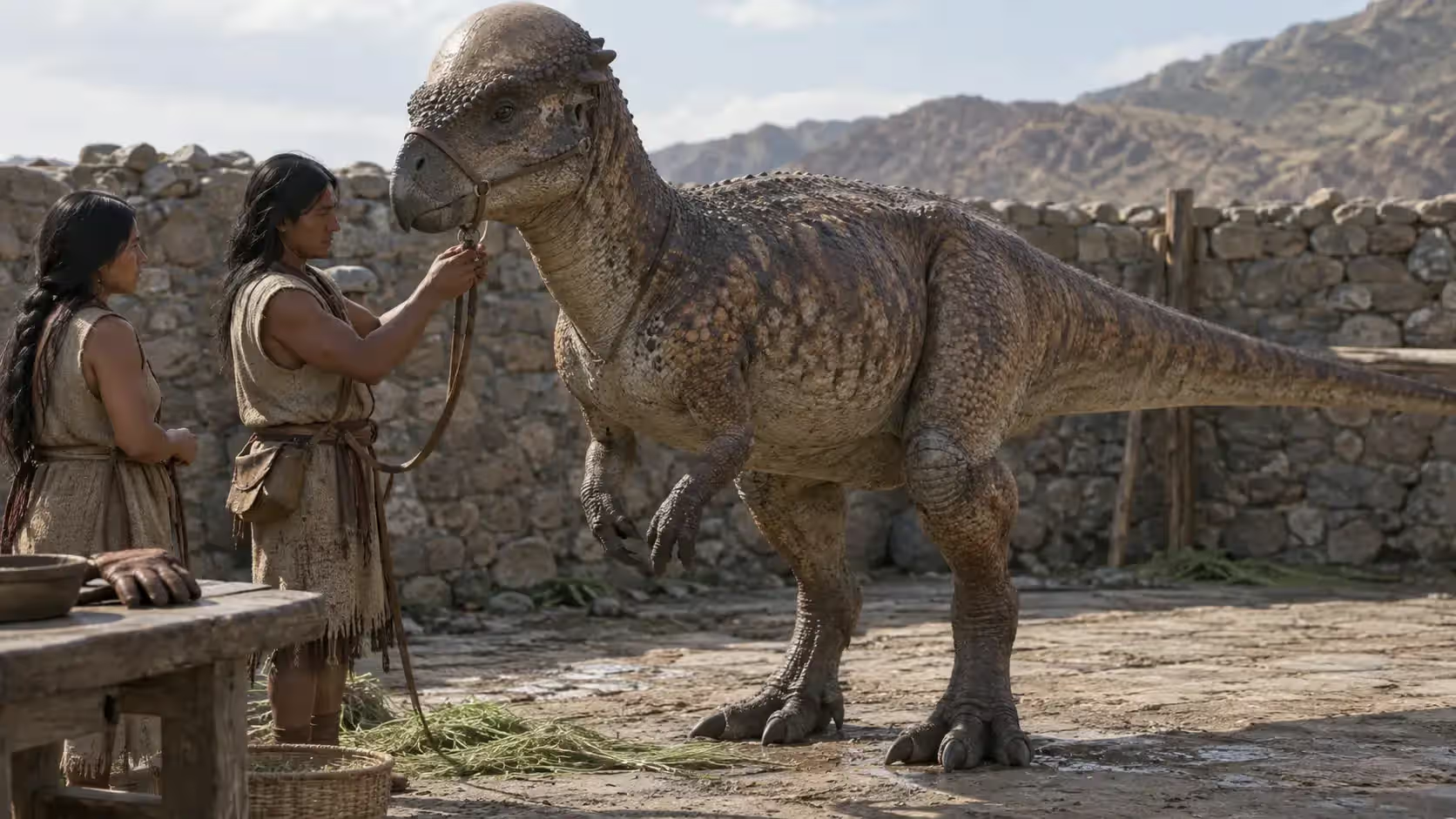
Pachycephalosaurs
The dome-skulled dinosaurs of Korath’s low marches, used for impact testing.
A science of impact
Pachys stay in Korath’s low marches and accessible levels. Test gates, mines, head-protection workshops and training grounds draw on their science of impact; the study of percussion can inform mechanisms and deep acoustics without bringing the animals into the central districts.
Un jeune pachycéphalosaure frappe de la tête un coussin de cuir suspendu dans un étroit passage d’exercice.
Tests require straight approaches and a long deceleration, separate outward and return lanes, side galleries for observers, sacrificial blocks and impact marks. Casts, failed caps, dates and corrections keep the memory of experiments, inventors and accidents.
Duels and arenas
At Qor-Zaï, duelling pachycephalosaurs with domed skulls clash in the arenas: duel, ritual and short impact, on which people bet. In Korath, the impact pachy, the Tête-marteau, is used for the sport of the impact arena and for testing armour.
The dome
Pachycephalosaurs owe their name to their skull: a dome of massive bone, several hands thick in large adults, often edged with knobs and short bony horns. They are bipedal herbivores with a compact body, a stiff tail and short forelimbs, covered in scales like every dinosaur of the known world. The largest reach four to five metres in length for a few hundred kilos, far from the ankylosaurs that share the marches with them.
Their whole social life revolves around this dome. Males clash head down, in shoves and short impacts, over territory or access to females, and trainers have learned to make use of this behaviour rather than fight it. The smaller, lighter species have flatter skulls bristling with spikes and strike at an angle; the large ones, with a full dome, strike head-on.
Korath’s pachys
Korath distinguishes several types of pachys by use. The Tête-marteau, “Hammerhead”, the impact pachy of the trial tracks and the arena, is the country’s best-known breed. For war, the stables of the marches keep two families. The Marto-Crânes, “Hammer-Skulls”, are large pachycephalosaurs whose dome is reinforced with a metal cap, able to break a line at first contact. The lighter, spiny-skulled Béliers-de-Col, “Pass Rams”, are the fastest beasts in the Korathi army: they are sent in at the point to open a way through.
All these beasts are imported, like the country’s other dinosaurs, bought young from foreign breeders or born in the few breeding yards of the low valleys. Trainers follow the lineages closely, because courage, neck strength and speed of recovery are inherited. The betting on the impact tracks, which concerns the beasts as much as their trainers, keeps this science of lineages alive.
The ram-helm
The ram-helm armourer fits pachycephalosaurs and gallery beasts with a cap of forged metal moulded to their dome. The helm spreads the impact over the whole surface of the skull, protects the eyes and the nape, and carries at the front a thicker brow plate stamped with the workshop’s seal. It is held by leather chin straps and lined with padding that is replaced after every series of impacts.
The base of the helm is often made from the skull dome of a retired pachycephalosaur, whose thick bone serves as a form and a reinforcement. Each helm is fitted to one particular beast, measured on it, and is not passed on: a badly fitted helm injures the animal wearing it at the very first impact. Ram-helm armourers rank among the most specialised trades of the marches.
At war: strike once
At war, the pachycephalosaur strikes once. Sent in at the right moment against the right point, a gate, a low wall, a shield wall already shaken, it breaks what pressure alone had not made give way. But the impact exhausts it, and for the moments that follow the beast staggers, vulnerable. Korathi doctrine therefore always plans to cover the pachys after the impact, withdraw them and let the artillery and the ankylosaurs take over.
In the mines and accessible galleries, gallery pachycephalosaurs wearing their helms are used to break in doors and low walls where no engine could pass. Officers use them sparingly: a beast that strikes too often injures its neck, and a line of pachys wasted on a badly chosen target is not rebuilt in a season.
Caring for a head that strikes
The carers of the marches watch the pachys more closely than any other beast. After every series of impacts they examine the animal’s neck, eyes and gait, look for signs of dizziness and rest it in quiet stalls, away from noise. The registers note the number of impacts each beast has taken, and a limit set by the tables imposes complete rest once it is reached.
A pachy whose reactions slow down is retired. It may end its days in a breeding yard, serve to train the young, or be slaughtered, in which case its dome goes to an armourer’s workshop. Korath treats these beasts as assets and test subjects; but the marches also have carers attached to one animal, who follow it from the first track to the last stall.
Elsewhere in the world
Korath is not alone in using pachys, but it is alone in taking them to war in this way. In the Empire of Urnok, the civic pachy, known as the Short-Ram, is used for games and for keeping order in towns, wearing parade helmets; at Qor-Zaï, duelling pachycephalosaurs clash in the arenas. Korathi look on these uses with a certain condescension, as parade work.
At home, pachys never go up into the deep cities: their place is in the marches, on the trial tracks and in the accessible galleries. City dwellers who want to see them go down on demonstration days, and come back with the memory of a beast whose weapon is its very head.
Part of this article covers events of season 1. Turn spoilers on in the menu to read it.