
Places and landscapes
The Long Boughs
Schools, markets and liana networks inhabit the mangroves’ middle world.
The inhabited middle world
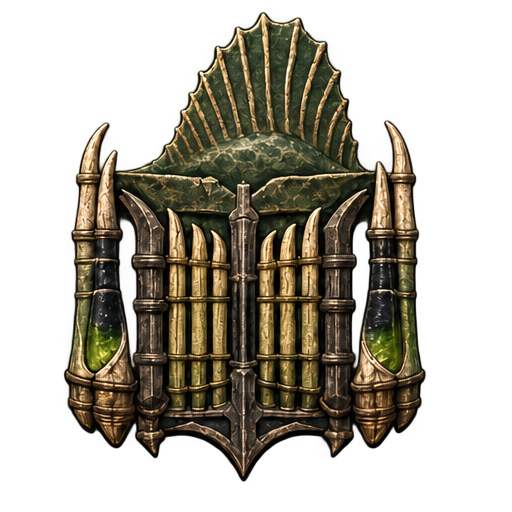
The Long Boughs form the middle world of canopy cities, schools, markets, lianas, insect houses and suspended routes. Giant mangroves provide root caverns, arches and platforms. Living at this level means moving between living supports: the neighbourhood is organised through trees, fibres and maintained passages.
Longues Ramures — la route suspendue
Des voyageurs traversent une passerelle de fibres, espacés entre ses ancrages et ses liens renouvelés.
The Conservatory works in the field
Yveth’s Conservatory belongs to the Long Boughs. Plants, spores, living wood, grafts and insects are the concern of a field institution attentive to ecosystem balance. Knowledge concerns what grows and changes around the inhabitants. School and route thus participate in the same environment, with needs for observation and maintenance.
The liana is also a message
The Knotters maintain the three-dimensional liana network. Knot, sap, smell and tension can encode destination, urgency, disease or danger. The route therefore carries information as well as bodies. A slack fibre or displaced insect can change how a passage is read before inhabitants see what altered it.
Routes that must be fed
A route in the Longues Ramures may have to be fed, sewn back together or abandoned; knots, smells, sap and tension tell of its state. Some lianas slowly close under heat, vibration, blood or touch. The network the inhabitants use is therefore not interchangeable with the surrounding vegetation: recognising a way, its anchors and its signs distinguishes a maintained passage from a setting that can turn constricting.
The hanging markets
The markets of the Long Boughs are held on broad platforms slung between the trunks, halfway up the mangrove, where the air is less heavy than at water level and less windy than in the High Canopy. One climbs there by vine ladders, baskets hoisted on ropes or the Conservatory’s living bridges. The stalls are mats laid on the bare wood, sheltered by bark cloths: fibres, ropes, remedies, live insects in rush cages, fruits and resins brought down from the heights, smoked fish brought up from the low waters.
Small purchases are paid in shells, large transactions in Venom Phials, and many exchanges are still made on credit, knotted on a cord. The market has its safety rules: no open flame, a threshold keeper at every access, washing basins for the hands. A foreigner first notices the noise — whistles, calls, the clatter of cages — then the smell, a mixture of resin, gentle smoke and overripe fruit.
The schools of the middle world
The schools of the Long Boughs are among the most renowned in N’Goro. Reading is not learned there as in Urnok, from registers, but by reading the environment: a vine’s tension, a water’s smell, a mushroom’s colour, an insect’s sound. Children also learn Ngóro and its four classifiers — Water, Skin, Chitin and Bone —, writing in spore ink on varnished fibres, the reckoning of doses and how to make up a threshold kit.
Teaching is collective, like all N’Goro education: former women warriors, Sap-Keepers, Knotters and Conservatory gardeners take turns there. Lessons are often given on the move, along the hanging routes, and the oldest pupils are responsible for the youngest. No diploma is awarded; after several years one receives the right to travel a route of the network alone, which families celebrate like a small shedding.
The insectaries
The insectaries of the Long Boughs are chambers of living wood closed with fine mats, where the insects on which daily life depends are bred. Fireflies are fed there on nectar and fruit, then shared out among the cages that light streets and houses; fibre caterpillars spin the silks from which light clothing is woven; cleaner beetles wait to be sent into latrines and refuse pits; pollinators spend the dry season there.
The insectophile breeders who run them form a profession apart, respected and somewhat feared: those who can raise a colony can also move it, and the insectophile orders are among the forces secretly opposed to the central power. In war this knowledge becomes the fifth threshold of defence, when colonies are released, moved or lured towards the enemy’s camps.
The carriers and the march of Urnok
The Long Boughs are also the land of carriers. The House of Vethan holds the living barges there, carried and hauled by titanids — marsh pack sauropods — and by barge hadrosaurs, as well as the locks of the Titans’ Channel, which pass whole cargoes from one basin to another. Its people gather the sap of the great beasts and tend them in vast stilt halls. Its town, Ngiyu-Mu, is a holy place as much as a port.
The region borders Urnok. The Ur, the Empire’s great river, ends in the marshes of N’Guwi, where the porterage river port lies, and the march of Gwami holds the threshold post facing the Empire: there anti-rot is traded for Sarnor fodder and imperial leathers, under the eyes of guards on both sides, in a hostility that has never taken the form of a declared war.
The canopy at war
The Long Boughs defend themselves from above. Lookouts in the High Canopy signal any movement in the low waters by whistle and drum; the Knotters read the network and cut routes by ceasing to feed them; centipede riders, mounted on arthropods that climb walls and run along roots, harry columns from angles no army of the plains has learned to cover.
A foreign force that wants to take a canopy town must climb, and climbing is costly: ladders are withdrawn, bridges raised, vines close at the touch of blood. The festival of the Rising of the Titans, when colossal animals swim up the waterways and porterage and barges are blessed, reminds the inhabitants every year that the middle world rests on what passes beneath it.