
Institutions
The Great Shedding
Cities remain; peoples, their workshops and their animals change dwelling.
A city that changes people
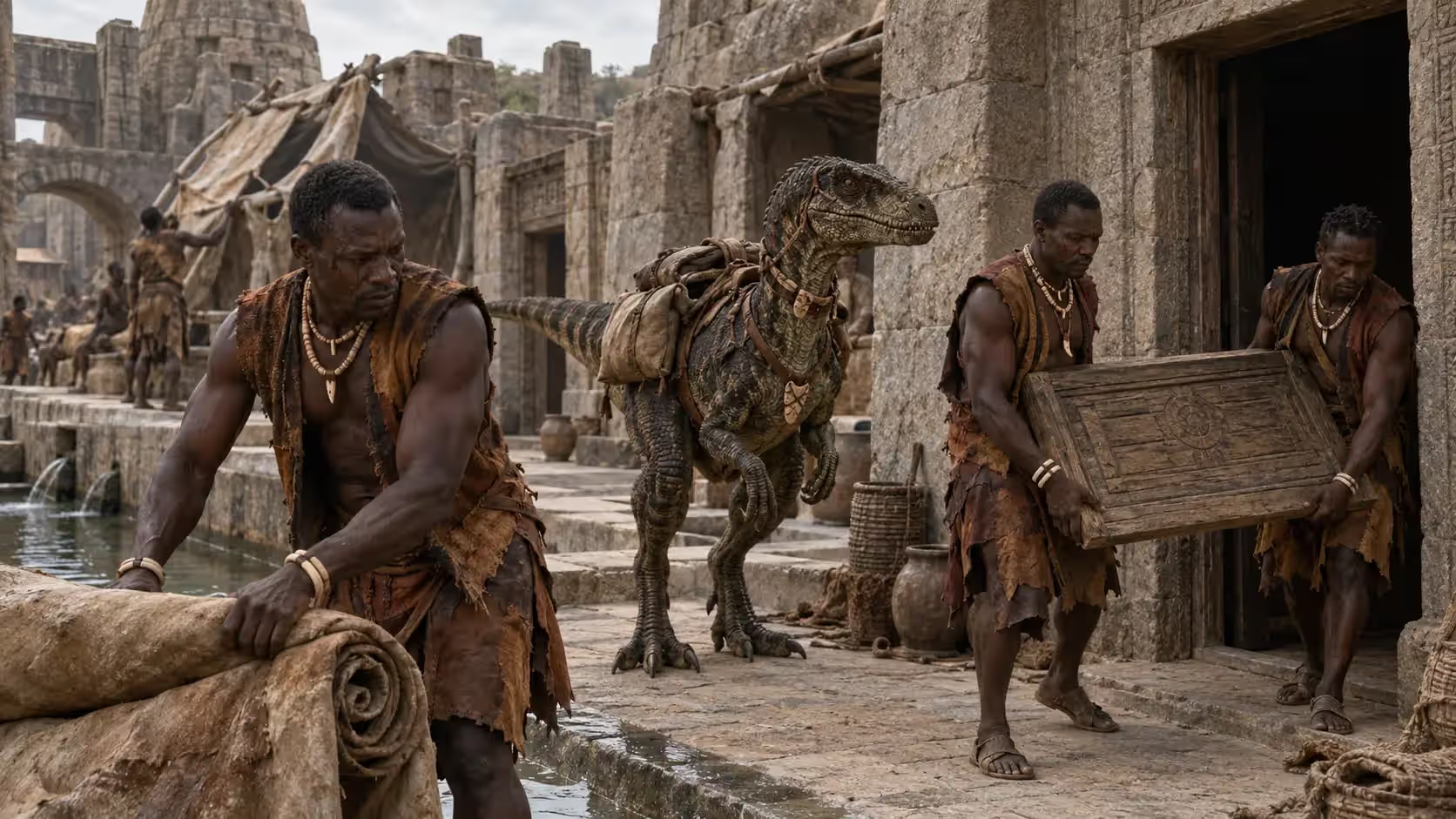
The Great Shedding organises a political transformation of the clans. The great cities are shell-cities: walls, cisterns, basins and sanctuaries remain while mobile populations, courts, herds and dismantlable workshops follow their people. The cycle of the Great Shedding governs departures and settlements. A city does not move geographically; its inhabitants and much of its material life change.
Walking, shedding, remaining
Three categories organise possessions: what walks with the people, what can be dismantled and carried, and what remains city property. Membranes, banners, workshops and movable objects do not follow the same rules as basins and walls. On the Night of Doors, at the final horn, an object still attached to a building becomes city property. Migration therefore also requires dismantling and sorting possessions.
Preparing the next arrival
Between two peoples, the Great Cleaning empties basins, removes carcasses, renews membranes and treats enclosures. The Shedding therefore has a sanitary as well as a political function. The incoming people change the city’s skin — roofing, markets, banners and uses — while the Anchored maintain what makes it habitable. A transferred city must become usable again before receiving its new life.
Distinguer ce qui part et ce qui demeure
This extended reading is currently available in French.
La Grande Mue échange les populations gouvernantes et une large part des populations actives entre les grandes cités d’Arkhan. La cité demeure à sa place ; ce sont les personnes, les troupeaux, les ateliers démontables et les éléments transportables qui changent de lieu. Le cycle oblige à distinguer trois catégories : ce qui marche, ce qui se démonte et voyage, ce qui demeure lié à la cité.
Cette séparation est matérielle avant d’être abstraite. Une bannière se transporte autrement qu’un bassin. Une membrane de toiture peut être démontée ; une citerne doit pouvoir servir aux arrivants. Familles et artisans décident de ce qu’ils emportent et de ce qu’ils restituent. Le départ engage un travail sur les installations, les animaux et les charges.
Réduire la Mue à une migration de cavaliers effacerait les gestes civils qui permettent à une ville de changer de population sans cesser d’être habitable. Les charges de départ doivent rencontrer les capacités de déplacement et les lieux d’arrivée. L’image des colonnes n’est que la partie la plus spectaculaire d’une transmission qui commence dans les ateliers et se poursuit dans les quartiers.
Le Grand Curage entre deux peuples
This extended reading is currently available in French.
Le passage entre départ et arrivée comprend un travail sanitaire. Bassins, enclos, membranes et résidus ne peuvent être abandonnés à la population suivante. Le Grand Curage prépare la cité à recevoir de nouveau des corps, des bêtes et des métiers. Le nettoyage devient une responsabilité politique : les conséquences d’un séjour ne doivent pas toutes devenir la charge des arrivants.
La salubrité dépend de l’état des lieux, pas seulement de la bannière qui les gouverne. Un bassin doit être utilisable, un enclos doit pouvoir accueillir un animal et une toiture doit remplir sa fonction. Le temps de transmission rencontre celui des réparations. Les grandes structures d’os et les réseaux d’eau rendent la continuité possible ; leur état réel décide de la capacité d’une ville à ouvrir ses quartiers.
Les Ancrés gardent la connaissance du lieu pendant que les groupes mobiles changent de cité. Archivistes, gardiens des bassins et artisans de mur conservent une mémoire que les gouvernants successifs ne peuvent entièrement emporter. Leur savoir participe à la transmission des obligations et à l’entretien. La ville a une durée plus longue que la résidence d’un khan parce que cette durée reste inscrite dans les gestes des personnes qui la maintiennent.
Zar-Khan le Sans-Mur
The Great Moult has a founder: Zar-Khan le Sans-Mur, the Supreme Khan who waged the fifteen-year War of the Seven Thrones against the khans rooted in their cities. His law forbids a great people to govern the same shell twice in a row and a khan to hand a city down to his son.
A settled nomadism
Arkhan thus practises a settled nomadism: the city stays, the people leave. The formula says it: “We built cities, not cages. Move.” The same city changes identity so much with the people who live in it that diplomats ask: “Which Vulkar? Today’s, or the one arriving in two years?” The Moult even has its contracts: Volonian houses offer “Moult relocation” contracts whose clauses exclude almost everything.
Carrying a people
A Great Shedding moves whole peoples with their beasts, their workshops and their stores, over distances counted in weeks. It is the Long-Bones, the lineage of the long trails, who make such a march physically possible: they know the water of every stage, hire out the pack beasts and hold the relays where the columns rest.
Carrying relies on the living. Hardy hadrosaurs pull the sledges and carry the cisterns, the workshop frames and the rolled membranes; khaans, small carrying oviraptors, take the tents, the waterskins and the children too young to walk. The raptors carry nothing: they guard the column and lead it. A khan who has miscounted his pack beasts leaves whole workshops behind, and his reputation suffers from it longer than his treasury.
A life counted in Sheddings
The Shedding sets the rhythm of lives. People readily count a child’s age in Sheddings: a boy “of two Sheddings” has seen his family change city twice. Many Arkhans grew up in three cities without ever having moved of their own free will. Marriages are often arranged in the year before a departure, so that both families leave together, and separations are timed the same way.
Mocking songs tell of parted lovers who count the year when their columns will pass within five leagues of each other, and of people who arrive in a city cursing the market badly placed by the previous people. “Idiots,” say the newcomers. The Anchored remind them that the same was said of them seven years earlier.
Wealth that can be carried
A people that changes city every seven years does not place its fortune in stone. Arkhan wealth is carried: lineage beasts, certified teeth and claws, ornaments, weapons, cords of debts, dismountable workshops. Walls, basins and great works belong to the cities, and nobody grows rich by owning them.
That does not mean the khans lose interest in the cities. On the contrary, they compete through the state in which they hand them back. A people that leaves clean basins, repaired pens and settled accounts earns a reputation that precedes it into the next city; one that leaves debts and carcasses pays at the restitution, then a second time in the songs. The Shedding thus turns upkeep into prestige.