
Power and institutions
Porte-Fange
A toll that holds the entrance to the marshes.
Function and place in war
Porte-Fange is a toll that holds the entrance to the marshes.
It extends a logic of N’Goro, which sells the remedy but keeps the road closed. Under N’Goro’s law, a quarantine can even act as a blockade, without any declaration of war. Further on, Marche-Mousse holds a frontier of living traps.
A gate in the mud
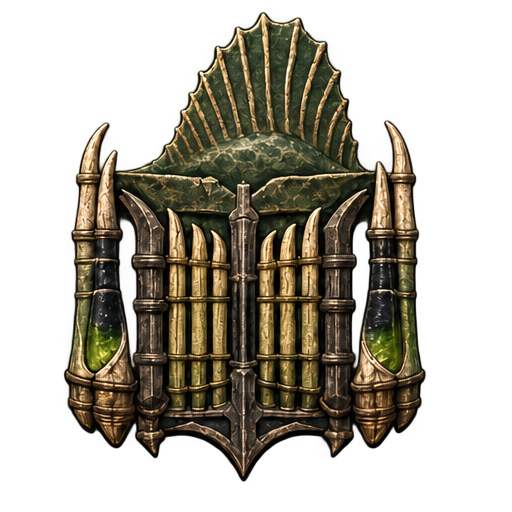
Porte-Fange holds the exact spot where firm ground gives up. On a wide bend of channel, where the clay banks give way to the first reed beds and mangrove roots, the minor power has planted its stilts: some thirty houses, an inspection pontoon, a watchtower built on an aerial root and, across the channel, the “gate” that gives it its name. It is a boom of floating logs lashed with vine ropes and copper rings, which a crew opens by hauling the logs towards the bank.
Behind the boom the marsh begins in earnest: branching channels, black waters, floating mats, routes that do not stay put. In front of it lies the last ground that will hold a hadrosaur cart. Any traveller arriving from dry land with a cargo therefore passes through here, or ventures at their own risk onto an unguarded pass — which few do twice.
What entry costs
The Porte-Fange toll is not reckoned by weight. The inspectors class each cargo by the grammar of Ngóro, which conjugates everything according to its toxicity: clean, irritant or lethal. Salt, leathers or fodder from Urnok are clean and pay little; badly tanned hides, eggs, live insects or unknown seeds are irritant and pay more; venoms, fungi and anything that can contaminate a water are lethal, and pay the most — when they are admitted at all.
Payment is in shells, in bronze Scales for foreign merchants, or in kind. The fee includes something Urnok travellers discover with irritation: a compulsory guide. No one crosses the boom without a guide hired on the spot, who knows the day’s state of the channels and answers to Porte-Fange for those he leads. The guide often costs more than the toll itself. No one haggles over him: a guide haggled over is a guide who tires early.
The filter, the declaration and the counter-flasks
Porte-Fange is not an institution of the Sap-Keepers’ Synod, but it applies the Synod’s protocols, because no minor power survives long if its waters become suspect. At the inspection pontoon each traveller declares the water they come from, the route they followed and what they drank or ate on the way. Hulls are washed in a rinsing basin set apart from the channel; draught beasts stay on the bank in a quarantine pen, for they will go no further.
Admitted venoms must carry name, dose, signature, origin and antidote; those whose antidote is known leave their counter-flask, which Porte-Fange sends on to the Sap-Keepers. The declaration is made before a filter of sand and fibre set on the pontoon, and everyone knows what that means: in N’Goro, lying before a filter is a profanation and a collective betrayal. A merchant caught lying pays no fine. He is sent back towards dry land, and his name is passed to the other gates of the marsh.
Closing the gate
In wartime, Porte-Fange becomes the first of the seven thresholds of N’Goro’s defence, the threshold of the road. The boom closes, the guides vanish, the scent beacons of the first day’s march into the marsh are torn out, and the inspection pontoon empties. An army arriving at the gate finds deserted stilt houses, a tower without a lookout and a channel barred by logs that take hours to clear under arrows.
It can then force the passage; that is what is expected of it. Beyond, nothing is marked for it any more. N’Goro law also allows a quarantine to act as a blockade without a declaration of war: more than once Porte-Fange has shut its gate for a fever rather than for an army, and the Urnok merchants waiting on the bank never knew which of the two reasons was the true one. Between N’Goro and Urnok, moreover, there reigns a hostility without declared war, the “frozen southern front”, which stops neither anti-rot glue going up to the Empire nor fodder and leathers coming down. At the gate people say that “mud needs no soldiers, only patience”.
Among the marsh minors
Porte-Fange does not hold the entrance to the marshes alone. It lives among tiny water sovereignties that complement one another: Marche-Mousse, further in, holds a frontier of living traps; Œil-Boue keeps watch against amphibious reptiles; Crécelle-Brume raises the alarm with sound signals; Écluse-Îlot guards the dykes and passages. A convoy that has paid at Porte-Fange often meets the water guards of Croc-Amphibe before the first evening.
These minor powers squabble over rights of passage, but they trade news, guides and the names of liars. Their strength lies in that web. A foreign power can buy or break one of them; it cannot buy the marsh.