

Places and landscapes
The trough aqueducts
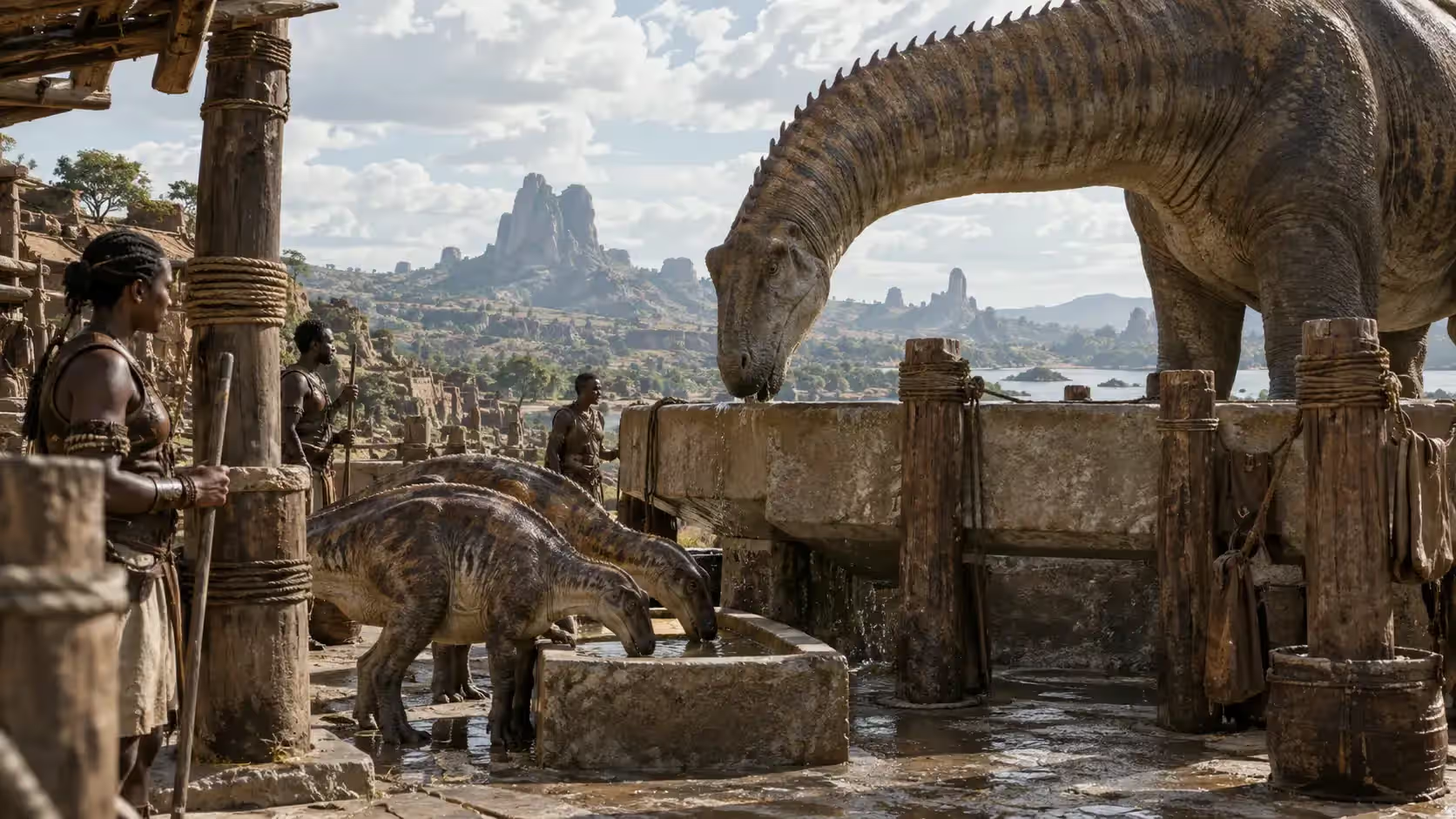
In Urnok, a single work carries the city’s water and waters the great animals. Trough aqueducts, cascading basins and vertical troughs set the capital’s hours around the drinking and feeding of the titans.
One work, two uses
The trough aqueducts cross Urnok without turning it into a lake city. A single work supplies urban water and serves as a trough for working animals; it also takes part in towing, drainage and supply. The Empire gains twice: the monumental beauty of running water and the logistics of the living. Cascading basins divide the uses according to the size of the bodies passing.
The work belongs to the city’s middle and lower levels. Sluice masters regulate the flow and washers maintain the basins. Drinking water, care water and service water must be at the right level when the animals pass, without mixing.
Drinking and eating at one’s own height
Vertical troughs and feeders give each animal its level: the largest sauropods drink and eat at neck height, medium animals at mid-level, the smallest on the ground. Feeding towers and fodder posts complete the arrangement; on the roads, stations play the part of oases.
This feeding sets the city’s daily rhythm. Every morning, feeders, measurers and carers serve the colossi in a mass ritual, and the rattle of the vertical troughs’ chains belongs to the sound of Urnok.
The hydraulic metabolism
Across the Empire, the trough aqueducts extend a network of rivers and artificial canals linking Calaron, Sarnor and Orlantis. Grain, fodder, water and waste travel along it by barge, often towed by hadrosaurs, stopping at inland ports. The network also carries its own risks: floods and contamination.
What a colossus drinks
The size of the trough-aqueducts is explained by what the animals drink. A brachiosaur drinks nearly three thousand litres of water a day, an archer hadrosaur more than three hundred, an iguanodon nearly two hundred. A capital that receives colossi, hundreds of draught and convoy hadrosaurs and thousands of small mounts must therefore carry every day a quantity of water comparable to the flow of a river.
In the morning the animals queue at the basins according to size and service. The Crown’s colossi drink first at the high basins; then come the animals of the convoys due to leave, then those staying in town. A delay in filling a district’s basins is paid for all day long, in late convoys and nervous animals.
The valve-masters
The valve-masters form one of the most respected trades of the lower town. Each answers for a section of the structure: he keeps its keys, holds its register of flows and sets the opening of the sluices according to the hour, the season and the announced needs. The washers maintain the basins under his orders, scrape off the lime deposits and remove what the animals leave behind.
In times of drought, the valve-masters apply an order of priority fixed in writing: the inhabitants’ drinking water first, then care water, then the animals according to their service. A war convoy carrying an imperial order goes before the others; a goods convoy waits. These arbitrations make the valve-masters figures one bows low to in the districts, and whom one readily suspects of favouring their neighbours.
Building and maintaining
The capital’s aqueducts have been built, enlarged and rebuilt over the centuries; their great works now fall to Karûm-Brakh, which also builds roads, bridges and feeding towers throughout the Empire. Their routine upkeep falls to the city and its lines, under the supervision of the Chancellery, which counts them among the works of the road: a leaking aqueduct is a road short of water. In Sarnor, the Corsen Line likewise keeps the duchy’s basins, sluices and troughs.
Repairs are made section by section, so as never to deprive a whole city. The water is diverted through emergency canals, the basin is emptied, the greased-leather joints and the lime are redone, then the water is let back in under the valve-master’s eye. Aqueduct works are preferably carried out in the wet season, when natural pools suffice for the animals.
Water in time of war
A structure that waters a whole city is also its weak point. In wartime the High Cistern and the aqueduct heads are guarded like gates, and the lookouts are doubled on the sections crossing the outer districts. Poisoning a water supply or breaking a conduit would deprive the capital’s colossi of what they drink within a day, and an army of great animals without water is no longer an army.
For this reason the city’s lake basins always keep a reserve that is touched only when the alarm is raised, and the valve-masters know how to close threatened sections within a few hours to isolate suspect water. The Opening of the Rings, the Empire’s last level of mobilisation, provides for the defence of these works before that of the palaces.
Gallery1 image
A raised avenue walked by a pack brachiosaur.