

Places and landscapes
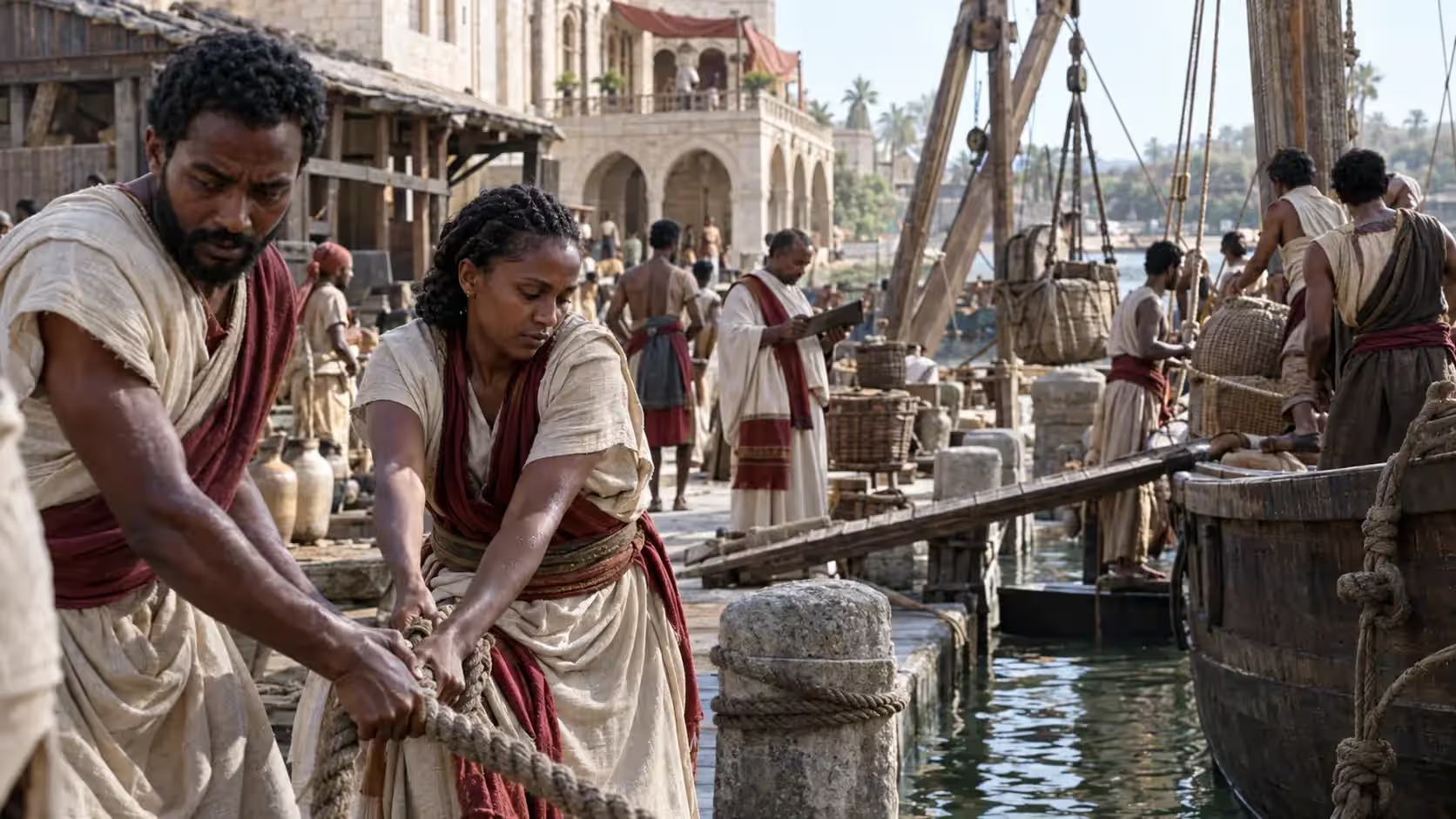
Fortified quays and river towing
Urnok also thinks of itself as a river port. Fortified quays, towpaths, niches for living barges, customs, locks and transhipment stores extend the roads into the river and the canals.
The city as a river port
Urnok lives on a network of rivers and canals shared with Sarnor and Orlantis. Its architecture makes it a port: fortified quays lined with towpaths, niches sheltering the living barges, amphibious hadrosaurs that tow or carry loads, and giant-arched bridges fitted with resting platforms. At the capital’s river port, towing and customs carry the roads on into the cargoes.
Along the water stand the works of living transport: terraced banks, barge docks, river customs posts, secondary canals towards granaries and gardens, locks and weirs to regulate the flow, repair yards working timber, resin and rope, and vast transhipment stores. Two great massive bridges with enormous arches span the river; the Empire’s bridges are designed to carry several beasts of burden at once.
Bridges that come apart
To cross where no bridge yet stands, modular bridges are assembled that can take heavy animals. The chain picks long sauropod bones as beams, lashes them with tendon, waterproofs them with tallow and tar, then turns them into pontoon modules that are hauled and quickly assembled, with timber, rope, canvas, stone and nails.
The Mariners’ Line
On the capital’s great river, transport by living barges belongs to a single trade family, the Mariners’ Line, which has held the monopoly for centuries. Every quay it works serves both as a toll post and as a court: cargo disputes are judged on the spot, before the barge leaves again, by a quay judge sitting under an arcade open to the water.
The Line has its appointed suppliers. Barge carpenters build its flat hulls, floating yokes and the dredges that maintain the low canals; ropemakers deliver its towing cables. A mariners’ line that stops, even for a week, leaves the capital’s granaries without deliveries: the Crown therefore humours its privileges while keeping an eye on its rates.
The living barges
Barge hadrosaurs are amphibious animals trained to pull or carry on the water. Some haul the barges from the bank, along the towpaths; others swim harnessed to light hulls in the secondary canals. Their work has its limits: a hadrosaur that stays too long in the water suffers in its feet and skin, and the quays provide dry niches where the animals rest between two hauls.
These animals are so valuable that their leaving the Empire is regulated. A service licence allows a living barge to be hired out abroad for a season, with its animal and its harness-maker, but return to the Empire is compulsory. An animal that does not come back is the subject of an inquiry, and its hirer loses his licence.
Why fortified quays
The capital’s quays are fortified for several reasons at once. Their terraced banks hold the river during floods; their walls protect the warehouses where the grain and fodder of Sarnor and Orlantis arrive; their customs posts control everything that comes in by water. In war they become embarkation points for the armies and locks on the river, and the Opening of the Rings, the Empire’s last level of mobilisation, counts on them to defend the imperial heart.
The river also brings its own dangers. A flood can close the quays for days; contamination of the water, from a pen or a badly kept tannery, forces the closure of a whole basin and the quarantine of the animals that drank from it. Locks and weirs are then used to isolate the affected part of the network.
A day of towing
The quay’s day begins before dawn, when the towmen harness their animals and the customs officers open their registers. The grain barges arrive first, because the mills and the feeding towers are waiting for them; then come timber, resin and stone, then luxury goods. By noon the transhipment warehouses are full, and hadrosaur-drawn wagons carry the loads up the bank ramps towards the districts.
In the evening the repair yards take over. Hulls are caulked there with wood and resin, worn ropes are changed and animals hurt by a cable or a hull are treated. The quay never empties completely: a night barge loaded with fodder always arrives before feeding time at the towers.