

Creatures
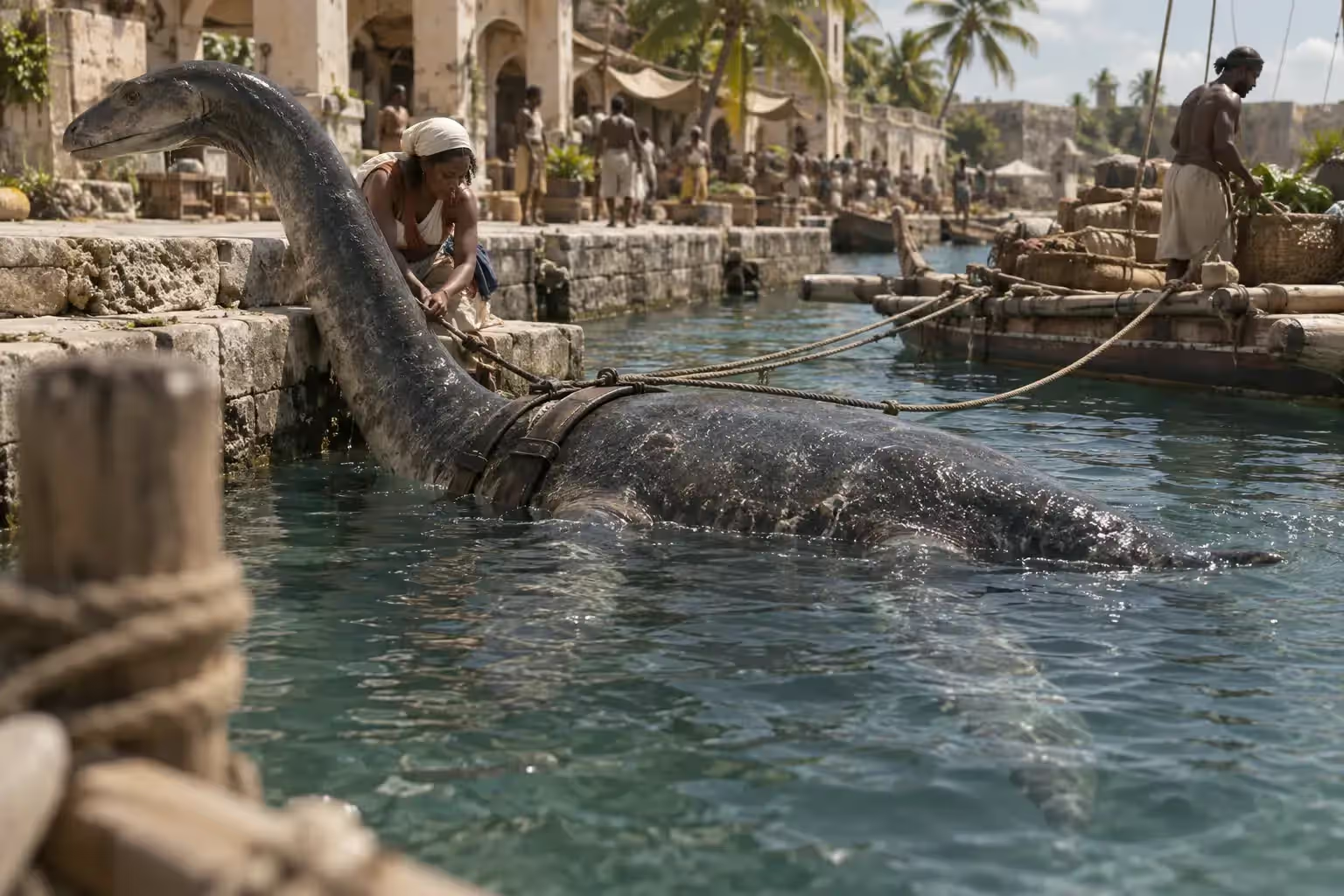
Volonia’s plesiosaurs
Towing, fishing, transport and rescue: a maritime working animal.
The civilisation’s working animal
The plesiosaur tows, builds, fishes, rescues and transports. It also participates in racing and coastal warfare. These uses connect the same animal to port labour, commerce and popular entertainment.
Deux ouvriers hissent sur un quai une lourde pièce apportée par une barge ; un plésiosaure attend derrière.
Around the trunk
Heavy variants carry two platforms near the trunk for archers or light ballistae. Animal use belongs to a system of harnesses, hulls and trades. Productive capacity explains the plesiosaur’s daily importance in maritime society.
A port adapted to living animals
Lagoon terraces separate fresh, brackish and salt water, waste and animal basins. Ramps, high or movable bridges, drained floors and hanging harnesses facilitate service. A working marine reptile depends on this coastal infrastructure as much as on a crew.
How many animals, and where
Volonia has a little over a thousand working plesiosaurs, which is few for a power that owes them so much. The most numerous are the towing animals, more than five hundred, half of them in the basins of Velasar and a good hundred at Port Volon; then come the fishing plesiosaurs, nearly three hundred, almost all at Marévant, then the shipyard animals that serve as floating cranes, and a few dozen war Double-Fins. To these must be added the Voilecous of the lagoons and processions, and the racing flèches-mer.
Every animal counts. A working plesiosaur weighs nearly six tonnes, eats nearly ninety kilos of fish a day and needs years of training; it cannot be replaced in a season. The houses keep their animal registers with the same care as their hull registers, and the loss of a towing team is declared like that of a ship. In wartime the Admiralty draws up the list of available teams before the list of hulls.
A working life
The plesiosaur is born alive, in the water, to a mother who has only one young at a time. The calf swims at once and stays near her for several years, first free in the basin, then tied by a light rope while she works: that is how it learns the harness, the whistles and the rhythm of the relays. The Velasar studs keep the register of every lineage, and a young animal of good lineage sells for more than an average hull.
Real training begins at around three or four years old and lasts several seasons. A towing plesiosaur then works for some twenty years, in rotating teams, with rests of several weeks after each campaign. Ageing animals move to lighter tasks: harbour towing, rescue, stud. In the basins they say a plesiosaur is trained by ear and kept by heart, and many traction masters end their careers with the animal that began theirs.
What an animal leaves behind
When a working plesiosaur dies, its death is declared in the Hand mode before the basin master, then the animal is cut up on the quay, and almost nothing is lost. The skin, tanned with Vaesh salt, becomes the smooth, close sea leather of riding boots, harnesses and bell bellows; the long flipper tendons, elastic and tough in water, go into lines and traces; the rendered blubber gives an oil for quay lamps, winches and harness care; the flipper bones become tool handles, quay shovels and marquetry.
Two objects escape ordinary trade. The team that worked with the animal keeps one of its teeth, often hung in the basin’s common room with the animal’s name carved on it. The stomach stones the plesiosaur swallows as ballast, polished by years of digestion, are gathered from the bottom of the basins and given to sailors as talismans; it is said the sea chose them.
What Volonians think of them
Volonians do not see the plesiosaur as a machine. Children on the quays know the animals of their basin by name, crews greet the teams that tow them into port, and the death of an old towing animal can gather a whole district on the quay. The saying that the mosasaur protects Volonia and the plesiosaur made it possible is repeated in the neighbourhood schools like a history lesson.
Foreigners are often surprised. The boatmen of Urnok, used to barges drawn by hadrosaurs, admire the strength of the teams without understanding the familiarity around them; captains from Ishtir or Korath hire Volonian tugs without seeing anything more than a service. Volonians know what a fleet owes its animals, and gladly remind those who have not seen it. An old harbour joke holds that a captain who does not thank his team will one day end up at the oars.