
Creatures
N’Goro — Le vivant, des soins aux manœuvres
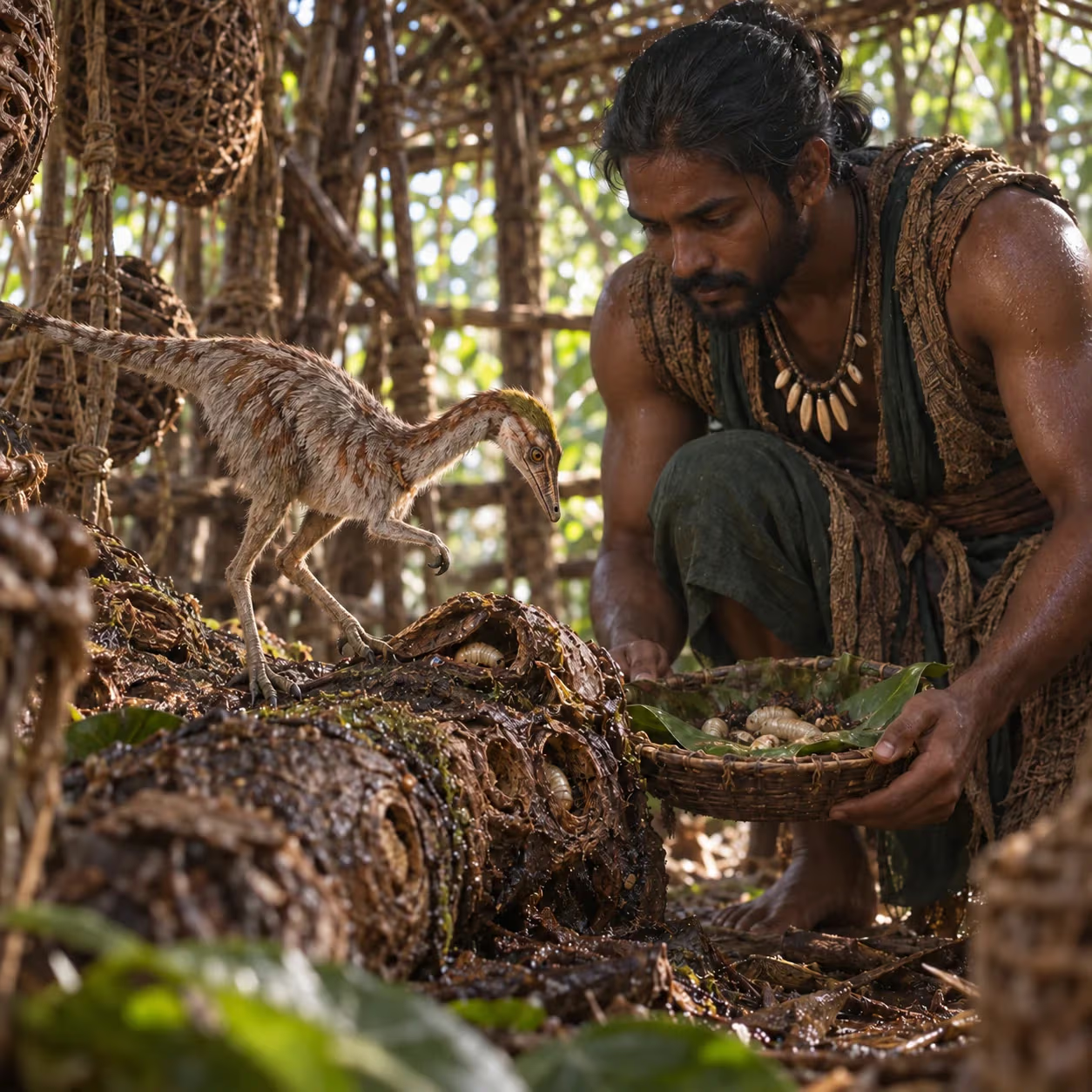
Observer les anatomies, entrer dans les enclos, suivre les équipes de soin puis les retrouver sur le terrain d’exercice : ces scènes rapprochent le bestiaire de la vie des civilisations.
Enclos, soins et circulation
This extended reading is currently available in French.
À N’Goro, les soins doivent rester attentifs au milieu : eau, humidité, passages et matières périssables modifient la manière d’abriter et de déplacer les vivants. Les Sèveurs et les savoirs liés à l’Antirot appartiennent à cette organisation. Les seuils sanitaires avec Volonia rappellent qu’une circulation peut demander un arrêt. Conserver un matériau, préserver un corps et choisir le moment d’un passage sont des opérations liées, mais elles n’ont pas les mêmes responsables.
Observe gestures and materials · 4 images
Sous le ponton des pêcheurs
Mangroves · pêche et nourrissage.
Le canal des longues mâchoires
Canaux de N’Goro · retour des pêcheurs.
L’œil des roselières
Marais extérieurs · observation du vivant.
Le géant qui retourne la vase
Marais sauvages extérieurs · faune libre. Rencontre avec un animal sauvage, qui n’a rien de domestiqué.
Le détail du vivant se découvre dans les gestes ordinaires : un harnais ajusté, un dégagement vérifié, un troupeau orienté.
L’animal au milieu des hommes
L’exercice donne à voir les distances entre formations, les signaux et les zones de rotation. Certains animaux travaillent avec une unité ; la faune sauvage croisée à l’exercice n’en est pas domestiquée pour autant.
Observe gestures and materials · 3 images
Le couloir d’eau
Canaux de N’Goro · interception amphibie et fermeture d’un passage.
Le leurre dans les roseaux
Marais extérieurs · leurre et coordination d’embuscade.
Se replier autour du géant
Marais sauvages extérieurs · exercice de terrain face à un vivant sauvage. Rencontre avec un animal sauvage, qui n’a rien de domestiqué.
N’Goro marshes: coexistence and precaution
Water is not merely a crossing
Marsh waters link food, care, filters and travel. A product, body or animal entering this environment can alter conditions for those who follow. N’Goro practices therefore combine observation, protection and waiting when the context does not permit a safe reading.
N’Goro marshes: coexistence and precaution
Care creates a relationship
The Breath Debt recalls that lifesaving care can create lasting reciprocity. This rule does not turn every assistance into trade or give a carer unlimited power. It makes visible what care leaves behind: memory, an obligation to negotiate and sometimes a bond difficult to leave.
N’Goro waters, thresholds and biosecurity
Each basin has its rules
Water routes are not interchangeable. Their accessibility depends on season, water quality, present species and health risks. Useful mapping notes possible passages and changing limits.
N’Goro waters, thresholds and biosecurity
Closing a route is also care
Quarantines, filters, antidotes and inspections can slow or stop circulation. This protects human and animal bodies but costs families, trade and rescue. Biosecurity is political capacity exercised by practitioners.
N’Goro waters, thresholds and biosecurity
Signals connect care and movement
Networks of roots, vines, markers and messages convey route changes or alerts. Their value comes from maintenance and local interpretation: an isolated signal does not remove the need to test water or observe the living body concerned.
Health opens or closes a route
The Sap-Keepers’ Synod oversees quarantines, antidotes, filters, inspections and protocols. It can close routes. In N’Goro’s waters and forests, this capability directly affects movement: a journey can exist on a map and become unusable for biological reasons. The health function thus becomes a concrete power over the movement of people, goods and animals.
A poison has a counterpart
Poison law requires a name, dose, signature, origin and antidote. A poison sold with a known antidote must have its counter-vial deposited with the Sap-Keepers. This duty connects dangerous material to the possibility of treating its effects. A biological product comes with a history and protection; its circulation involves more than the value of its contents alone.
A filter commits the community
Deliberately modified water must be marked. Hiding contamination is more serious than admitting an error, and lying about a filter is collective betrayal. Health trust therefore rests on information that must accompany products and passages. The Synod’s inspections and protocols operate in this culture where an admitted error still allows a response, while a lie exposes others.
Anti-rot: preserving living material
A use beyond remedies
N’Goro, Orlantis and Volonia produce glues, resins, enzymes, oils and treatments. These products enter bone cements, composite bows, harnesses, boats and preservatives. N’Goro participates in this treatment economy without holding a worldwide monopoly or a single formula.
Anti-rot: preserving living material
A dependency crossing borders
N’Goro anti-rot products, enzymes and glues travel to other civilisations. Their value comes from stabilising organic materials already used elsewhere. Inspections and quarantines condition those passages.
Anti-rot: preserving living material
Treatment does not remove maintenance
Sinew remains exposed to moisture, decay and fatigue; leather depends on treatment and environment. A preservative responds to these limits rather than magically removing them. Its presence in a chain recalls that an object must continue to be observed, maintained and replaced when its condition no longer permits its intended use.
Quarantine and exchanges between N’Goro and Volonia
Biological knowledge must remain linked to control
Materials and knowledge from the marsh require people able to prepare them, check their condition and decide their passage conditions. This expertise is not an abstract commodity: it depends on water, containers, preparation time and the responsibility of those who transmit it.
Quarantine and exchanges between N’Goro and Volonia
Quarantine organises waiting
At Vaesh, a closure or isolation requires separate routes, cleaning, carers, guards and places where cargo can wait without contaminating neighbouring work. The slowdown is a public decision that protects people and animals while affecting dock trades.
Quarantine and exchanges between N’Goro and Volonia
The threshold joins care, control and upkeep
Care, control and upkeep meet at the passage between the two territories. Filters, observation and dock teams decide when movement can resume.
A morning at the beast hall
The hall of beasts and titans at N’Gashu, in the Control Basins, wakes before daybreak. Helpers carry baskets of fish and fern on poles, keepers make the round of the enclosures with their spore lamps, and the trainers on watch note on strips of fibre what each beast has eaten, drunk and passed during the night. Under the great framework of mangrove wood, the hadrosaurs of a foreign caravan wait out their observation in separate stalls, each with its own water; further on, in a pool, a wounded great spinosaurid is being treated under the eye of its team.
What strikes the visitor is the silence and the slowness. No one shouts, no one runs; each beast is approached from the front, with quiet words, and hands and arms are washed in filtered water between one enclosure and the next. The hall’s Sap-Keepers tell their helpers that a beast treated in haste is a beast that will have to be treated twice.
The spinosaurid teams at exercise
In the Foam Marches, the spinosaurid teams exercise at high water, when the channels are wide. The exercise resembles no cavalry manoeuvre: no beast advances in line and no trainer gives an order. The teams lay scents and rations on the water, beat on their hulls in rhythm, and watch how their Siirmuu converge on the same arm of the estuary, each by its own path. The pass captains, in their pirogues, note how long it took and which beasts refused.
These exercises prepare the Foam March, the rare mobilisation in which the great spinosaurids of a whole estuary converge on an enemy already weakened. The beasts are never made to fight one another or a mock opponent: it is only checked that they come, and then that each goes back to its quay.