
Creatures
Ceratopsians
Frilled, horned dinosaurs, Ishtir’s signature: herds, ceremonies, frontal charges and certified careers.
Ishtir’s signature
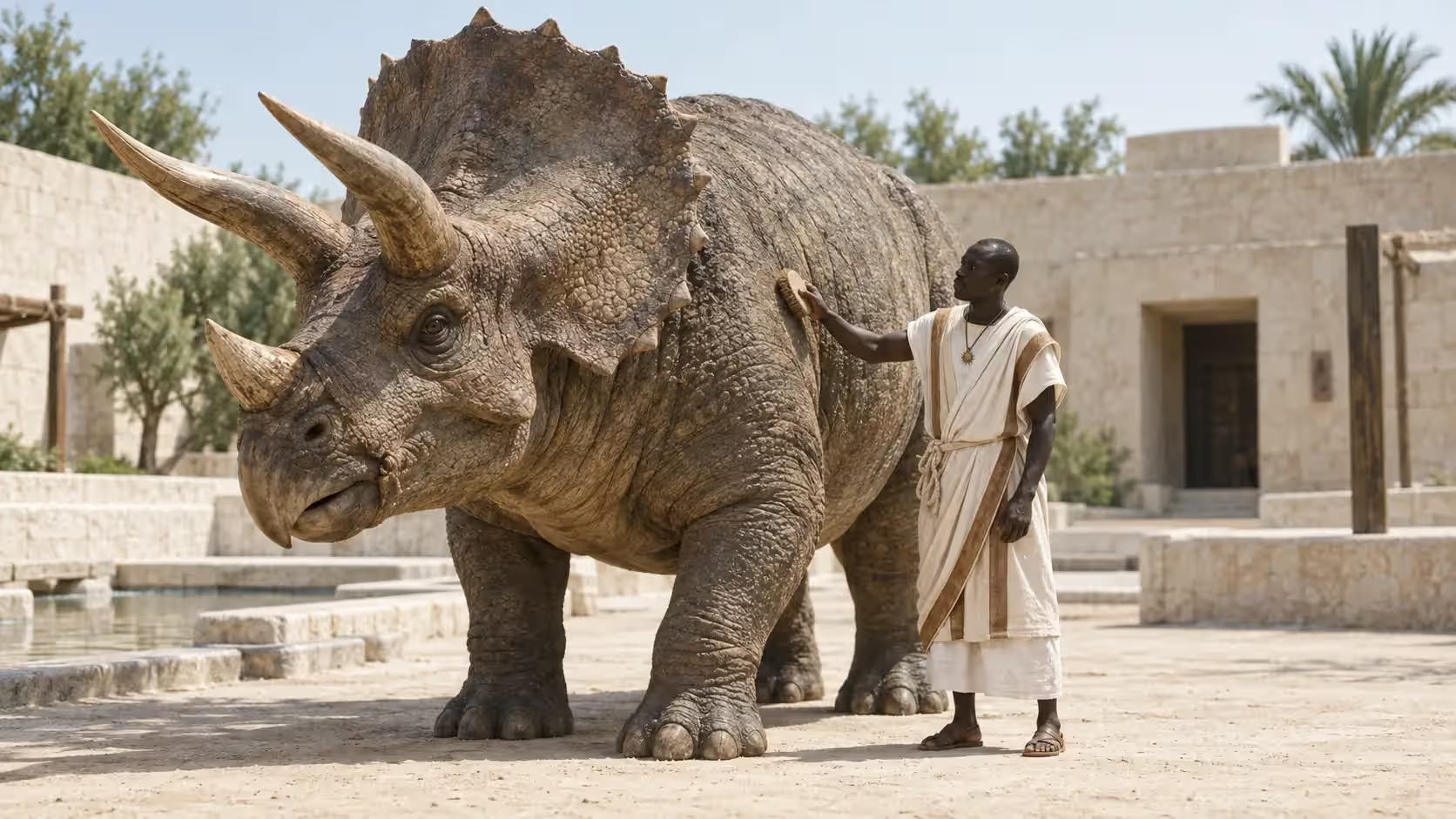
Ceratopsians are part of Ishtir’s public signature; Triceratops and Pachyrhinosaurus are its great lineages. They have an agricultural, civic, religious and military place: their horns, sheathed in gold, serve for defence, frontal charges and prestige. A consecrated animal remains a living creature, with its needs, reactions and limits. The sacred ceratopsians are not among Ishtir’s hundred and twenty great living animals, which are pteranodons.
Herds need clean water, pastures, rotation circuits, pens, care teams and roads that leave the horns room to turn. The Plaines des Brontes organise pasture, fodder crops, water, shelters and herd watch.
A ceratopsian career
The Silver rank brings together command, certification, ceratops and pterosaurs. A Bronze can certify, one after another, ceratopsian care, herd behaviour, riding, the mounted lance, group manoeuvre, fodder logistics, tactics, command and work with a sacred lineage; this record can open the way to Silver at a Weighing. Courage alone is not what is judged: one must read fatigue, adjust a harness, prevent panic and stop an action that has become dangerous. The Silver Horns concentrate ground tactics and riding certification.
The charge
The Silver Horns’ doctrine uses the ceratops’ frontal force without mistaking it for invulnerability. A charge needs readable ground, protected flanks, understood signals, a way to withdraw and teams able to recover the wounded afterwards.
Beyond Ishtir
Urnok imports ceratopsians from Ishtir for controlled imperial uses, together with the workers and trainers who come with them. Licences, transport clauses and lineage rights govern the transfer: breeding does not become free because an animal has crossed the border.
The lines of Ishtir
Ishtir tells its ceratopsians apart by lineage and by use. The Sha-Qerim, a sacred Triceratops with gilded horns and white-and-gold tack, is the country’s military heart: solar wall, battle and procession, but also ritual draught and heavy farming, in the Plaines des Brontes. The Aru-Qerim, a styracosaur with a great spiked frill, holds the mobile guard and the flanks, from the Plaines des Brontes to the Marche de Keryth. The Hel-Qerim, with an immense gilded frill, is reserved for high processions and the great rites of the Jardin du Levant.
Other lines carry daily life. The monoclonius of the Terrasses d’Auréon, with small multiple horns, defends the orchards and pulls farm loads; the parade chasmosaur of the Jardin du Levant marches and guards ceremonies; the school leptoceratops serves classes and small convoys; the anti-raptor ceratops of the Marche de Keryth, horns lowered in a tight line, guards the roads against Arkhan’s cavalry. Outside Ishtir a ceratopsian is not sacred at all: in Urnok, imported convoy ceratops are mere tools for defending the roads.
A ceratopsian’s body
Ceratopsians are herbivorous dinosaurs with a horny beak and a frill. Their beak, toothless at the front, slices through the toughest stems and fronds; behind it, rows of tightly packed teeth, constantly replaced, grind fibre like a millstone. The frill, a broad plate of bone extending the skull backwards, protects the neck, serves for display and in some lines flushes red when the animal grows heated.
The horns are bone covered with a horny casing that grows all its life; Ishtir’s gold sheaths are fitted over this casing, never over the bone. The skin is thick and covered in scales, larger on the back. Sizes vary a great deal: a school leptoceratops is barely more than two metres long and weighs as much as a man and a half, a qerik less than two hundred kilos, while an adult triceratops is nearly nine metres long and weighs about seven tonnes.
From nest to herd
Ceratopsians lay eggs. The female digs a nest in sand or loose earth, lays her eggs in a ring, six to twelve for a triceratops, each of more than four kilos, then covers them and stands guard. Incubation lasts about six months in the great lines, much less in the small ones; the qerik lays large clutches several times a year, which also makes it an egg animal.
The young leave the egg with a tiny frill and horns reduced to bumps. They follow the herd at once, which keeps them in the middle, and grow for years: a triceratops is adult at seven or eight and lives some twenty years, sometimes close to thirty. Its horns change shape with age, and a good herd chief can tell an animal’s age from their curve alone.
Temperament and herd life
The ceratopsian is a herd animal. When threatened, a herd draws into a ring, young in the middle, adults facing outwards, horns lowered; it is from this natural defence that Ishtir drew its lines and wedges. Among themselves, males size each other up by showing their frills, shaking their heads and then, if need be, locking horns, and laying seasons are seasons of jostling.
These animals are patient and stubborn, slow to be roused and slow to stop. They remember people, their voices and their gait, and long remember ill treatment. What frightens them most is what they do not understand: a shadow moving sideways, a cloth that snaps, a noise from behind. Training does not remove this fear; it teaches the animal to wait for a signal before giving in to it.
An ancient domestication
Ishtir’s tales trace the alliance with ceratopsians back to the country’s first centuries, when the communities that came out of the Exodus of the Broken Sun settled on plains where wild herds grazed. The small ones were tamed first, qerik and leptoceratops, for ploughing and eggs; it took generations to approach the great ones, and longer still to ride a triceratops. The temples say the first gold-sheathed horn belonged to an animal that had defended a village against a raid, and that it was gilded to honour it.
Wild ceratopsians still live far from the borders, in the steppes and plains no power claims. Their herds are shy and dangerous, and Ishtir’s breeders have taken nothing from them for a long time: every line in the country was born in its pens and entered in its registers.
Part of this article covers events of season 1. Turn spoilers on in the menu to read it.