

Places and landscapes
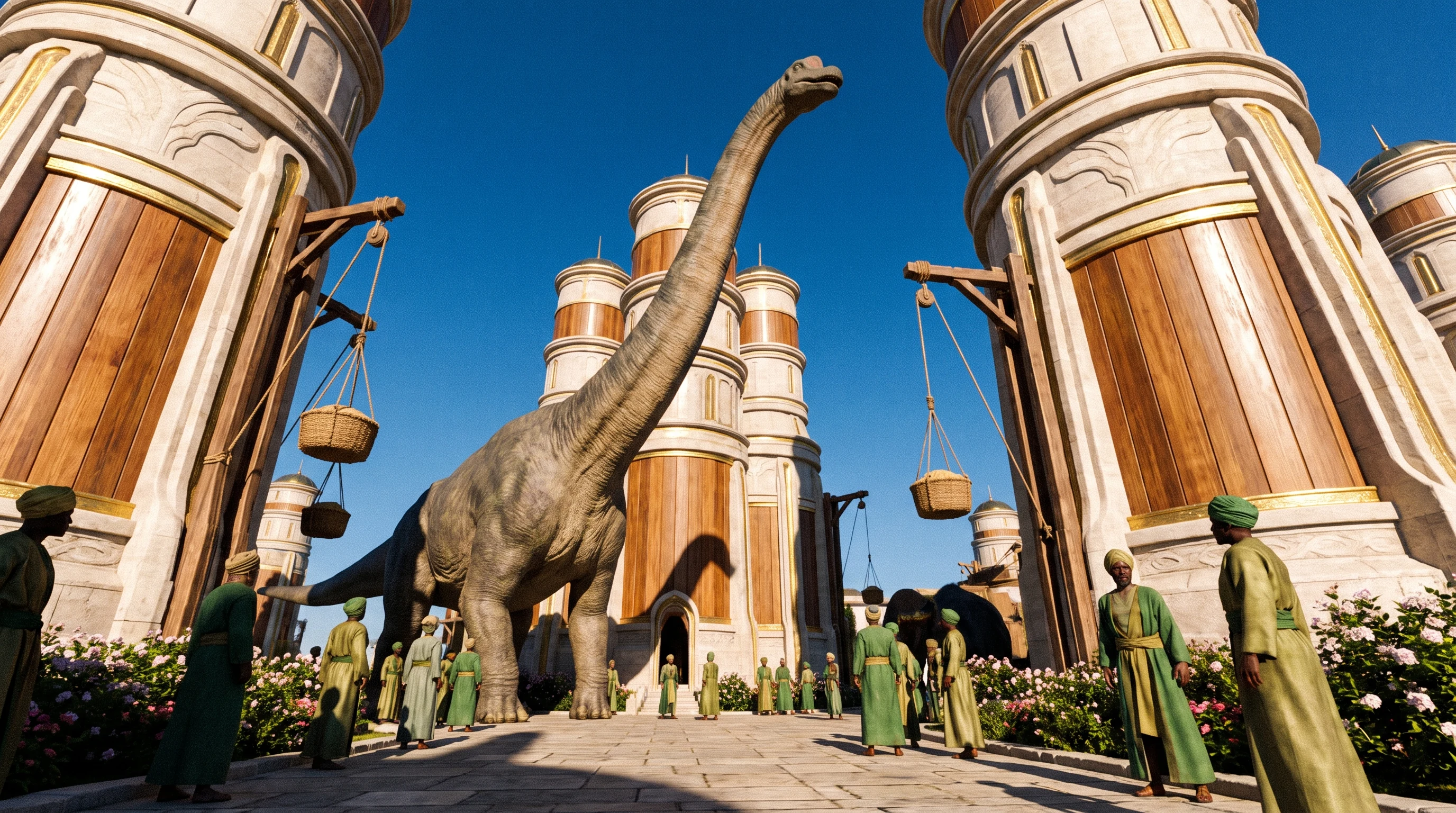
Fodder stations and fodder cathedrals
In Urnok, true greatness lies not in the palace but in the fodder chain. A belt of low stores, terraced granaries, inner docks where sauropods line up and ceremonial squares: the fodder station is at once depot, market and place of public accounts.
A storage belt
A capital that feeds its people and its colossi draws its power from granaries more than from the palace. Around it runs a storage belt: a ring of low stores, terraced granaries and ramps for carts. Large-scale storage demands control of temperature, humidity and airflow to avoid condensation and mould; ventilation therefore becomes sculpture, with slotted air towers, floor ducts and vents facing the wind.
These buildings are low cathedrals, given rhythm by buttresses, vents and shadows. Their scale speaks of the great city, and controlling food amounts to controlling the city.
Docks for the colossi
Fodder stations receive convoys at inner docks: on their platforms, sauropods line up to unload like ships at a quay. Fermentation workshops prepare the animals’ food there — hay, pulp, fibre cakes. Preservation follows a fixed chain: building the granaries, anti-mould treatment, controlled fermentation, rationing, taxes. Lime, timber, leather, ceramics, salt, tallow and ferments are used there, and bile serves for degreasing.
The fodder organ
A whole style, the fodder organ, makes storage the heart of the city. Granaries there form a forest of tubes: some low and lying horizontally, others standing like organ pipes. Each fodder station becomes a ceremonial square, mixing market, songs and public accounting; water runs in monumental gutters, visible like the staves of a score on the ground.
The organ silos
The name of fodder organ does not come only from the shape of the silos. During fermentation, the vertical silos in which fern is ensiled resonate, and a full fodder station gives out a dull rumble the inhabitants recognise. Silage is made there in several grades, common, road or Crown, according to the quality of the fern and the care taken over fermentation; the grade decides how fast the convoy that eats it will march.
The companies that build and run these silos treat the walls against mould, control fermentation and organise rationing. Their masters of ferments are sought after by every station in the Empire, and in the stewardships it is said that a good master of ferments is worth a legion.
How much a convoy eats
A fodder station’s accounts are dizzying. A draught hadrosaur eats about a hundred and twenty-five kilos of fodder a day, a silo camarasaur five hundred, a brachiosaur nearly a tonne, a Dreadnoughtus of the Silos more still. A convoy of twenty hadrosaurs thus consumes two and a half tonnes of fodder a day, and an army that takes colossi with it must have mountains of fodder follow it, or find them ready along its road.
The stations’ kitchens prepare this fodder into rations: there the high-tower mix for the colossi, the towing ration for the barge animals and the tithe fodder for the Empire’s reserves are chopped, mixed and pressed. Pressed cakes travel better than loose fern and are easier to count.
The smouldering fire
Stacked fodder heats up. A poorly dried heap ferments, its temperature rises, and it can catch fire by itself several days after being brought in. Fodder stations therefore employ probers who drive long rods into the heaps and silos every day, then pull them out to judge the heat by hand. A heap that is too hot is opened, spread and cooled before it catches fire.
Work inside the silos has its own dangers. The air becomes unbreathable during fermentation, and no one goes down without a rope, a test lamp and a lookout left at the top. Accidents are entered in the station’s register, and the line that holds the silo answers for the men it sends down.
The public accounts
Once a week, on the station’s ceremonial square, a scribe reads aloud the state of the reserves: tonnes received, tonnes delivered, tonnes in silo, grade by grade. The fodder tithe delivered in kind is declared there, after being weighed and sealed by the Fodder-Counters. The crowd listens closely to these figures: in an empire born of a famine, knowing what the granaries hold is more reassuring than a promise.
The figures read out are then posted on tablets on the station’s pediment, and grain merchants and Bank agents alike copy them down. A station that announces falling figures three weeks running drives up the price of a bale across the whole district; a station that stops reading its accounts is more worrying still.