

Institutions
Urnok : le registre du vivant
À Urnok, une responsabilité civile commence par un statut lisible : ce qui naît, circule, travaille ou se consacre ne relève pas de la même décision.
Nommer l’usage avant de décider
Le droit distingue la semence, la table, la matière technique et le rituel. Cette distinction permet de savoir si un œuf doit être élevé, consommé, récupéré ou confié à une fonction consacrée. Le registre ne remplace ni le soin ni l’observation de l’animal : il rend visible la responsabilité qui accompagne une lignée et évite de traiter tout vivant comme une ressource identique.
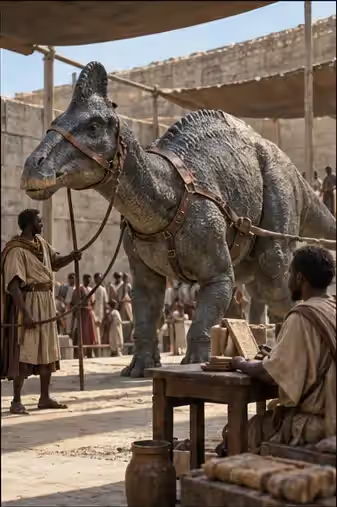
Registre relié sur une table
Vue de détail.
Une licence engage une chaîne
La naissance des grands vivants stratégiques relève des grandes Maisons homologuées par l’État. L’autorisation engage la reproduction de la lignée, le soin et le travail futur de l’animal. L’éleveur et les responsables inscrits doivent répondre d’une fraude ou d’un accident ; le franchissement d’une frontière ne rend pas la reproduction libre.
La fraude porte sur une destination
Un faux statut peut détourner un œuf de son usage réel ou vendre une promesse qui n’existe pas. Le droit donne donc un poids public à la trace écrite et à la destination du vivant. Cette logique éclaire les contrôles et les litiges sans réduire toute justice urnokienne à l’élevage, ni transformer chaque faute en affaire impériale.
Declaring a birth
The birth of a working animal is declared like that of a child. When a draught hadrosaur or an iguanodon hatches on a farm, its keeper must have it entered in the register before the following season: species, lineage, date of hatching, the name given to the animal, the keeper’s name. In the countryside it is often the travelling registrars who come by to collect these declarations along with those of human births.
The animal then receives its mark. Young animals wear an engraved leather collar; adults a bronze token fixed to the harness and stamped with the register number, which can be compared with the registry’s entries. Small farmyard livestock, raised for laying and meat, are not registered head by head: the flock is declared, not each animal.
Selling, lending, bequeathing
The register follows the animal. A sale, a long-term loan, a dowry or an inheritance must be entered to take effect; as long as the transfer is not written into the register, the previous keeper remains responsible for the animal. This rule follows from the principle that organises all Urnokian law on living beings: it must always be known who answers when the living destroy.
In practice the rule protects as much as it binds. A buyer who has had his animal registered can prove ownership against a thief or an heir who claims it; a careful seller has the sale registered the same day, so as not to pay for the damage of an animal no longer his. Animal markets therefore all have a registrar, and no important sale is concluded without passing by his table.
When an animal causes damage
A hadrosaur that smashes a fence, an iguanodon that injures a passer-by, a convoy that crushes a crop: every piece of damage caused by a living animal has someone responsible, and the register says who. The registered keeper answers for the animals he keeps; the convoy chief for those he drives; the Line for the animals it hires out with their handlers. The local judge sets the redress, often in kind: a season of the animal’s work in the victim’s service.
Very large animals are a case apart. Military titans legally belong to the Crown, even when they serve in a duchy or an order. When one of them, on duty, knocks down a wall or ravages a field, the Crown answers for it. The victim lodges a claim at the nearest relay, which passes it on to the High Chancellery of the Living Roads; compensation often takes months to come, but it comes.
The death of an animal
The death of a registered animal must also be declared. The keeper gives the date and cause, and the registrar closes the animal’s line in the register. The carcass has value: the hide, tendons, bones and fat go to the knackers, tanners and workshops, and their sale goes to the keeper, after deduction of what is owed in tax.
For military very large animals the rule is different: the carcass, materials, equipment and study rights revert to the Crown, and specialised crews come to recover them. A registered animal that vanishes without a declaration of death always arouses suspicion, that of a sale off the register, or even of a clandestine departure from the Empire. The inspectors then start by looking for the hide.