
Places and landscapes
The Marais Lumineux
A wetland of walkways, filters and channels where every water follows its own circuit; during the Respiration, its nights of lanterns and small boats draw night owls.
A maintained wetland
The Marais Lumineux are a wetland where walkways, filters and water circuits must be maintained without mixing drinking water, irrigation, washing and drainage. Like the Marche de Keryth, they show that water and borders require local rules: a marsh dyke has neither the materials nor the risks of a terrace road.
Passage there also depends on the state of the ground and on the teams’ ability to maintain the thresholds. The Canaux Clairs maintain sluices, filters, jars, bridges and measuring instruments.
Water gardens and channels
The region is a land of water gardens and sacred waterways: its wet gardens and canals are devoted to water regulation, wet farming and communication by channel.
The regional form of the canal towns — wooden sluices, bronze pins, measuring poles, filtering baskets, bridges and jars — suits these wet margins without serving as a model for all of Ishtir.
Marsh nights
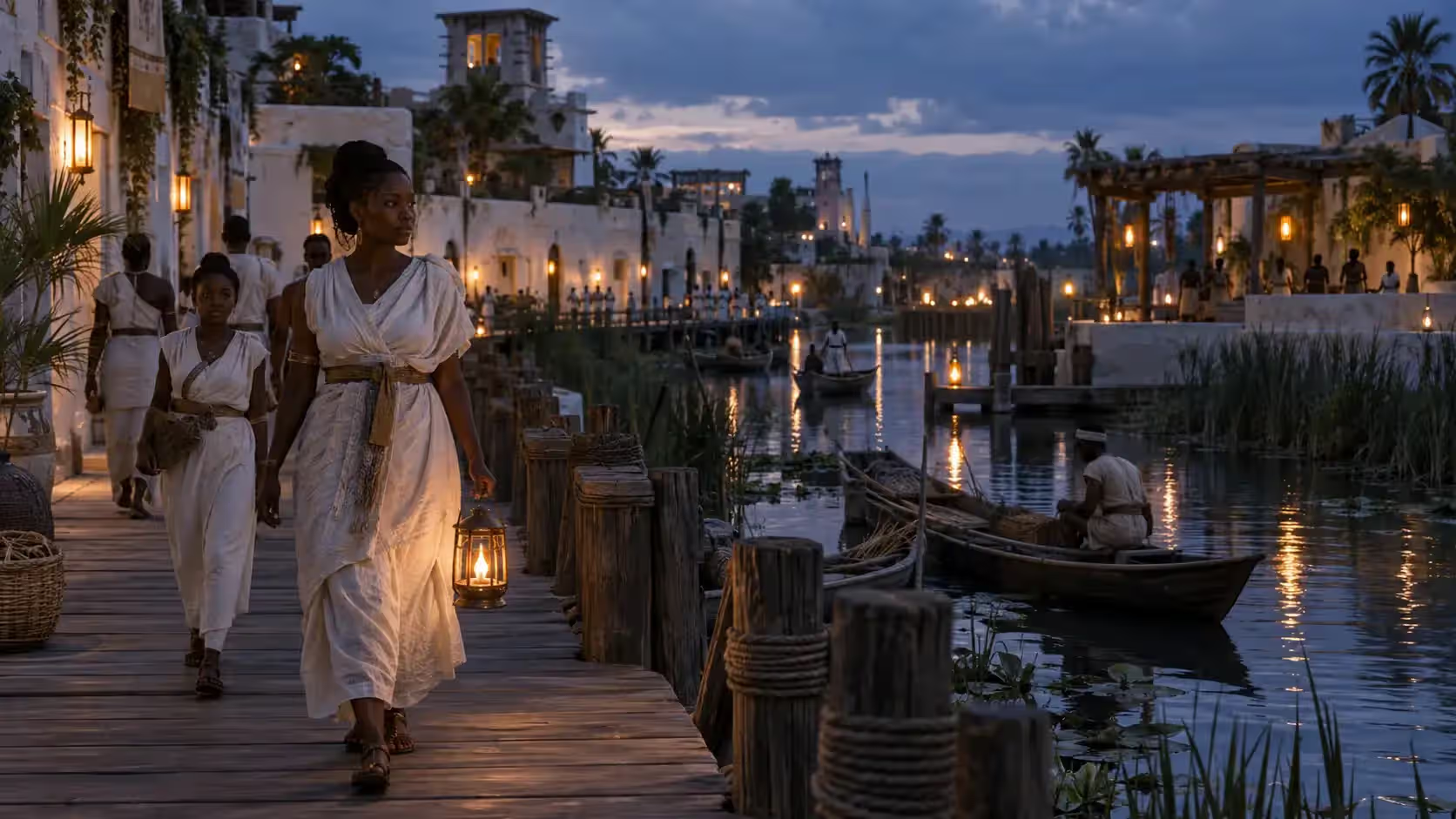
During the Respiration, the Marais Lumineux are the region of nights: lanterns, small boats, soft music that grows less soft as the night goes on. People go out on boat trips there. Whether bioluminescence plays any part remains uncertain.
Places and place names
The Voies Fluviales Luminescentes are among the region’s named places.
Lumis and Port-Lotus
The region’s main town is Lumis, built on a levee between several lakes and a maze of channels. Next to it, Port-Lotus houses the seat of the order of the Canaux Clairs: water keepers from all over the country are trained there, and the great sluices that set the level of the rice fields are kept there. Houses stand on mounds or on wooden platforms linked by walkways, and every quarter has its landing stage as elsewhere one has a square.
Beyond Lumis the country alternates between marsh, wet meadows, woods and small jungles, as far as the coast of the Corridor of Winds. The Luminescent River Ways, the main channels, serve at once as roads, irrigation canals and sacred axes: marsh processions are made by boat.
Rice, lotus and reeds
The marsh feeds people differently from the plains. The rice fields of the Canaux Clairs yield rice, the water gardens yield solar lotus, whose rhizomes and seeds are eaten and whose flowers go to the temples; the higher ground yields tubers and a few orchards. Reeds, cut in the dry season, are woven by the White Hands into cloth, sacks, mats and ropes: a good share of Ishtir’s sacks and coarse cloth comes from here.
Carrying is done by water. Hardy hadrosaurs, a draught line bought from Urnok, tow the boats along the channels and carry the loads on the quays; they are fed on horsetails and sluice algae. The great ceratopsians rarely venture here: their feet sink into the soft ground, and no one walks an animal of several tonnes across a marsh dyke.
Marsh medicine
Stagnant water brings its fevers, and the marsh has learned to heal itself. Its gardens of simples supply balms, eye salves and antidotes; its collective baths, run by the Canaux Clairs, are fed with water that is filtered and renewed every day. Many of Ishtir’s basic healers serve their apprenticeship here: they learn to recognise a marsh fever, to drain an infected wound, to apply an algae poultice.
Care boats make the round of isolated hamlets, with a healer, a store of remedies and a jar of quarantine water. Contagious patients are housed on separate islets, linked to the rest by a single walkway that can be removed; sick animals have their own islets, further away still.
Why “Luminous”
The people of the country give two reasons for their region’s name. The first is dawn: when the sun rises over the flooded rice fields, leagues of water mirrors throw back its light, and the whole marsh seems to light up before the dry lands. The second is the night of lanterns: boats travelling after sunset have always carried a lantern at the bow, and the great channels then look like rivers of fire.
The festival of nights during the Breathing comes from this habit. Quarters compete with painted lanterns, boats follow one another in slow processions, and young people from the other regions come to spend nights there that they talk about for years afterwards.
Living on the channels
In the marsh, people learn to swim before they learn to read. The children’s cohorts have their own learning pools, and every eight-year-old can pole a boat. Daily journeys are made in light boats of reed or wood, and the educators count their pupils at every embarkation.
The rules of water are stricter here than elsewhere, because everything flows into everything. Nothing is washed in a drinking channel, no animal is taken to drink in an irrigation canal, and waste water follows separate ditches to the settling basins. The marsh water keepers have the reputation of being the strictest in the country, and the most in demand.