

Places and landscapes
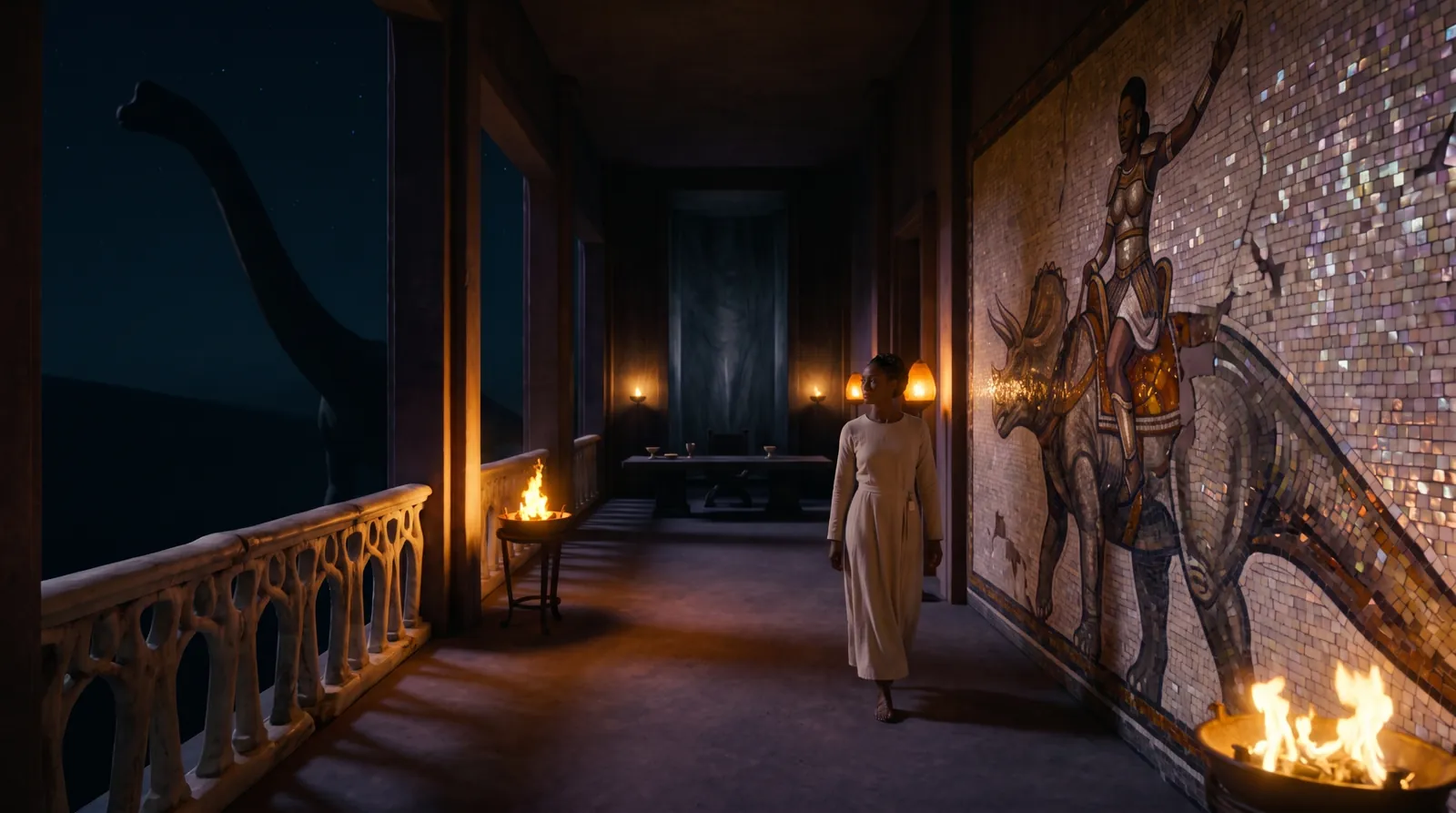
The Vael-Orûn palace
Home of the imperial family in Urnok, the Vael-Orûn palace is also a workplace: council chambers, upper rooms and rooms taken over by maps and registers. The great animals stay outside it.
A working palace
The imperial family’s palace is first a centre of decision. In Empress Marjory’s wing, ceremonial rooms have been taken over over the years by maps, calendars, service accesses and working objects. Quiet corridors and heavy doors serve small working rooms there.
Une salle de conseil placée autour d’un œuf consacré.
Une salle de conseil placée autour d’un œuf consacré.
The great animals have outside accesses and never enter the private corridors. Family, physicians, scribes and unobtrusive guards live there amid an invisible cost: staff, heat, food and information.
The Council chamber
The Council chamber places a consecrated egg at its centre. Two statues of sauropods with coiled necks cradle eggs; gilded frescoes show titans and nests, and a ring of gold is set into the floor. Bronze doors with panels bearing a procession of titans close it. The palace also has an upper chamber of pale basalt, separate from the Council chamber, where the emperor receives in private.
Une matriarche du Conseil devant l'œuf de la salle.
Une matriarche du Conseil devant l'œuf de la salle.
Ramps and terraces
The palace occupies the heights of the capital, above the avenues and next to the archives. One goes up by ramps rather than stairs, because the great animals of the imperial family must be able to reach it: in Urnok, power receives the great animals long before their riders. The ramps of Nahara lead to a high boarding terrace, from which the heir’s diplodocus takes up its rider.
The terraces open onto the roofs of the capital and, on clear days, onto the first hills of the duchy. Brachiosaurs sometimes browse there at the height of the balustrades, watched by their handlers, and courtiers stroll among the colossi as elsewhere among statues. The privilege of the ramp, the right to use a given ramp at a given hour, is among the most sought-after favours at court.
The gallery and the high chamber
A long imperial gallery leads from the apartments to the Council hall. Its walls carry a fresco of bone and mother-of-pearl depicting the great animals of the Empire, and the floor rings enough for the guards to hear every visitor coming. The high chamber of pale basalt, where the emperor receives in private, is lit by an oculus; a round table fills its centre, covered with maps, beast tokens and seals.
This table says something about the way of governing. People work standing up around the maps, and no one sits at its head. The tokens stand for the great animals, the convoys and the reserves, and they are moved about to estimate what an order will cost before it is given.
The household
The palace houses several hundred people: the imperial family and those close to it, physicians, the Council’s scribes and secretaries, the governesses and maidservants of the wings, cooks and water carriers, animal handlers and the guard. The guard belongs to the Imperial Order of Orûs, a heavy guard distinct from the Order of the Diplodocus, whose soldiers show themselves little and keep to the doors.
Protocol falls to House Calaris, which manages audiences, precedence and the court seals. An audience is requested in writing and granted in writing; one enters by one door and leaves by another, along a fixed route. This ceremonial has a cost, in staff, heat, food and information, which the palace stewards count as carefully as the reserves of a silo.
The titans’ stables
The great animals have outside entrances and stables of their own at the foot of the terraces. The imperial titan stables are immense halls opening onto manoeuvring yards, where the Crown’s colossi live between two services. The largest of them, Azhor the Ash-Bearer, the imperial ultrasaur, has its own yard and appointed handlers there.
On feast days the stables give the palace its living décor. Nobles received at court cross yards where caparisoned hadrosaurs parade, musicians play on the terraces, and some guests arrive with their companion hadrosaur, a small adorned animal walked about as a mark of rank. The stables have their own fodder kitchens, basins and infirmary, and they alone employ more people than many districts.
The palace and the city
The palace is not cut off from the capital. It receives the first branch of the aqueducts after the High Cistern, its kitchens buy from the same market halls as the upper town, and its stewards keep a grain reserve of its own, opened to the neighbouring districts in years of dearth. On certain days a lower courtyard of the palace receives petitioners of every condition, who come to present their requests before the Crown’s scribes.
Seen from below, the palace is recognised mostly by its ramps and terraces, where the silhouette of a colossus is sometimes glimpsed. People in the lower town say that one knows the emperor is in residence when the terraces stay lit late into the night.
Part of this article covers events of season 1. Turn spoilers on in the menu to read it.
Gallery7 images
Sahina enters the Council chamber. Sahina and her attendants in the imperial gallery. A servant of the imperial wing. Emperor Orûs III, never fully lit. The imperial gallery at night. Sahina Vael-Orûn standing at the head of the council table.