
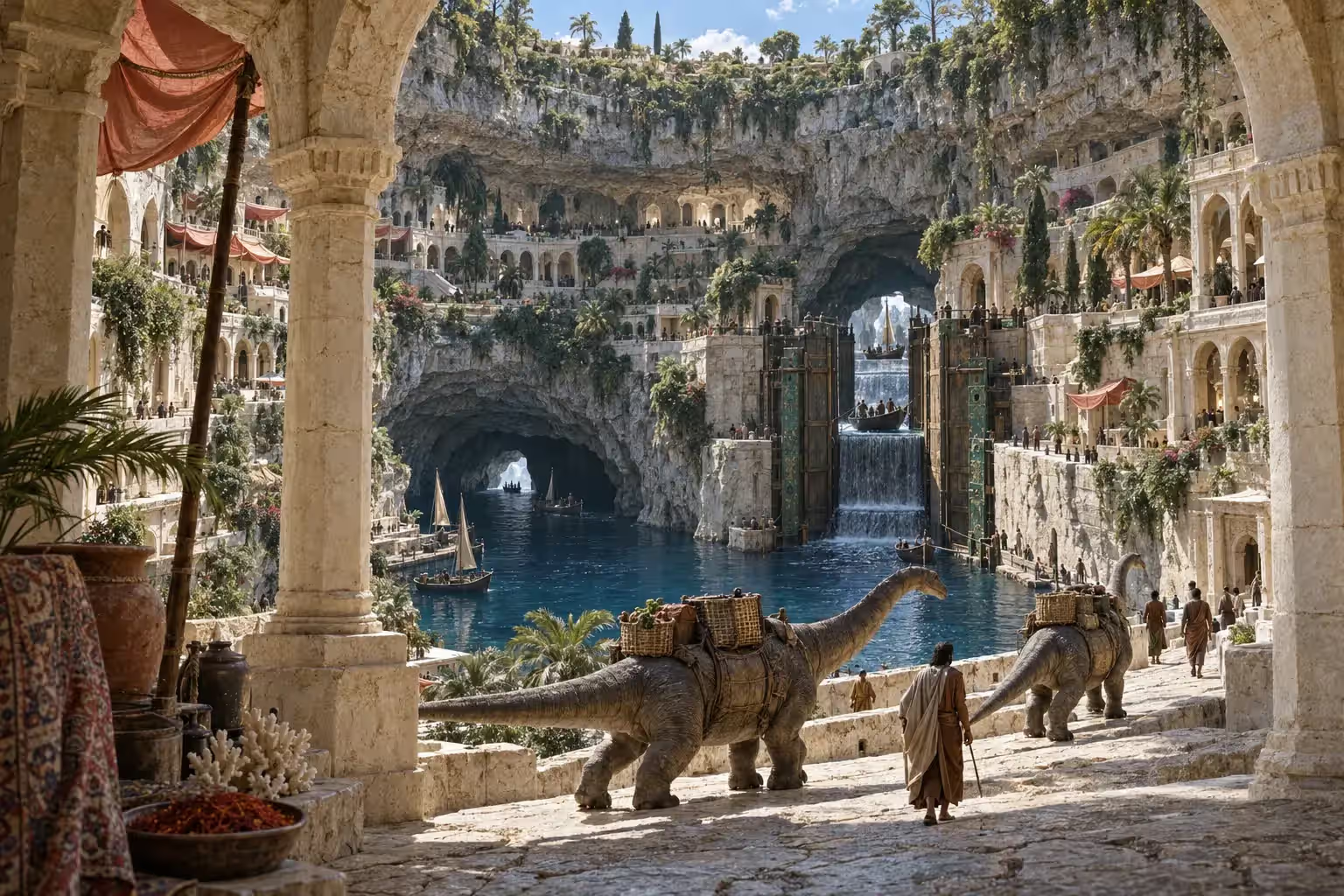
Magyarosaurus
The dwarf titanosaur of the League of the Stone Gates: a titan scaled to its island.
A titan the size of the island
The magyarosaur is a dwarf island titanosaur. It keeps the outline of a four-legged sauropod — small skull, long neck, load-bearing body, long tail — and differs from Urnok’s giants only in scale.
It carries loads, accompanies processions and uses the wide ramps of the chasm cities. It does not swim at the bottom of the harbours and is no substitute for the Volonian mosasaur.
The right volume
Island life makes adaptation a central idea: an animal must be feedable, a ship must pass through a Gate, a building must respect its rock face. The little titan embodies this relation to size — using only the size the environment can bear. Ramps, loads and food reserves are organised around its needs.
The little titan’s body
The magyarosaur weighs little more than two and a half tonnes when adult and measures six to eight metres from snout to tail tip: an animal a standing man can look in the eye while barely raising his head. It is adult at about six years and lives from thirty-five to fifty; its eggs, four to eight to a clutch, incubate for nearly seven months. Calm and sure-footed, it climbs without flinching ramps that a heavier animal would refuse, and the cities’ ramps never exceed the slope it accepts.
It eats about a hundred and seventeen kilos of fodder a day, a modest ration for a sauropod and a decisive one on an island with no great plains. Its skin is thick and greyish, mottled with pale patches in the young; its short, broad legs spread its weight over the slabs. Its breeders say it never needs hurrying, and that no one should ever try.
The Rampers of the Little Titan
The magyarosaur belongs to the League, but it is the Rampers of the Little Titan who breed it. This cooperative of breeders and guides keeps the breeding ramps, incubates the eggs, trains the young and hires the animals out by the day, with their guide, to anyone who must haul a load or lead a procession up the ramps of the chasm cities; a day costs seven to eight Dracos. The whole League numbers only about a hundred and sixty of them, and each is known by name.
Feeding them is a matter of organisation. Doline hay, made of grasses and ferns mown at the bottom of the irrigated dolines, is pressed with sluice algae and salt into ramp cakes, stored along the ramps at regular intervals, as elsewhere water is stored. A magyarosaur climbing from the sea to the upper terraces thus finds its ration at every landing.
At the water gates
The little titan does not only carry loads: it drives part of the works that make the League rich. At the great water gates, which open or close the sea’s access to the inner basins, magyarosaurs turn the winches that work the chains and counterweights. Along the quays and in the locks, others haul the flat-bottomed lighters that carry stone, lime and grain from one basin to another.
This work calls for an animal that does not panic amid the roar of water and the grinding of chains. The Rampers choose the calmest of their animals for the gates and accustom them to it from an early age; some spend their whole lives there. Foreign sailors who pass through a Gate like to tell how they were hoisted into the inner ocean by a sauropod barely larger than a hadrosaur.
No egg leaves
The League holds to its little titan as the Empire does to its colossi. No magyarosaur egg leaves the island without the Gates’ consent, and adult animals are not sold: they are hired out, with their guide, and come home in the evening. Every egg is declared when laid and followed until it hatches, every young one entered in the Rampers’ register. The rare foreigners who have tried to carry one off in the bottom of a hold have learned that the Gates close to keep things in as well.
The rule is not merely a matter of wealth. The League’s philosophers see a lesson in it: an animal made for an island has no business elsewhere, and tearing it from its ramps would mean making it live beyond its measure. The League’s merchants, more simply, know that an animal found only at home draws visitors.
What people say
Visitors from Urnok often smile on first seeing a magyarosaur: used to the colossi of the Grandes Sauriales, they talk of a titan in miniature, a sauropod for children. The people of the League take no offence and answer with a proverb from the quays: a titan that gets through the gate is worth more than a titan left outside.
In the chasm cities the animal is part of public life. Children follow it up the ramps, processions put it at their head, and the porticoes where measure and threshold are debated have taken it as their image: that of a greatness that accepts the size of its world. A reasonable man is said to have the little titan’s pace, and an ambitious one to want ramps made to his size rather than a size made to the measure of the ramps.