

Economy
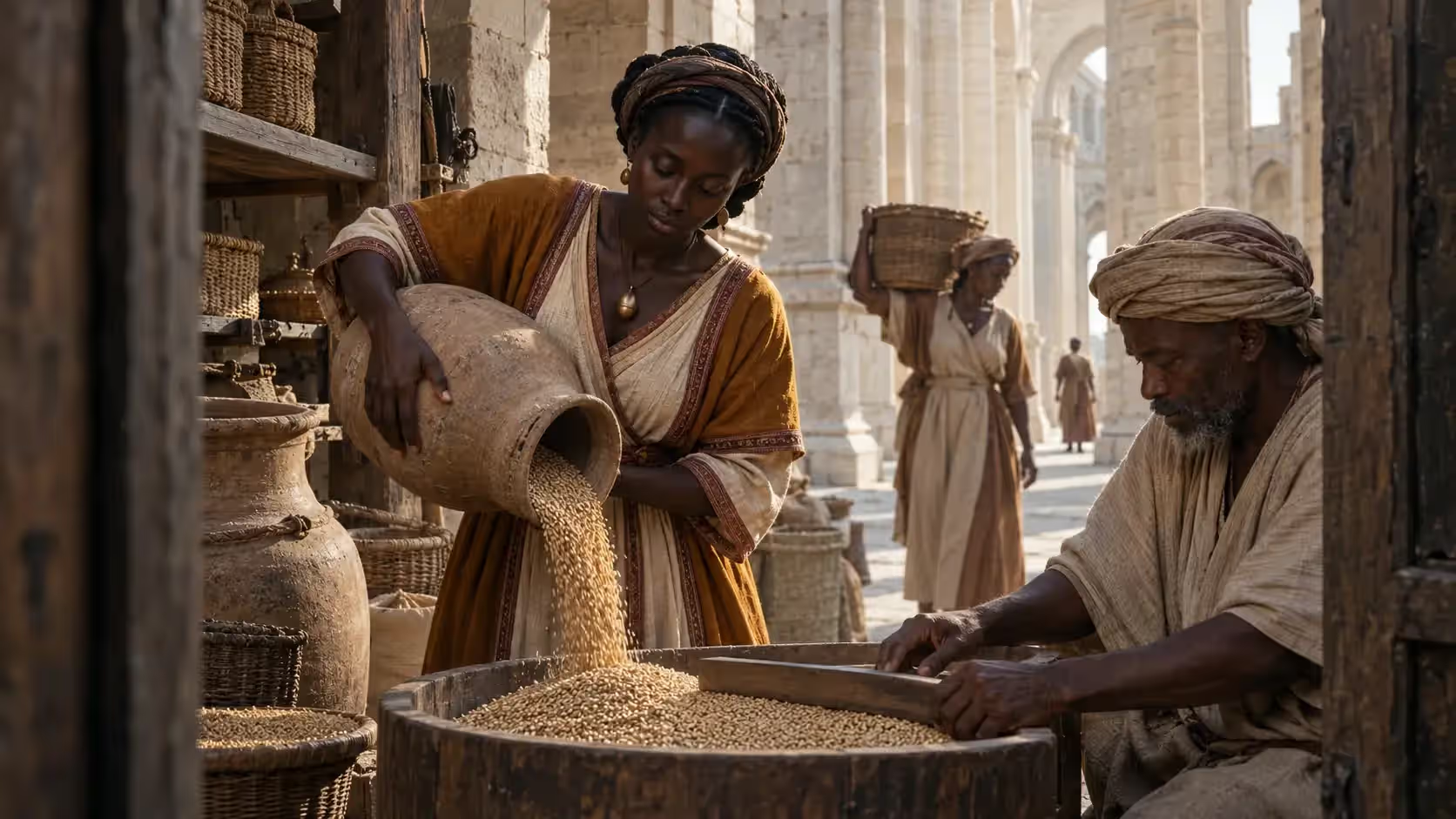
Urnok: the road feeds
Grain, stone, timber and fodder connect the duchies within a single logistical power.
Resources that depend on one another
Sarnor gathers silos, reserves and grain; Bralnor provides quarries, blocks and heavy stone; Orlantis holds forests and timber. These specialisations make circulation essential. Imperial power depends as much on an arrival and a relay station as on the great animal carrying a load.
Silos, charpente de levage et réserves
Vue de détail.
Power needs rest
Sauropods support construction, transport and siege, but need water, fodder, care and suitable spaces. A broken road or failed relay therefore affects an entire chain of work. The Empire must maintain the conditions of its power before moving it: the giant depends on the trades that precede it.
Departure has several responsible hands
A convoy does not rely on a single order given in the morning. The convoy inspector checks what must leave; the harness controller examines the join between load, animal and vehicle; the imperial rationer counts water and fodder; the load surveyor compares real weight with the road available. Each can identify a deficiency. A refusal is not a display of prestige: it postpones work until the faulty link has been addressed.
An incident leaves a record
When a load breaks, a delay deprives a relay, or a crossing goes wrong, the event does not vanish with the dust. The incident archivist fixes the circumstances; the death notary records what must be recorded when a life has been lost; the toll judge separates a disputed passage from an ordinary delay. These trades do not create a new justice. They make responsibility legible between a part, a road, a load and the people answerable for them.
A road is remade piece by piece
A road is not merely a strip that people use. Pavers restore its bed, boundary markers make a junction legible, and load surveyors indicate what a passage can still bear. The Master Harness adjusts the effort asked of a living animal; the marker teacher passes on the actions that keep a mistake from becoming routine. Repair is therefore measured through successive small tasks before it becomes visible movement on the road again.
Sauropods, roads and work crews
Great living animals move blocks, logs and loads that no human crew could handle alone. Their presence does not remove human work: it requires drivers, road crews, relays, fodder, water and veterinarians. An Urnok construction site is prepared long before the animal arrives. The road, loads, resting space and people able to respond if the convoy stops must all be arranged.
The daily cost of power
Silos, roads and great animals form a single material economy. Grain surplus becomes useful only when it can be stored, checked, moved and turned into suitable rations. Water and fodder are not scenic details: they determine route, number of stops, travel season and the duration of a siege or building site. When a relay is missing, military or political decisions are limited by a simple need: feeding and watering.
Urnok in figures
The average annual output of an inhabitant of Urnok is estimated at about 68 Dracos. Agriculture and fodder make up 34% of it, industry and crafts 18%, animal husbandry 12%, trade and finance 11%, administration and learning 10%, the army 9% and elite rents 6%. Urnok produces in bulk, but part of that value flows to Volonia through insurance, credit and specialised imports. Its prices serve as the reference for the known world’s average rate.
Six duchies, six materials
Each of Urnok’s duchies gives the Empire a material that sums it up. Calaron, around the capital, administers and lends: egg paper, ink and the register are products there as much as tools. Sarnor feeds everyone with grain, seed, fodder and irrigation water. Bralnor sells stone: blocks, counterweights, paving slabs and cutting powder. Orlantis supplies wood and resin, and with them glues, ropes, tannins and the black of inks. Velmor makes leather and draught gear: black harnesses, bows, ballistae, armour and black stone. Imperial Qor Zaï holds bone and intelligence, at the customs posts and relays of the march.
None of these materials is enough on its own, and that is the point. A Velmor harness is tanned with Orlantis bark, a hall in the capital built with Bralnor stone and paid for out of Sarnor grain. Karûm-Brakh, the only house present in all six duchies, lends and builds wherever these chains cross.
What the Empire sells and what it buys
Urnok exports first what its animals give it. Its hadrosaur tendon is the quality standard throughout the known world, and its sauropod tendon, calibrated for siege work and more than twice as strong, goes to Korath, where it strings the heavy ballistae. Orlantis timber, resins and ropes go to sea towards Volonia, which pays in pearls, fabrics and luxury goods; Volonia also buys fodder and raw materials.
In return, the Empire depends on other powers for what it cannot make. Korath sells it ballista parts, armour plating and a large share of its metal. N’Goro supplies, by the jar and at a high price, the anti-rot glues without which tendons, leathers and bows would end up spoiling. Leather is always short, and part of it is bought in Arkhan, the land of bones and hides. Finally, Ishtir provides ceratopsians and their trainers, used for prestige more than for war, and from the Arkhan border come a few raptors, under closely watched licence.
Capital that eats
The Empire’s real wealth walks on four feet. Its sauropods are estimated at about seventy-eight thousand, providing in heavy traction the equivalent of the work of three to six million people. This capital does not sleep in a strongbox: it eats, drinks, falls ill, ages and wears down the roads. The surplus it produces is immense, but much of it is swallowed by fodder, water, veterinarians and road upkeep.
An adult traction sauropod is worth around nine thousand Dracos, what more than a hundred and thirty of the Empire’s inhabitants produce in a year. The military very-large animals belong to the Crown, even when they serve in a duchy or an order; the others belong to the dukes, the orders and the great houses, and some are hired out by the day with their keepers. That is Urnok’s particular fragility: a break in a road or a silo does not just stop trade, it starves the capital itself.
Earning a day’s pay
A day’s work in the Empire is paid between three and six tenths of a Draco, depending on the trade and the duchy: less for a day labourer without a line, more for a journeyman turner or a scribe. A twenty-five-kilo sack of common grain costs a little over one Draco, a veterinarian’s visit a little less; a civil-status deed costs only a few hundredths. A working family therefore lives close to its bread, and the price of fodder, which weighs more than human food in the price index, quickly passes into every expense.
Part of the pay is often given in kind. Karûm-Brakh’s building sites pay partly in rations, which draws day labourers; soldiers receive the twelfth-loaf of the relays and part of their pay in fodder spirit. Road people, for their part, count in leagues and stages as much as in Dracos.
When the economy goes to war
“A war without rations is a defeat written earlier,” says an adage of the High Chancellery of the Living Ways. Before an army marches, the Empire’s economy is already changing shape. The Crown raises a war tax at a variable rate, which the Imperial Bank of Scales and Roads must accept before it is voted; quartermasters requisition fodder, animals and convoys in writing; useful Lines are placed in service.
Prices move first. Fodder rises, then iron, caravan services and insurance, which Volonian merchants raise as soon as the roads become uncertain. The markets sense war before the criers do, and families in the capital fill their jars. A long campaign can then be read in the Empire’s accounts for years: roads to rebuild, animals to replace, pensions to pay, Lines to reopen.