

Creatures
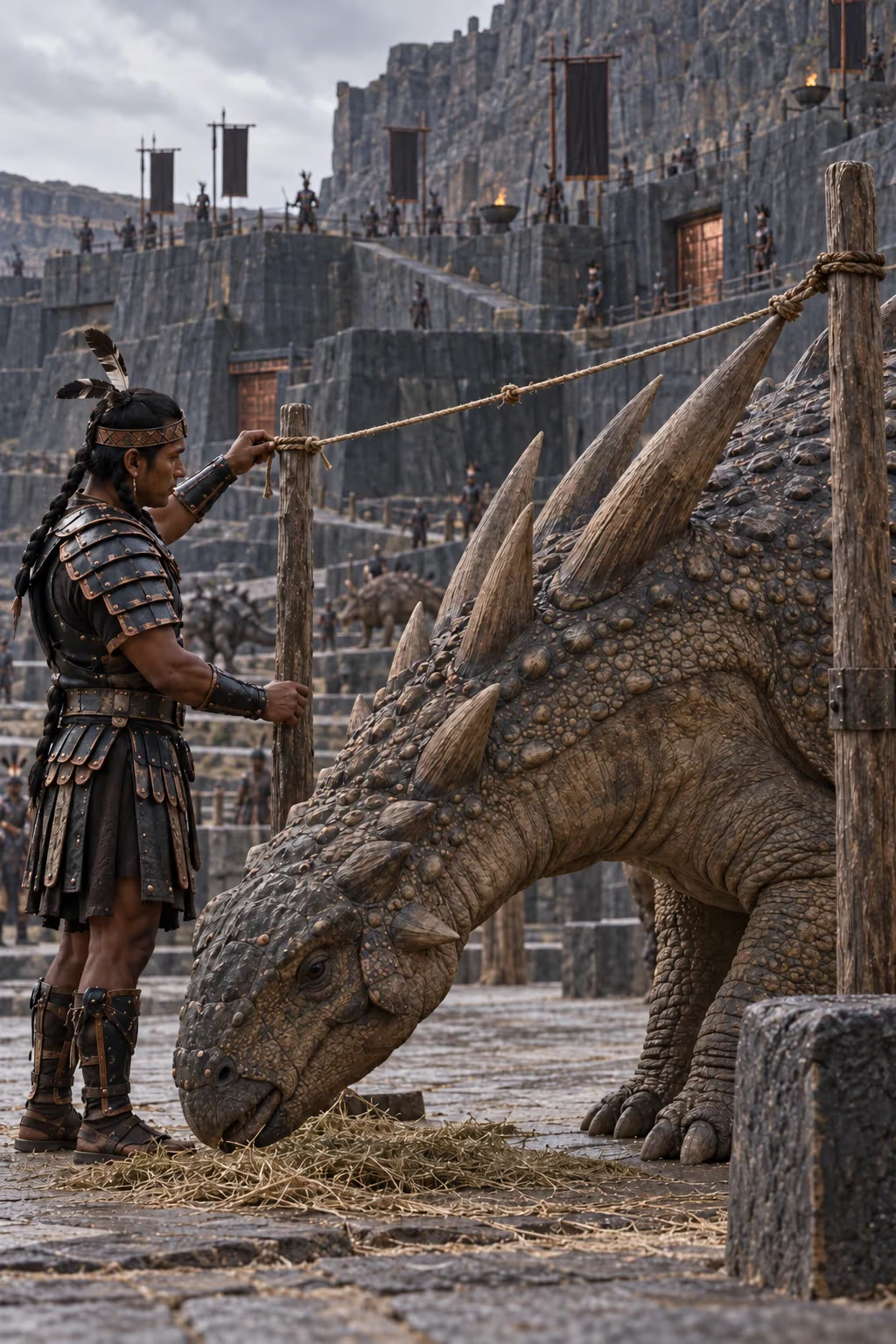
Ankylos of Korath’s marches
Imported animals in the lower facilities of a country of stone and mechanisms.
Animals at their proper scale
At the lower levels
Imported animals remain mainly in the lower marches. Depots, testing posts and animal yards can accommodate them; animals do not structure the deep cities. This distinction connects the trade to places bodies can access rather than a uniform national image.
A clear arc for the tail
Turning yards must preserve the tail’s arc. Wooden buffers, niches and recessed benches reduce obstacles around the animal. Armour and strength remove neither the need for clearance nor the risk to nearby humans.
Un arc libre pour la queue
Dans les marches basses, les cours préservent le rayon de la queue. Niches de service, pare-chocs de bois et abreuvoirs restent hors de cet arc.
A depot must also allow rest
In the low marches, an animal depot must allow unloading, water and feed service, and access to care. The yard retains a clear tail arc; niches and inset benches keep service areas from becoming obstacles. Imported animals require costly, localised acclimatisation.
In Korath they are fed tough vegetation, lichens, mushroom forage and grain supplies, with no recipe or identical ration for every species. Osteoderm cleaning is part of their daily care.
How many beasts
Korath’s marches keep something like eight thousand ankylosaurs, two to three thousand nodosaurs, a few hundred euoplocephali and about four thousand pachycephalosaurs. The figure looks considerable; it is tiny compared with the herds of the Empire of Urnok, and only a small minority of Korathi workers live by tending beasts. The mountain, not the animal, remains the country’s foundation.
These animals are divided according to their use. Beasts of the fortress ankylosaur lineage hold the pass locks and haul the armoured convoys; forge and mine ankylosaurs work in the quarries and at the gallery mouths; nodosaurs escort the columns and block the defiles; the few euoplocephali serve as gate-breakers and mobile barriers. Each beast is registered with its lineage number, its use and the depot it belongs to.
What an ankylosaur eats
An adult fortress ankylosaur weighs about six and a half tonnes. Every day it eats nearly two hundred and forty kilos of fodder and drinks some three hundred and sixty litres of water, which makes each beast a continuous expense that depots calculate as carefully as the wear on a part. The basic ration consists of pass scrub, juniper, black pine and alpine grasses cut on the slopes, supplemented by fodder mushrooms grown in the galleries, rich but quick to spoil outside the dark.
In winter, algae raked from the thermal basins are added, and all year round the hay of the Reflected Terraces, the best local fodder, kept first for the war beasts. The rest comes from Urnok as baled fern, re-pressed by winch at the foot of the passes to climb the stairways; this fodder pays two tolls before it arrives. Blocks of crystal salt are left to lick in every yard.
The beast-master
Every working ankylosaur has its beast-master, who drives it, cares for it and answers for it. The bond often lasts the animal’s whole career: the beast learns its master’s voice, its depot’s gong strokes and a few simple orders, and a beast-master who changes animals must start all over again. The best are sought after by the pass forts the way good engineers are sought by the workshops, and their name appears in the beast’s register next to its own.
This bond travels with the animal. When Korath leases an equipped fortress ankylosaur to the Empire of Urnok, the month-long contract includes the beast, its barding, its harness and its Korathi beast-master. The lease grants no breeding rights, and the beast returns to its depot at the end of the contract. Imperial officers who have worked with these crews say they leased a man as much as an animal.
A day at the depot
A day at a depot of the marches begins before dawn. Carers go from yard to yard, examine the beasts’ feet, eyes and skin, check that none has stopped eating, and write everything in the registers. Then come water, the morning ration and the harnessing of the animals going out to work; those resting are led to the grazing yards, where the arc of their tail has all the room it needs.
On their return, the packs are unloaded, the osteoderms rinsed of dust and soot, the places rubbed by the straps greased, and the parasites that lodge between the plates sought out. The beasts spend the night in yards sheltered from the wind; in winter, some are warmed by a branch of the Warm Vein, because a chilled ankylosaur eats more and works less. The depot never quite goes to sleep: a guard crew watches over the beasts until morning.