
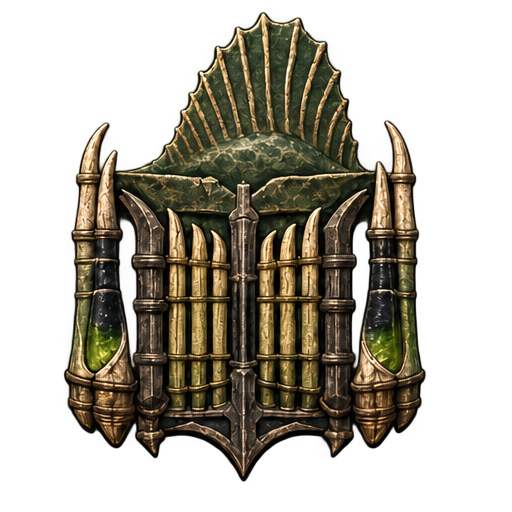
Armies
The centipede rider
Mounted on a giant centipede, N’Goro’s rider carries messages, hunts and fights vertically, among roots and on cliff faces.
The mount of the roots
The centipede rider handles messages, hunting and vertical combat. Giant centipedes are the mounts of the roots, the cliff faces and the low canopy; they also serve for ambushes. The trade gives N’Goro a silhouette of its own.
A mount is not to be confused with the wild centipedes of the same environment, and it must move along suitable passages: roots, lianas and structures react to loads and vibrations.
The beast and its saddle
A riding centipede measures four to six metres and weighs around a hundred and fifty kilos, which makes it a light mount by the standards of the marsh’s great beasts. Its ember-brown chitin is streaked with phosphorescent green, its dozens of legs move in a wave, and its forward fangs carry a burning venom that brings pain, local paralysis and fever. It climbs the root-arches, runs along walls of living wood and clings to the lower canopy where no barge or hadrosaur can pass. Royal centipedes, eight to ten metres long, remain rare and reserved for great rites and decisive battles.
The centipede saddle is segmented: its three pieces of leather and chitin fit three rings of the body and follow its undulations. The rider does not sit upright as on a hadrosaur; he rides lying flat, belly against the saddle, legs held in rope stirrups, so as to stay pressed to the beast as it passes from a horizontal root to a vertical wall. It is guided by knee pressure and by scent pastes laid on its antennae, never by a bit.
Learning to ride
One becomes a rider young, and one becomes one first by caring. The apprentice feeds the beast on fat larvae, cleans its chitin of moulds and parasites, watches its segments and learns to read its mood from the rhythm of its legs. Riders are often small and light, women and men alike, because weight counts on a wall. A saying of the trade holds that you do not ride before your first bite: nearly all have been bitten at least once during their training, and centipede antidote, which brings the fever down in one day instead of six, never leaves their kit.
The most dangerous moment of the year is the beast’s moult. Like all arthropods, the centipede changes its shell as it grows; for a few days it is soft, hungry and irritable, and no one rides it. The riders then keep it in a chamber of living wood, feed it from a distance and wait for the new chitin to harden. The Ngoro see an echo of the Mystique in this moult: a rider who has seen a mount through several moults is held to be a master, and the two are said to have “grown up together”.
Couriers of the roots, hunters of the walls
In peacetime the centipede rider is first of all a courier. Where a barge has to skirt a mass of roots by a channel several leagues long, the centipede goes over the top; a mounted courier often covers in one day what a laden barge takes three days to travel. The Sap-Keepers, the threshold posts and the pass captains employ these couriers for messages that must arrive fast and carry proof — a sealed flask of water, a strip of fibre, a counter-flask requested in an emergency. They work with the Knotters, whose network of lianas carries messages through the canopy.
The rider also hunts. Centipedes track amphibians, small reptiles and the great insects that live among the roots, and a team of riders brings back to the village a share of the meat that the fishers do not provide. Some make a trade of guarding the roots: they patrol the suspended quarters, dislodge the predators that climb up at night and bring back lost children. Their passage can be recognised by the claw marks left on the bark, which the inhabitants call “the thousand-steps”.
Vertical combat
At war the centipede rider never charges a line: N’Goro lacks breaking power, and its centipedes melt under blows delivered across an area. The rider fights where the enemy is not looking. Riders drop from the roots onto a column committed to a channel, strike the rear or the pack beasts, cut the ropes of rafts and barges, then climb back into the lower canopy, out of reach of the spears. Foreign hadrosaurs and iguanodons, which have never smelled a centipede, often panic before the first blow.
Some companies live by this trade. The Écumeurs des Roseaux d’Argent, centipede riders hired for guard duty or war, are reputed to cut roads rather than face armies: they harass convoys, carry off guides and vanish. At the Three Waves, the N’Goro contingent already fielded ridden arthropods among its low units, to win crossings and wear down the depth of the enemy array. Veterans of those wars say the enemy learns quickly to look up, but never quickly enough.