

Places and landscapes
Urnok: a capital built for living bodies
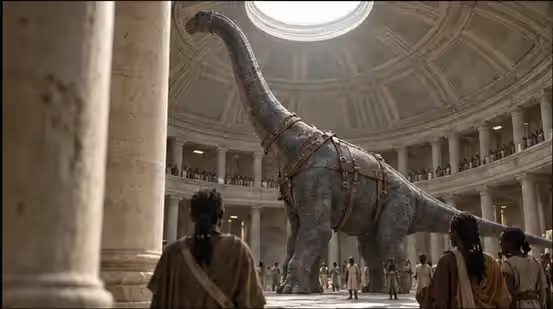
The imperial capital organises heights, water, stores and circulation around human and animal bodies of different sizes.
Rings with a history
Urnok, the capital within historic Calaron duchy, develops through irregular rings. Older neighbourhoods, basins, granaries and terrain deform and shift urban boundaries. Works from several periods join in a city of heights, reserves and great circulation roads.
Each level receives a different burden
Urnok’s heights separate uses without making them independent. Palaces, archives and banks stand above; middle roads carry convoys and working animals; lower levels hold service water, channels, collection and dirty workshops. Reserves, crews and works on these levels enable the upper terraces to function.
Avenues are mass infrastructure
Spine avenues are dimensioned so that large animals, convoys and human traffic can follow one another without occupying the same place at the same time. Closures, diversions and ground crews are part of the street when living mass passes through. The capital therefore does not treat animal transport as a parade: it allocates time, space and refuges to this work.
Honouring living infrastructure
Urnok’s statuary depicts the great living animals linked to imperial power. Brachiosaurs, ultrasaurs and diplodocus belong to this monumental language, alongside load stelae and inscriptions. Their presence beside roads and basins recalls transport, care and provisioning in capital life.
Rings of functions
The capital’s irregular rings are not just stages of growth: they also distribute functions. At the centre, on the heights, the places of proof and power, palaces, archives, banks and Houses of Proof. Around them, transitional districts, where the families of the offices and fine workshops live. Further out, the working districts, tanneries, heavy workshops, harness yards. Finally, on the outskirts, a logistical belt: fodder stations, quarantine gates, yards and warehouses.
Depending on the district, one thus counts three to five rings, whose limits never quite match the old walls. A historic working district can find itself in the middle of the heights, an old temple among the warehouses. The city keeps the traces of every age in which people believed they could put it in order.
Several cities in one
A capital of this size brings together several architectural grammars, and Urnok counts at least five or six. The City of Two Skies separates the humans’ streets, on a mezzanine, from the great animals’ roads on the ground. The Blue Terraces make water an architectural material, with their lake basins and their squares that drink the storm. The architecture of the Threshold multiplies quarantine gates at the entrances; the fodder cathedrals form the belt of reserves; the Imperial Rib gives the monuments their buttresses and oculi.
None of these grammars reigns alone. They overlap according to district and period, and it is this mixture that distinguishes a living capital from a model. A single walk can pass from a suspended street to a floodable square, then to a quarantine gate, in less than an hour.
Districts that are links
As in every duchy, a district of the capital is not merely a neighbourhood: it is a link in a chain. Calaron’s material is egg paper, ink and the register, and the city can be read by following that material: the hatcheries and shell-workers on one side, the paper-makers and ink-makers further on, then the districts of the scribes, binders and seal engravers, up to the archives on the heights. To name a resident’s district is to state his trade, his income and often his marriage.
Accidents follow the same logic. A fire among the paper-makers deprives the offices of paper three weeks later; an epidemic in the hatcheries then shows in the price of registers. The city’s stewards therefore think not in streets but in chains, and they know which link to watch when one of them weakens.
The river and the bridges
The river crosses the capital in a wide curve that serves as the city’s backbone. Its fortified quays, towpaths and warehouses occupy the lower levels; two great massive bridges with enormous arches span it and link the two banks for the convoys of colossi. These bridges are designed to carry several beasts of burden at once, and resting platforms open on their sides.
The rest of the city crosses the water by more modest bridges, reserved for people, wagons and light mounts. On days of great parades, when the colossi must cross from one bank to the other, the two great bridges are closed to all other traffic for hours, and the whole city arranges itself around these closures.
The places that do not work
A city inhabited for centuries has its failings, and Urnok is no exception. Some old districts have avenues too narrow for the largest sauropods, which must make long detours; a few ancient bridges now carry only hadrosaurs; ramps that are too steep force wagons to be unloaded halfway up. The low districts near the river are flooded at every great flood, and the smell of the tanneries rises to the terraces when the wind turns.
Other places humiliate more than they hinder: the long queues before the tax scribes at the great gates, the passages reserved for seal-bearers, the streets where one must wait for a noble convoy to pass. Residents know these places and how to get around them; a plan of the capital that ignored them would be of use to no one.