
Trades
The Black Quarantine
N’Goro’s biosecurity guild holds the filters, antidotes and fumigations; it can close a port or a relay by protocol.
Closing by protocol
The Black Quarantine is N’Goro’s biosecurity guild. It works on enclosures, filters, antidotes and fumigations. Its principle is economic as much as medical: an epidemic among the beasts means an economy collapsing. It therefore has the power to close a port or a relay by protocol.
A country of thresholds
This power is rooted in the environment. Every basin of N’Goro has its own bacteria, pH, parasites, minerals and cycles; a neighbouring water can kill a body that is not adapted to it. Quarantines, antidotes, filters and inspections allow the Sap-Keepers’ Synod to close routes, and a quarantine can act as a blockade without any declaration of war.
A guild of the field
The Black Quarantine is not to be confused with the Sap-Keepers’ Synod. The Synod holds the knowledge, the formulas and the protocols, and decides in the last resort on the opening and closing of routes; the Black Quarantine is the guild that does the work. Its members keep the pens, filters, fumigation posts and observation basins all over the country, and even in the ports where foreign ships put in. Its heart is at N’Gashu, at the Control Basins, where it employs more than a third of the inhabitants, but it also keeps stations in the hidden ports, on the edge roads and on the marches of Urnok.
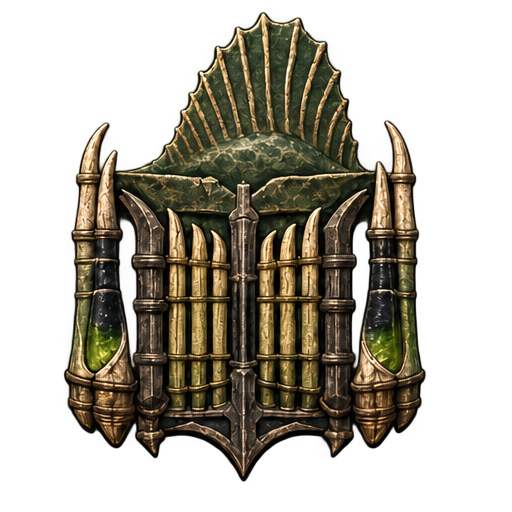
Its name comes, it is said, from the colour of its people. The guild’s filterers, quarantine keepers and fumigators wear aprons and gloves of spore-black leather, and their posts are blackened by the smoke of the spore cakes they burn every day. In the ports their dark figures and bronze bellows can be recognised from afar, and a foreign captain who sees them come aboard knows he will not sail for several days.
A protocol, step by step
The power to close “by protocol” rests on written procedures, which each post keeps on varnished fibres and the keepers learn by heart. A protocol is triggered by precise signs: beasts coughing or losing weight in a pen, a fever declared in a port, a water found altered without a mark, indicator insects dead in a hold. As soon as a sign is observed, the keeper need ask no one’s permission: he closes, then reports.
A sanitary closure always follows the same order. Guards take up position at the entrances, buoys and painted stakes bar the channels, fumigations are lit, and a register of entries and exits is opened in which every person is recorded with the water they come from. Ships’ holds are fumigated with the bronze bellows-burner, which burns spore cakes and ether mud, then marked with a passage sign. Nothing leaves without the Synod’s health certificate. Only the Synod may lift a closure decided by protocol, and only on a new reading.
Beasts first
The guild protects humans, but its first business is the living creatures that work. An epidemic among draught beasts, bred insects or the great spinosaurids would ruin the country more surely than a war, and it is for beasts that the protocols are strictest. Foreign animals arriving in N’Goro — caravan hadrosaurs and iguanodons, live beasts sold at market — often stay under observation longer than their owners, in separate pens whose water connects with no other.
At the Control Basins, the great hall of beasts and titans takes in even the largest animals. A titan quarantine is held at the third basin: the beast is installed in a pond, fed a prepared ration, watched by trainers day and night, and its water is analysed every day. Such a quarantine is costly and lasts weeks, but no one disputes it. The guild’s keepers repeat it to protesting merchants: one sick beast that gets through today means a thousand dead beasts in a year.
Selling the right to enter
Foreigners first see the Black Quarantine as an obstacle, and they are wrong to see only that. Its services are N’Goro’s largest export: Volonian ships and Korath and Urnok caravans pay for their quarantines, hold fumigations, filter inspections and passages through the Basins, and that right to enter earns the country more than any remedy. Outside N’Goro the guild also sells its know-how in the form of filters, spore masks and fumigators, and its bronze bellows can be found in ports where no Ngoro lives.
With Volonia the relationship is one of esteem and mistrust. The Vaesh Quarantine, a Volonian military and sanitary order, cages what the Black Quarantine knows how to recognise, and the two institutions compare their methods as much as they criticise each other. The merchants have their own opinion, which they repeat on every quay: the Black Quarantine does not close ports, it makes them expensive. The guild’s keepers do not dispute the phrase; they merely point out that a port open to anyone ends up closed for ever.