
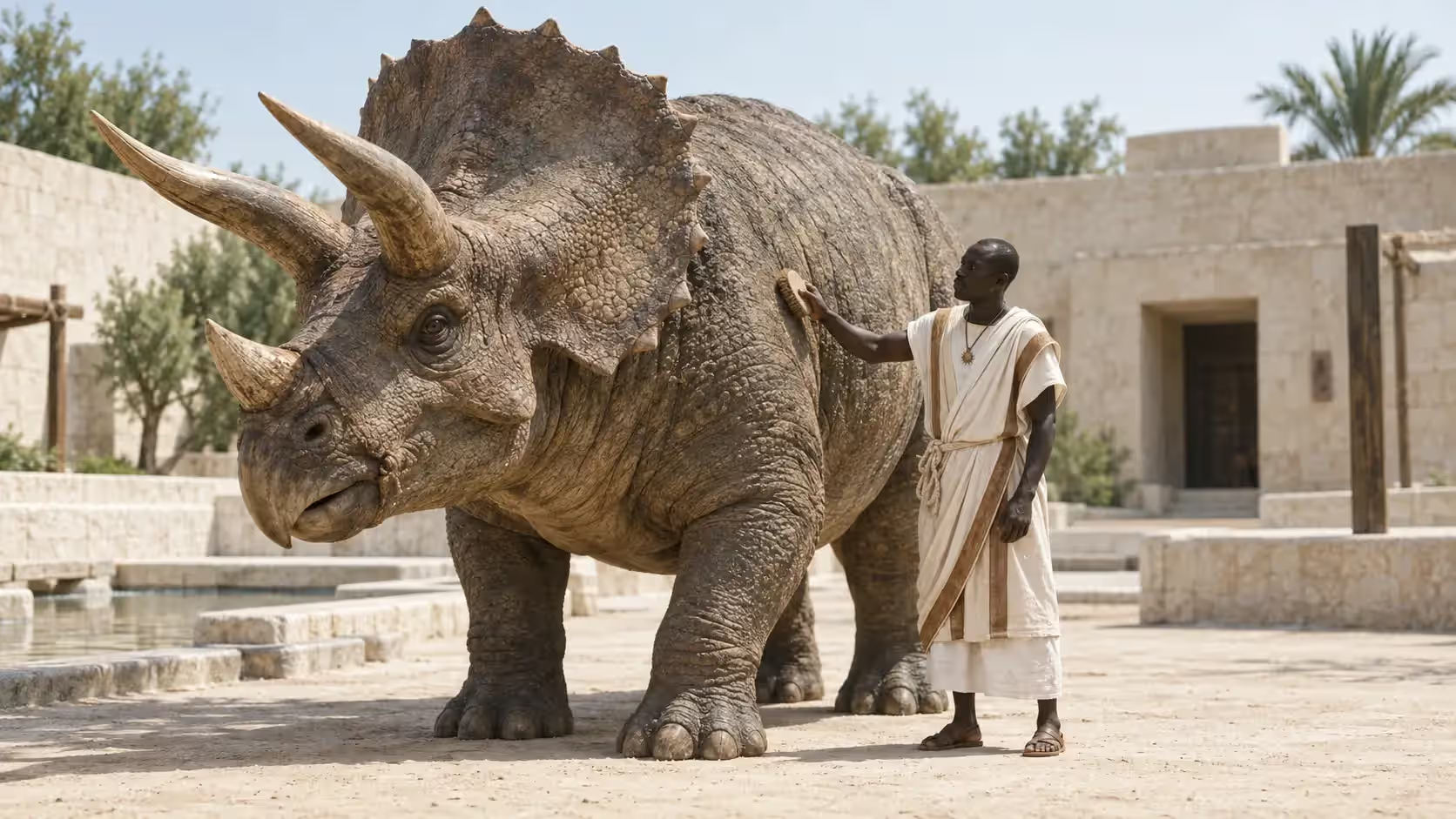
Trainers, keepers and drivers: the trades of the living
In a world where dinosaurs haul, carry, fight and feed, those who train, tend and drive them hold a share of power.
Whoever holds the living
“Whoever holds the living holds power.” The axiom runs through every nation, along with its shadow: to hold the living is to be held by it. Living creatures are infrastructure, capital, religion, risk and weapon, and prestige is measured by what one can do with them: power means feeding, tending and registering a bloodline.
The trades that care for beasts are therefore not farm trades. They decide what an army, a building site, a convoy or a port can actually do.
Several lines of work in every nation
Every civilisation keeps several domestic lines of work: traction, packing, escort, war, scouting, ritual, care, transport and quarantine. An emblem species is not a monopoly: a nation has a signature, never a single species. Draught and carting rely on hadrosaurs and iguanodons; raptors are scaled beasts.
The signatures are well known: the sauropods of the Empire of Urnok, the ceratopsians of Ishtir, the raptors of Arkhan, the ankylosaurs of Korath, the spinosaurids and arthropods of N’Goro, the plesiosaurs of Volonia.
Becoming predictable to a beast
The first dinosaur ever domesticated was the Vrii, an archaic raptor. The most widely accepted account is deliberately ordinary: a child is said to have picked up an egg, hidden it from the family and, without knowing it, begun the greatest rupture in human history.
The first great sauropod domestication is credited to Urnok and a female Diplodocus. Tradition does not make it a heroic conquest: it came from habits, food and repetition, and from several generations of humans who learned to become predictable to a gigantic animal.
The gestures of the trade
The old catalogue of trades names the gestures common to every nation. The mount-trainer conditions raptors and ornithomimids; the harness-master looks after the mount’s comfort, safety and efficiency; the scale-keeper treats skin, parasites and wounds; the bone-vet treats fractures, teeth and horns.
The egg-breeder controls the temperature and humidity of incubation; the herd-marker establishes identity, descent and ownership; the line-breeder selects for temper, stamina and docility; the claw-cutter works for safety, hygiene and rites; the colossus-whisperer specialises in sauropods; the enclosure-manager handles layouts, rotations and biosecurity.
From one nation to another
In Urnok, the colossus-whisperer reads the fatigue of the very large, the Harness-Master answers for their interfaces, the harness inspector refuses a badly prepared departure and the death-notary records the lost beast. The titan-vet tends the great beasts of the Longs-Pas and of the Order of the Diplodocus; he names every titan, even those about to die. Tigist’s mass-drivers set the pace and direction of the diplodocus.
In Arkhan, the pack-trainer carries knowledge the Confederation does not export; the Vur-vaa trainer prepares the wall-climbing raptors; the tooth-masters harness the breaching carnosaurs. In Ishtir, the ceratops technician follows the pace, harness and health of the Silver Horns, and the keepers of the Gold lines watch over the great living ones. In Volonia, the plesiosaur traction master turns the beast into a ship’s engine. In N’Goro, the fisher-trainers work with spinosaurids without ever steering them, and the insect-breeders make insects into infrastructure. In Korath, the weight-clockmaker calculates the fatigue of draught beasts and the ram-helm armourer equips pachycephalosaurs.
Around one of the very large
One of the very large is at once an organism, a bloodline, capital, infrastructure, a weapon, a symbol, a memory and a legal problem. Around it, platform crew, drivers, archers, vets and guards form a community; harness, armour, fodder, workshops, roads and munitions are designed for its exact body. Forty years of campaigning can vanish with an animal known to several generations.
In Urnok’s military apparatus, technical chains run alongside the chain of command. The High-Living chain answers for committing, withdrawing and recovering the very large; the Living chain brings together vets, animal recovery and quarantines; Heavy Mount and Mobile Mount hold the cavalry. Specialists say what matter and living bodies can really do, without holding a political veto during the action.
Who answers for the beast
Law is born of accidents. The master, the harness, the bridge, the trainer, the house and the beast each bear distinct responsibilities, and bureaucracy is born of possible catastrophes. Ownership of the living — bloodlines, breeding, rings, insurance, vets — makes a zoo-capitalist nobility.
Knowledge travels badly
An animal can travel; its ecosystem, its bloodlines and its trades travel far less well. Arkhan does not sell its pack-trainer as property: his tacit, irreplaceable knowledge moves only through marriage, hostage-taking or adoption into a clan.
Animals that are not for sale
Not every animal is merchandise. In the known world, some are never sold, whatever the price: the sauropods of the Empire, down to the dwarf sauropods of the League of the Stone Gates; the great theropods; the largest pterosaurs; Ishtir’s pedigree ceratopsians; N’Goro’s war insects. These animals work among their own people or are lent on orders, always with their masters, and come back when the contract ends.
The rule has its reasons. An animal sold takes with it a knowledge its new owner lacks, and often a line its country of origin wants to keep. Better, say the powers, to hire out the work than to give up the animal: Korath hires out its equipped ankylosaurs, with their beast-masters, without ever selling a breeder; the Empire hires out its sterile sauropods under imperial guard; the League’s breeders hire out their magyarosaurs by the day, with their guide, and bring them home in the evening.
What an animal is worth
The animals that are sold cost dear. An adult draught hadrosaur, the commonest animal on the Empire’s roads, is worth about four hundred Dracos, years of a labourer’s wages; a reconnaissance raptor of Arkhan, when it is traded between clans, about the same; a Volonian traction plesiosaur a little more. Great pedigree animals are counted in thousands of Dracos, and the most precious have no price at all, since they are not for sale.
These prices explain the standing of the trades of the living. A family that owns a single draught animal owns its main capital, and the healer, the parer or the harness-master who look after it keep that capital alive. Animals are insured like houses, inherited, pledged; an animal that dies through neglect is judged like a ruin. In the countryside they say of a rich man that he has animals, and of a ruined one that he has sold the last.
Growing up among animals
The trades of the living are not learned from books. Children of healers’, trainers’ and drivers’ families grow up in the pens: they sweep, carry water, cut fodder and learn first of all to stand near a great animal without making a sudden movement. Before touching an animal, they must be able to read its mood from the carriage of its head, the movement of its tail, the way it breathes.
In Urnok these families form registered Lines, and a child born into a Line of drivers almost always becomes a driver. In Arkhan, the pack trainers’ knowledge is passed down within the clan, generation after generation, and leaves it only through marriage, hostage-taking or adoption. In Ishtir every skill is certified, and a young healer can rise through the ranks by his trials. Everywhere the first lesson is the same: an animal does not forgive impatience.
Gallery1 image
Training a young pack hadrosaur in a pen.