

Trades
Collection, composting and upkeep in the capital Urnok
Collectors, compost workers and channel cleaners sustain the city of great animals.
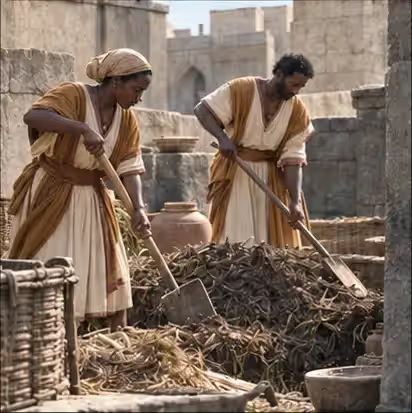
Below the avenues
Urnok, within historic Calaron duchy, distributes its uses vertically: palaces and archives, great-animal roads, then channels and waste work. Lower levels accommodate collection, composting, tanneries and channel cleaning. Clean terraces and usable avenues depend on crews handling urban residues.
Water serves several purposes
Aqueduct watering places, service channels and drainage connect urban water with animal needs. Gate keepers, washers and channel cleaners do more than decorative work: they maintain the conditions for movement, drinking and removal. A city feeding great bodies must also keep the works carrying water and residues usable.
Waste can become a resource
Compost connects urban maintenance with fertility. Collecting waste, removing it and transforming it are different tasks within the same metabolism. They support gardens and crops as well as clean routes. Animal mass makes these trades indispensable: what remains after feeding must itself find a destination.
A night of collection
The work begins when the last convoy of colossi has passed. The collection teams then come out of the service ramps with their bronze-rimmed wooden shovels, their shoulder baskets and their tumbrels drawn by hadrosaurs. Each team has its avenue and its order of passage, set by the office of heavy roadworks: first the crossroads and turning circles, where the animals stop most, are cleared, then the long straight sections, and finally the yards of the relays and pens.
A very-large animal leaves several hundred kilos of dung behind it each day, and hundreds of them pass through the capital: the collection is counted in hundreds of tonnes. Everything must be gone before the valve masters open the water at dawn to wash the paving with service water. The collectors then go back down to the lower city, wash with bile soap in the basins reserved for them and sleep while the upper quarters wake. A team that has not finished on time answers for it to the office, and the delay is docked from the night’s pay.
Making good compost
The compost yards lie outside the inhabited quarters, on the low terraces where the wind carries the smell away. There the composters build long windrows, alternating fresh dung with straw, spent fern bedding, sawdust and hearth ashes. Within a few days the heap grows hot enough to steam in cold weather; it is turned with forks at regular intervals to air it, and the parts that dry out are wetted.
It takes several months for a windrow to become a dark, mild-smelling soil. Master composters judge it by hand and by nose, and sort their output into several grades: the finest goes to the gardens and terraces of the upper city, the coarsest to the farms of the duchy, and part of the dung, taken fresh, is sold to the tanneries of the lower levels, which use it to soften hides before tanning.
The people of the lower city
Sewer-cleaners, collectors, composters and compost carriers form a world apart, with its quarters, its feasts and its pride. Many are day labourers without a line, but some families have held the cleaning of a canal or the upkeep of a ramp for centuries, and register it like any other trade. Their children do not always share the same fate: the Synod of Living Measures recruits by competitive examination, and the capital can name sons of canal cleaners who became stewards.
The people of the lower city also give the army its first levy. The Calaron Skirmishers, the Empire’s light infantry, are recruited among the sewer-cleaners, compost carriers and tanners’ sons, who are handed a short spear and a round shield. They do not shine on a battlefield, but there are always others behind them, and they are called the first paving stone of the road.
When the lower city stops
A few nights without collection are enough for the capital to notice. The avenues become slippery, the great living animals refuse certain passages, the lower canals clog and overflow at the first rain. A flood that drowns the compost yards or an epidemic that strikes the teams therefore worries the stewards more than a quarrel at court. When a pen falls sick, the affected animal’s dung is set apart, covered with lime and burned outside the walls.
The methods of the lower city ended up serving in war. An Urnokian army camp digs its pits, places its compost yards downwind and organises its cleaning rounds according to the capital’s rules, because a legion camp with its hadrosaurs and sauropods produces in a week what a quarter produces in a month. Veterans say a well-commanded camp can be recognised by its smell, and that a dirty camp falls sick before it falls.