

Creatures
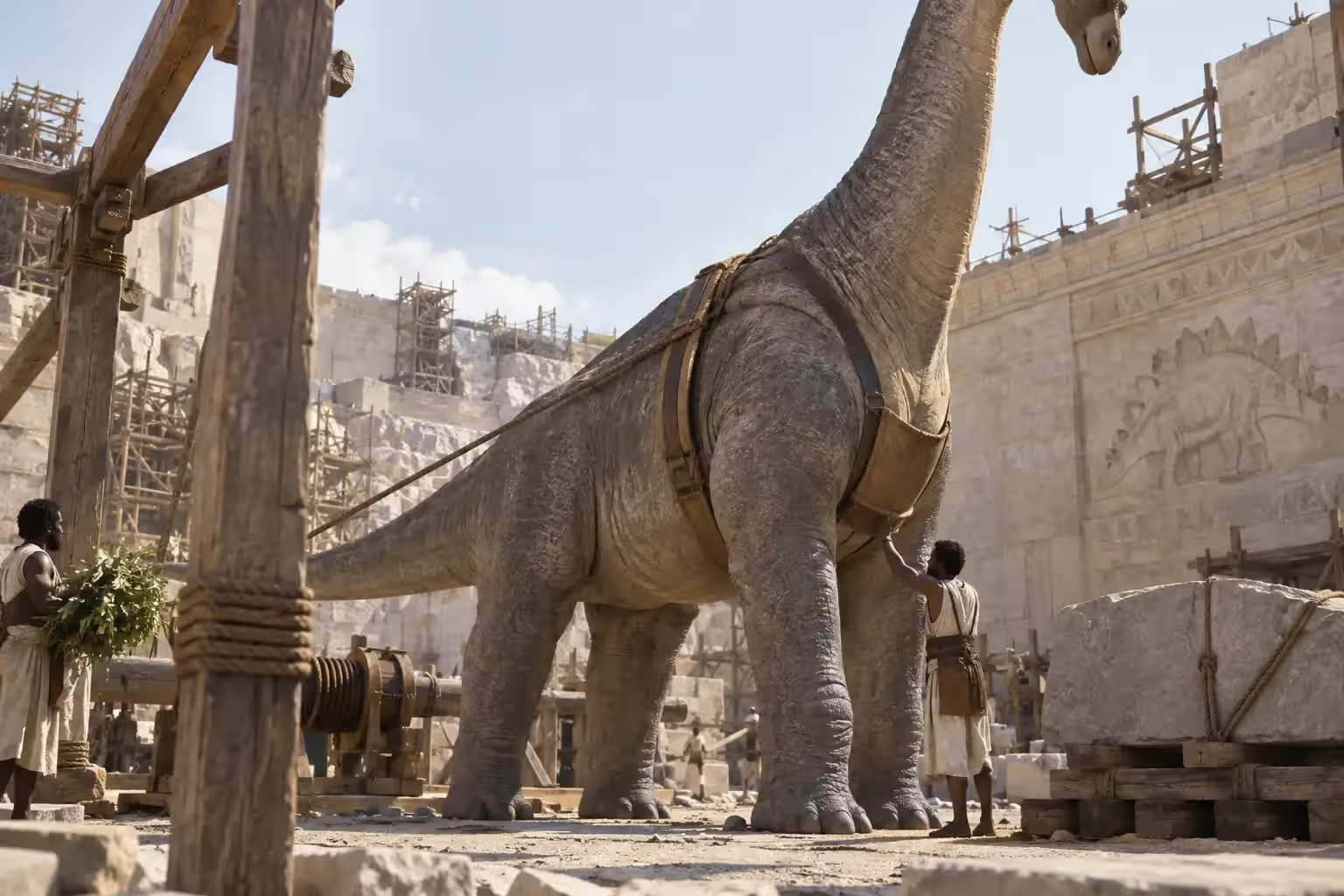
The quarry brachiosaur
Bralnor is the duchy of stone and heavy loads, held by House Eralis, whose emblem is the quarry brachiosaur. Its brachiosaurs help lift and move masses, alongside quarrymen, counterweight and winch specialists and heavy-haulage crews. Bearing roads must be inspected so that a convoy can advance without the road giving way.
The Tours-Portantes
At war, the brachiosaur is more than a beast of burden. The Tours-Portantes set a command post, observers, archers, scorpions or ballistae on brachiosaurs and other tall frames: the animal’s height gives sight and range. This is not the role of the imperial Ultrasaurs, which fight without towers or archers.
In the city
Imperial towns raise statues of brachiosaurs and diplodocus in their squares. This non-human statuary — vertebra colossi, load steles — honours the beasts as partners of civilisation: there, the Empire reveres function rather than heroes.
The tallest of the working sauropods
The brachiosaur is the tallest of the working sauropods. Its forelimbs, longer than its hind limbs, give it a back line that slopes down from shoulders to croup, and its raised neck carries the head more than twelve metres above the ground, the height of a four-storey house. An adult measures about twenty-five metres and weighs some forty tonnes. Its nostrils open high on the head, giving it in profile a domed brow that Bralnor’s sculptors are fond of exaggerating.
It browses high. Branches of araucaria, conifers and ginkgo make up most of its ration, close to a tonne a day, and it drinks two to three thousand litres of water depending on heat and work. A brachiosaur reaches adulthood at about eighteen and then works for several decades; Bralnor’s yards keep animals that have carried stone for three generations of quarrymen. On the work sites, the white dust of the quarry faces settles on its grey skin, and a quarry animal coming back to town is recognised by its powdered flanks.
A neck that lifts nothing
The first rule of Bralnor’s quarrymen fits in a sentence: a brachiosaur’s neck is never used as a crane. A load hung from the neck would injure the animal within days, and a brachiosaur injured in the neck is a lost animal. Lifting is therefore done from a platform strapped to the back, eight to ten metres off the ground, where independent winches worked by winchmen raise loads of one to three tonnes; the animal’s own weight serves as counterweight. Elsewhere the brachiosaur simply turns a winch on the ground, walking round at a steady pace.
This work takes room. To turn with its platform, a brachiosaur needs a circle of some thirty metres, which the sites clear before it arrives. The tower handlers and winchmen who work the platform form a team distinct from the handlers on the ground, and each lift is made on the signal while the animal stands still. This is the very discipline the Carrying Towers use in war: the army has merely replaced the winches with archers, scorpions and ballistae.
Hiring a brachiosaur
A brachiosaur is not sold: it is hired, with its handler and its team. The hire contract sets the duration, the work required, the hours of effort, the fodder and water the site provides, and the rest days; a day costs about sixty-five Dracos, ration not included. Hired animals are certified by the Chancellery and insured, and the contract states who answers for an injury: the site, if it asked for more than the hire letter allowed; the lineage, if the animal was badly prepared.
Karûm-Brakh is by far the largest client. Its great aqueduct, silo and bridge works hire brachiosaurs by the dozen, and Bralnor’s handlers know its works foremen better than their own cousins. Small communes hire too, for a season, an animal that will raise the blocks of a bridge or a market hall. In the duchy, a man who asks too much of his people is said to be “loading the neck”, and the expression is never a compliment.
The Bralnor yards
Brachiosaurs live in yards outside the walls, between the quarries and the load-bearing road, and are born in the studs of House Eralis, the only house in the duchy licensed to breed them. A female lays four to eight eggs, brooded for about ten months. Two strains share the studs: the quarry animals, chosen for strength and sure footing, and the high-chassis animals, with steadier backs and proven calm under noise, which the army reserves for the Carrying Towers.
A brachiosaur egg is worth a farming estate, and the law of the egg has made it proverbial. Throughout the Empire a “brachiosaur omelette” means criminal luxury, an expense so monstrous it can only be a crime; the expression comes from rare black-market cases that judges punished as crimes of State. In Bralnor, where people see the nests up close, no one says it with a laugh.
Gallery4 images
Sahina Vael-Orûn on a palace balcony. Golden brachiosaurs before the gate of a circular fortress. Two brachiosaurs pass through a fortified gate. A raised avenue walked by a pack brachiosaur.