

Trades
Caring for living convoy animals
A great working animal depends on roads, water, fodder, rest and people able to intervene.
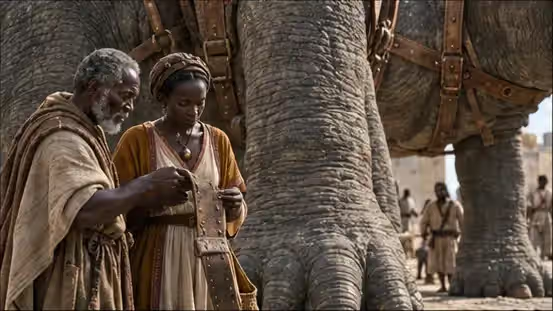
Care begins before departure
Moving a great living being is prepared alongside people and loads. Roads, relays, watering places and fodder stations form part of the conditions that make a journey possible. Preparing an animal for work therefore does not consist only of equipping it: the route must be made usable, stops planned and space maintained where the animal can be observed and tended again.
Several trades around one body
Drivers, road crews, relay keepers, feeders and carers intervene at different stages of a journey. Drivers follow the animal; road officers prepare passages; relays organise water, feed and stops. A load ready to depart must wait if the next road or the animal’s condition prevents continued travel.
Stopping is a logistical decision
Rest, water and fodder determine the real duration of a construction site, transport or operation. When a convoy stops, safety conditions and the people able to intervene must be maintained. This constraint makes care part of everyday administration: a decision made at the centre produces effects only if the living beings carrying it can continue the journey.
The carer’s bag
A convoy carer travels with his own pack. It holds a jar of sole ointment, made of tallow and herbs; pots of resin balm for wounds and chafing; strips of fibre; needles and tendon thread for stitching skin; a bronze lancet; salt and sachets of minerals for animals that refuse to drink; bile soap; brushes, waterskins and a tablet on which he notes everything he does.
The carer answers for this pack as the relay master answers for his pharmacy. He restocks it at every relay, against a receipt, and a convoy that leaves without sole ointment is a badly prepared convoy. On the trade roads, Volonian insurers require a registered carer to be present before covering a convoy of large animals; their premium falls when his name appears on the departure slip.
The ills of the road
The road wears bodies down in predictable ways. Paving splits and hollows the soles of the large animals, especially in the dry season, when the horn hardens; straps cause chafing at the shoulder and belly; heat and dust exhaust the animals and irritate their eyes. Mouldy or over-fermented fodder brings on gut colic, which can kill a hadrosaur in a night. In the marches one must add the bites and scratches left by predators.
Each ill has its answer. A split sole is cleaned, packed with ointment and protected by a leather boot; colic is treated with fasting, water and slow walking; a wound is washed and stitched. The carer also knows when he can do no more: an animal that lies down and refuses water must be left at the nearest relay, with someone to watch over it, even if the convoy loses a load.
Care at the halt
At every halt, the order never changes. The animal drinks before the man: the animals are led to the troughs before anyone thinks of the crews. They are unloaded, their straps loosened, their feet and chafed areas washed, then the carer makes his round, animal by animal, and notes on his tablet what he sees. Fodder comes next, in the quantity counted by the rationer.
Care also plays out in the order of march. The lead animal, which sets the pace and gives the rhythm, tires more than the others; a good convoy leader has it change places at every halt, on the carer’s advice. At night someone always stays awake near the pens, because an animal that is unwell often gives itself away in the dark, through a breath that changes or a trampling that does not stop.
What care costs
The care of a civilian convoy is paid for by whoever answers for it: the Line that moves it, the house that hires out the animals, the merchant who chartered them. A veterinarian’s visit costs a little under one Draco, a convoy carer’s day about the same as a journeyman’s; that is little compared with a draught hadrosaur worth several hundred. Road people say it bluntly: care is the cheapest of insurances.
The great houses have their own carers. Sarnor Trois-Saisons keeps some on its fodder roads, Karûm-Brakh on its building sites, and the Crown entrusts its very-large animals to the Longs-Pas veterinary corps. Small convoys share one carer among several owners and divide his day in proportion to their animals. A carer with a good name knows on every road the relay where the water is good and the one where it is better not to leave a sick animal.