
Economy
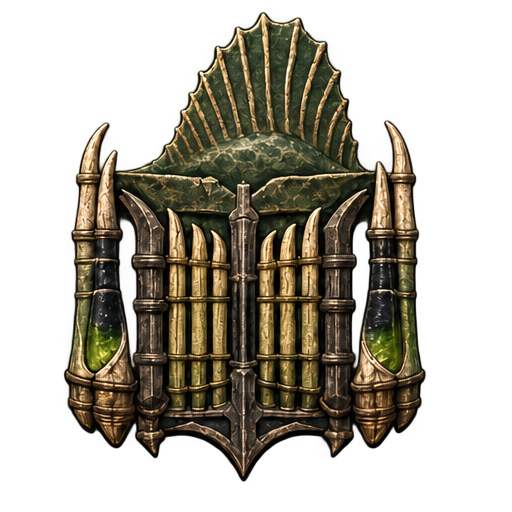
The League of Master Carriers
Transport, barges, guides and salt connect the activities of the Bay of Roots.
Carrying by water
The League of Master Carriers is associated with transport, barges, guides and salt in the Bay of Roots. In a world of mangroves and changing waters, these activities connect goods with passage skills. Transport depends on an environment to cross: cargo, a barge and usable access belong to the same chain of work.
The Pact of Roots
The Pact of Roots names a structural alliance between the Master Carriers, ports and the Houses of Black Milk. Transport therefore belongs to relationships combining movement, protection and local powers. Quayside activities meet the Houses’ credit and service networks; several actors give the same journey its means and connections.
Routes require several kinds of knowledge
Seasonal routes belong to the Living Mirror’s domain, while filters, inspections and quarantines give the Sap-Keepers power over passages. The Master Carriers’ transport operates in contact with these conditions. Having a barge available does not settle every question of travel: the environment, health conditions and relationships between networks also affect whether movement is possible.
More than a thousand years of barges
The League of Master Carriers is said to be more than a thousand years old. It was born, by its own accounts, from a confederation of hidden ports, families of boatmen and ferrymen who moved goods through the Bay of Roots without asking anyone’s permission. From that origin it has kept a mobile power, hard to centralise: the League has no single head and no fixed seat, and each of its ports is governed by a council of master carriers that meets on a quay, around a filter, at each change of water.
One joins as an apprentice, often as a child, in a family of carriers. One becomes a carrier after several seasons on the barges, then a master carrier on knowing how to share out a crew’s effort, choose a route according to the load and answer before the others for what has been carried. The pilots, who know the bay’s passes without ever drawing them, form the League’s elite. Some old lineages are its pillars: the House of Rith, at Ngunya, holds quays, pilots and stills where venoms, anaesthetics and antidotes are distilled.
Barges, canoes and hauling beasts
The League’s fleet is made of very varied craft, each suited to a water. Pilot canoes, hollowed in one piece from a mangrove root-arch, are fast and go everywhere. Cargo barges, flat and broad, carry the bulk of the goods; on the black canals they are poled or hauled by barge hadrosaurs, the marsh’s draught beasts, which wade in water up to the chest. For the heaviest cargoes the living barges of the Long Boughs, carried by titanids, are called upon.
The League also carries things that do not look like goods. Its master carriers move the sick to the Control Basins on covered barges, tow the modules of Shedding Villages when the water turns dangerous and take foreign envoys to their audiences in the capital, Muu-Shanga. A journey is counted among them in load and days rather than distance: a laden barge makes three or four leagues a day on a confirmed water, and the price of carrying follows weight, season and risk.
What the League carries up and down
The League’s barges follow two great currents of goods. Upriver go salt, which the freshwater marshes lack and which comes mostly from Volonia through the hidden ports, grain, metal and tools bought abroad, beer, wine and cloth the country does not make. Downriver to the sea go the products that make N’Goro rich: licensed venoms, antidotes and counter-flasks, balms, anti-rot glue and varnish, spore-black leather, peat amber, nacre and marsh pearls.
Part of this traffic escapes the Control Basins, and the League only half hides it. Through the Pact of Roots, which binds it to the hidden ports and the Black Milk Houses, it moves cargoes whose origin no one wants to know; it has already carried, for payment, crews from the Dents Noires. Its rule is that of every black-canal boatman: you do not ask what you carry, you ask what it weighs and what it risks. Only the law of poison is an exception: no serious master carrier ships a venom whose counter-flask has not been lodged.
The carriers in war
War changes the barges’ cargo. When a foreign army approaches, the League does not fight; it moves house. Its barges carry off the wounded, the sick, the stores of Shedding Villages taking themselves apart and the families who flee; its pilots vanish from the passes the enemy would like to use; its hidden ports empty in a night. An invader arriving in a region held by the League finds deserted quays and absent barges, and must push its own boats through a mud it does not know.
That strength also makes the League a partner the central power treats with care. Muu-Shanga needs its barges for any mobilisation, and especially for the Foam March, which requires ports and boats as much as trainers; the League needs Muu-Shanga for its routes to stay open to the Basins. The master carriers have a saying to sum up their place: “The Circle decides where the country goes; we know whether it can get there.”