

Creatures
Urnok — Le vivant, des soins aux manœuvres
Observer les anatomies, entrer dans les enclos, suivre les équipes de soin puis les retrouver sur le terrain d’exercice : ces scènes rapprochent le bestiaire de la vie des civilisations.
Enclos, soins et circulation
This extended reading is currently available in French.
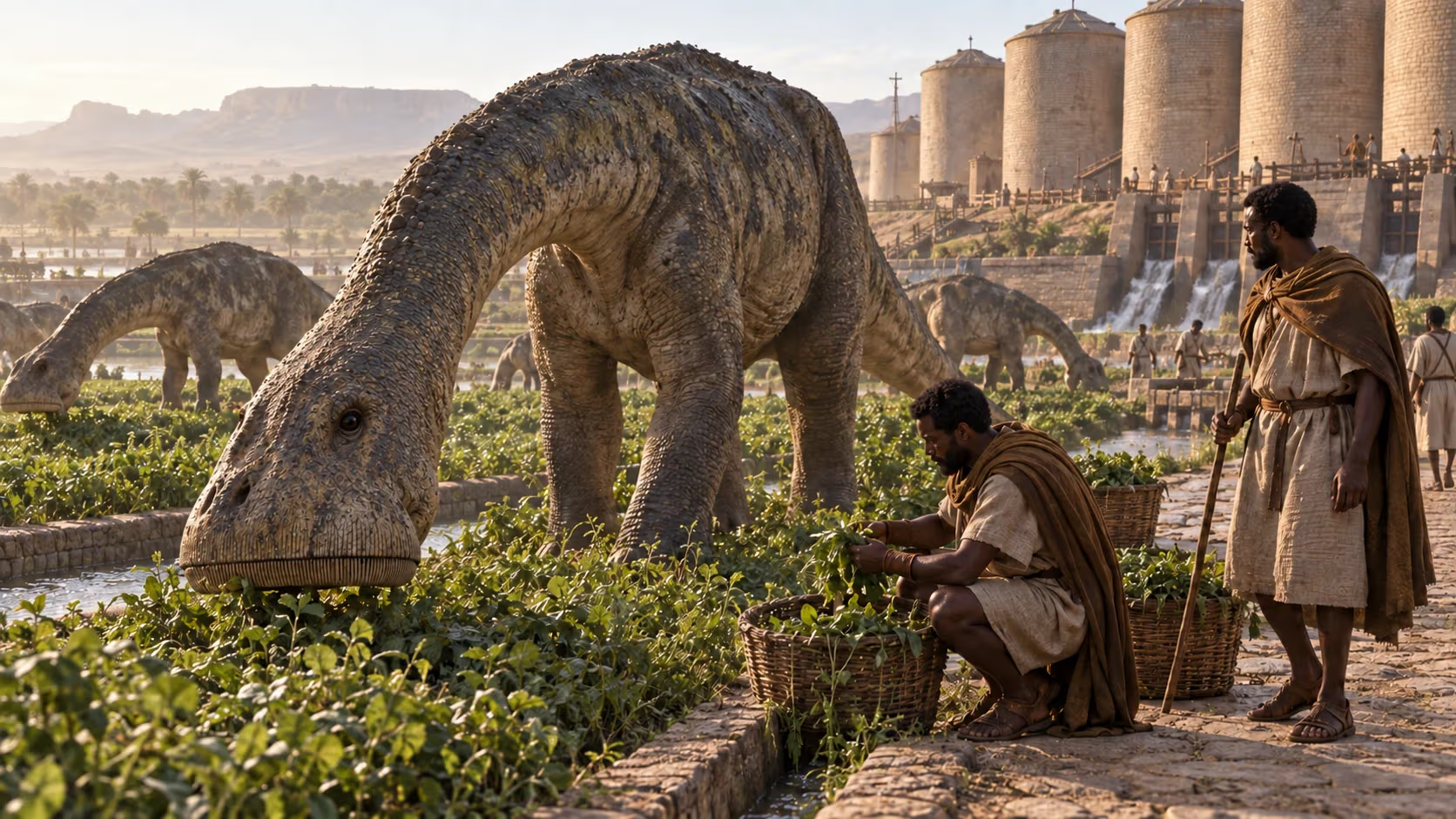
Un grand vivant ne se réduit pas à sa force de traction. Il faut entretenir son équipement, fournir le fourrage, ménager le repos et préparer les voies de circulation. Les équipes doivent coordonner l’animal, les charges et les passages sans confondre puissance et disponibilité. Les caisses d’incubation et les métiers des soins appartiennent à cette continuité : l’intendance du vivant commence avant une manœuvre et se poursuit après elle.
Observe gestures and materials · 11 images
Mamenchisaurus
Bralnor. Un usage du bestiaire.
Bajadasaurus
Drakeris / Qor Zaï. Un usage du bestiaire.
La masse au bout du convoi
Sarnor · convoi et inspection.
Les épines lavées par la pluie
Marches impériales · soins du cou.
L’ombre qui traverse Sarnor
Sarnor · retour des champs.
L’appel sous les voûtes
Capitale impériale · apprentissage des signaux.
Le dernier convoi du soir
Sarnor · orientation du troupeau.
Les Hadros noirs de Velmor
Velmor · patrouille des passages.
Les voies des résines
Orlantis · circulation forestière.
Le cercle de la queue
Orlantis · inspection de l’aire de rotation.
Le jardin des hautes feuilles
Orlantis · entretien des jardins.
Le détail du vivant se découvre dans les gestes ordinaires : un harnais ajusté, un dégagement vérifié, un troupeau orienté.
L’animal au milieu des hommes
L’exercice donne à voir les distances entre formations, les signaux et les zones de rotation. Certains animaux travaillent avec une unité ; la faune sauvage croisée à l’exercice n’en est pas domestiquée pour autant.
Observe gestures and materials · 8 images
Le passage des piques
Marches impériales · franchissement d’une formation.
La ligne qui pivote
Sarnor · pivot des corps d'hadrosaures et d'iguanodons.
Le corridor s’ouvre
Capitale impériale · ouverture de corridor interarmes.
Au bruit des batteries
Sarnor · accoutumance au choc et continuité.
La charnière noire
Velmor · charnière de ligne de Velmor.
La rotation d’Orlantis
Orlantis · contre-infiltration et rotation stégo.
Au pied des boucliers
Orlantis · garde basse anti-infiltration.
Le retrait sous les ramures
Orlantis · repli protégé et relève.
Weight must be distributed
A harness joins a load, vehicle, person and living body. Straps, padding and tension parts distribute effort and keep fastenings inspectable. Care starts before departure, in how a load is placed and in the ability to remove it.
Practices that prevent wear
Harness inspectors, saddle repairers, carers and convoy leads do not hold the same post, but their work follows in sequence. They observe fit, the condition of a component and resumption of movement. Their cooperation explains why a working animal is not a machine that can simply be replaced when a strap wears out or a crossing puts it in difficulty.
From field to water point
Fodder passes through reserves, convoys and stops before becoming working capacity. This chain links agricultural land to work sites and roads without confusing human food, seed reserves and animal feed. A local shortage can immobilise an otherwise well-equipped effort.
Feeding grants no universal right
Holding a reserve or moving a ration grants no general right over the animals that consume it. Storage, transport and responsibility for use are distinct tasks. This separation makes the economy legible: the same convoy can depend on several trades and decisions.
A harness does not have a single workshop
Inspection belongs to movement
Inspection and cleaning are part of Urnok movement, alongside stops, water and fodder. Written responsibility accompanies great animals’ passage. Between movements, a part and its condition matter as much as its provenance. Maintenance therefore extends beyond a spectacular repair after an accident.
Materials keep their limits
Leather, sinew and binders remain sensitive to treatment, moisture and fatigue. Orlantis chains supply tannins, fibres and adhesives; Velmor receives materials from elsewhere. Military maintenance therefore depends on suppliers and intermediate parts before any tactical decision. No material becomes indestructible through animal or imperial prestige.
Eggs in transit and in the nest
Moving something fragile
Cushioned crates, humidity chests and seals serve to transport eggs. Joinery, inner protection and closure serve different purposes. Packaging is more than a miniature cage: it protects fragile contents during movement and preserves a trace of what was closed.
Eggs in transit and in the nest
A workshop of warmth and observation
Incubation uses artificial nests, warm stones and humidity control. Inspection lamps, markers and gauges belong to another task: observing and identifying the egg. Each clutch requires its own observation: these tools set no temperature or duration valid for every egg. The hatchery remains a place of supervision.
Eggs in transit and in the nest
In Urnok, preserving status too
In Urnok, an egg’s destination is registered before use: Seed, Table, Technical or Ritual. Niches, seals, supports and classified storage accompany these destinations. A chest can thus protect both an object and a responsibility. This framework is Urnok’s; it does not make the same marks universal law for every carrier.
A road is maintained infrastructure
Slabs, drainage, turning zones and clearances distribute weight and keep a route usable. A heavy road remains shared space: human traffic, animal passage, water and emergency response must meet without blocking one another.
A relay has several functions
A relay provides water, rest, inspections, repairs and information on the next route segment. Human food, fodder, supervision and care do not move through the same chain. A column leaves only when these needs have been checked together.
Fodder determines reach
Stores of fodder, grain, water and mineral salts determine what can actually cross the territory. They govern routes, timing and the load a road can carry. A local shortage forces a plan to change even when arms and people are ready.
Growing up beside giants
An Urnokian child learns to live beside the great animals before learning to read. The first rules are passed on in the street and at home: never walk behind a tail, never under a turning neck; stand where the animal can see you; stop and fall silent when a colossus passes. Neighbourhood schools add the colours of the ground markings, the bells of the manoeuvre circles and the drivers’ gestures, learned through play: one child is the animal, another the handler, and the rest count the mistakes.
Many children work early around the animals. The youngest carry fern bales, fill buckets and brush the flanks of neighbourhood hadrosaurs; at twelve or thirteen some enter a yard, a relay or a stable as apprentices. Families in the trades of the living measure their children by the animals: a small child is said to “reach the knee” of a hadrosaur before anyone gives his age, and an adolescent to “touch the shoulder”.
A morning in a sauropod yard
A sauropod yard wakes before daybreak. Fodder carriers take the first loads up wooden ramps to the high troughs, the sluice masters open the basins, and the animals drink in order of rank and duty. The muckers come next with their shovels and carts, and the smell of the yard changes as they work their way through. Then comes the hour of the feet: each titan sets its limbs one after another in a washing basin, where the washers scrape out the sand and pebbles packed under the soles.
By the time the city’s workshops open, the harness-makers have checked collars, straps and platforms, the colossus whisperers have made their round and noted the animals that ate poorly, and the first are leaving for the work sites or the corridors. Those that stay in the yard rest, browse at the racks and are visited by the veterinarians. A well-kept yard is recognised by its relative silence: few shouts, practised gestures, and registers up to date before noon.