

Creatures
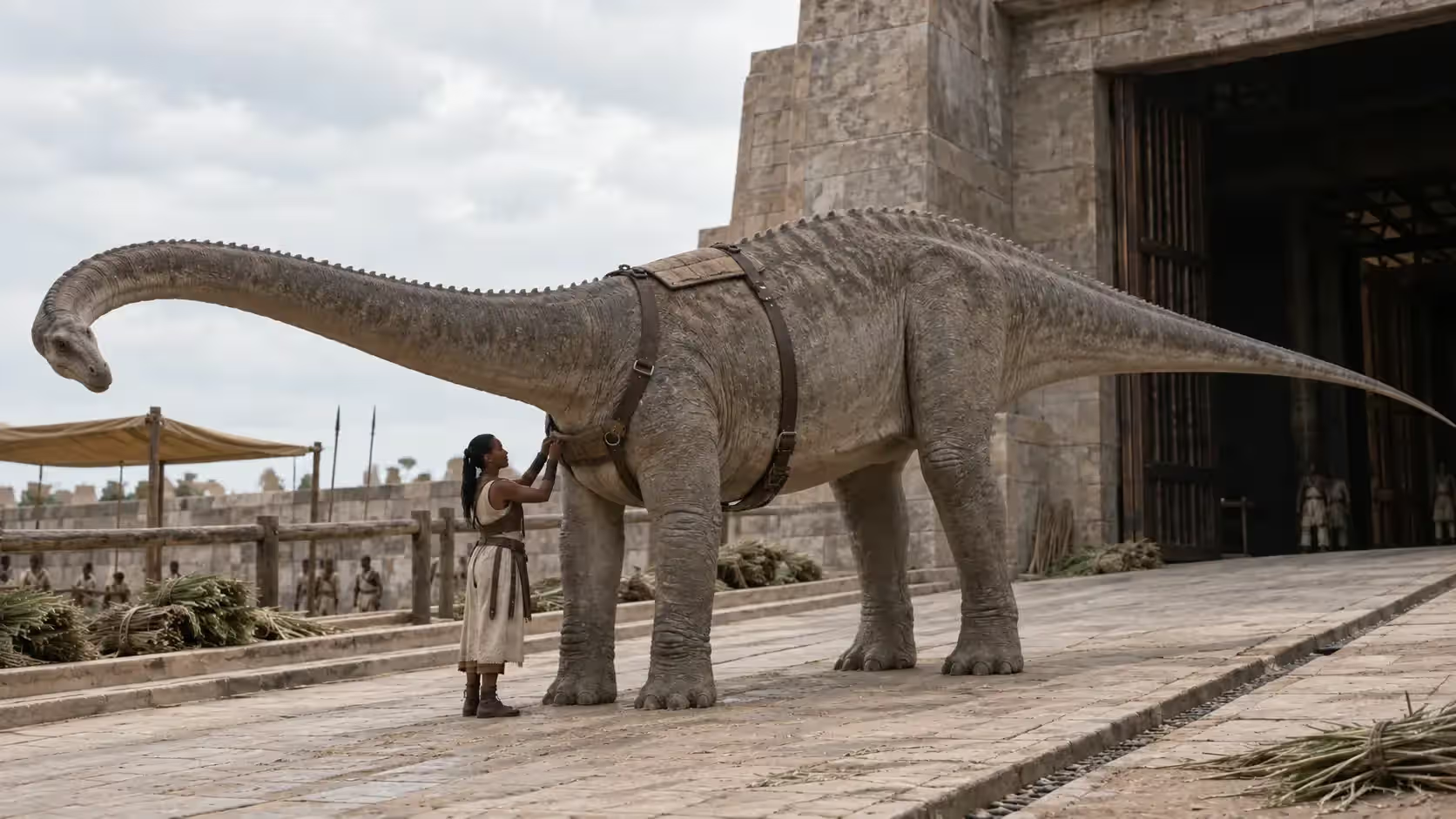
Nahara
Sahina’s young Diplodocus: a bond built through learning.
A named animal
Nahara is the young Diplodocus bonded with Sahina. She belongs to a world where great animals require care, food, suitable routes and human responsibility.
Breath, footing, harness
The relationship develops through breath, footing, refusals and harness adjustments. Training makes cooperation credible; obedience is not immediate. Sahina must learn to recognise what Nahara’s body accepts or refuses.
A living presence
Nahara has limits, habits and observable bodily choices. Her bond with her rider relies on learning and trust. Humans read behaviour; they do not gain direct access to animal intention through telepathy.
A Diplodocus of the Order
Nahara is Sahina Vael-Orûn’s personal mount. Her mother is Marjory’s mount: an exceptionally agile Diplodocus with whom the empress shared a fusional bond, and whose name remains unknown.
Nahara trains in the palace’s lower courtyard with the mass handlers of the Order of the Diplodocus, led by Captain Tigist. Six riders form an exercise unit around her; for training her tail is sheathed in padded bands, and a tail armourer checks their seams.
Shy, and mistress of her flank
Nahara is shy and timid, with an intelligence of the flank: she chooses her side. Her flank is grey-green. Their bond is still in the making, and from her Sahina learns that commanding is not owning.
Daughter of Marjory’s mount
Nahara was born in the hatchery of the Order of the Diplodocus, in the capital, from a clutch of Marjory’s mount. Like every great military animal she belongs to the Crown, and her egg was entered in the register as a title, with her mother, her lineage and the date it was laid. She grew up in the Order’s growing pens among the young diplodocus of her season before being assigned to Sahina; the mass drivers remember that she chose her place in the herd very early, on the edge rather than in the middle.
She has not finished growing. Her grey-green flank, paler towards the belly, still has the proportions of a young animal, and the Order’s veterinarians reckon it will take her several years to reach her mother’s length. That growth governs her training: her joints are spared, her hours in harness limited, and the length of her neck and tail is measured every season and entered in the notebook in which her keepers record everything that concerns her.
Nahara’s ramps
At the palace, ramps carry her name. They lead to a raised boarding terrace at the height of her withers, from which Sahina takes her seat in the saddle without a ladder. The terrace was built for her: the master builders measured the animal and worked out the slope her feet will accept and the width her tail needs to turn at the foot of the ramp. As Nahara grows, the terrace floor is raised.
Away from the palace she is mounted by a flank ladder held by two servants, and that is where her flank intelligence shows: she accepts the ladder on one side more readily than on the other, and the servants have learned to present it on the right one. The saddle, set at the base of the neck, is a low seat with a leather back and thigh straps for the rider; for exercise, Nahara’s tail is sheathed in padded bands that a tail armourer checks before every outing.
Caring for a young giant
A whole team lives around Nahara: keepers, fodder carriers, washers, harness-makers, and the Order’s mass drivers who supervise her exercises. She eats several hundred kilos of fodder a day, mostly tender branches and foliage, and drinks from basins set at her height in the lower courtyard. Her feet are washed every evening and her soles watched, for the paving of the exercise yard wears them faster than the grass of the meadows where she grew up.
The Order’s veterinarians examine her as they examine the fifteen Longs-Pas: from a distance first, to watch how she shifts her weight, then up close, hands laid on her joints. They record her refusals as carefully as her progress. In the Order a refusal is not the animal’s fault: it is information, to be understood before asking again. It is in this school that Sahina is learning to read her mount.
A young animal the capital watches
The exercises in the lower courtyard draw onlookers. From the galleries and the walls, palace folk follow Nahara’s outings, her six exercise riders and the cracks of the mass drivers; the household’s children know her habits better than their lessons. Everyone in the palace knows she is shy, that she likes to keep to the edge of the yard and that she chooses her side.
In the capital she is spoken of as the heiress’s heiress: the daughter of Marjory’s mount, ridden by Marjory’s daughter. This double bond makes her popular far beyond the palace, and figurine sellers offer little terracotta diplodocus painted grey-green that they all call Nahara. The mass drivers smile at this fame. They point out that a young diplodocus is not a symbol but a growing body, and that her bond with her rider is built every day at exercise, and nowhere else.
Part of this article covers events of season 1. Turn spoilers on in the menu to read it.