
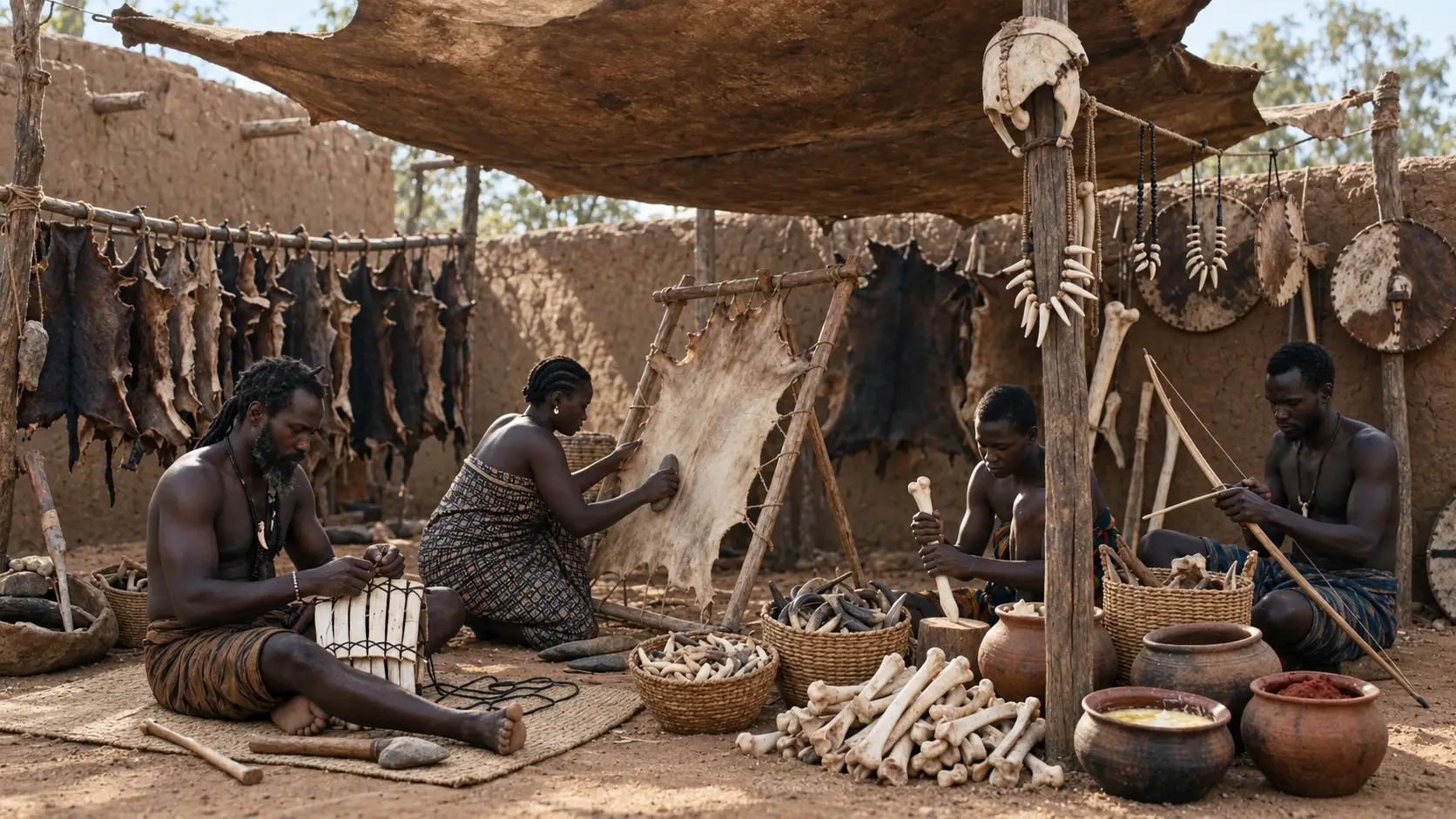
Bone, horn and leather craftsmen
Bone-smiths, tooth cutlers, thick-hide tanners, tendon binders and shield-makers: the workshops that draw from the dead beast the material of daily life and war.
The human-bone taboo
In Arkhan, the taboo is absolute: never human bone in craftwork or armour, not even an enemy’s. Every piece of bone, tooth or skull is animal.
Bone, teeth and horn
The bone-smith makes heavy tools; the tooth cutler fine blades and saws; the horn turner cylindrical parts and tips. The scale inlayer sets decorations, the tooth setter makes jewellery and insignia, the bone engraver carves registers and rites. The point-maker makes shafts, arrows and stakes; the shield-maker laminates horn; skull helmets are made too, as practical trophies.
Hides and leathers
The thick-hide tanner works sauropod and ceratopsian hides, the fine-hide tanner those of mounts and gloves. The plate-harness assembler makes beast armour, the scale-armour repairer maintains it, the studded-leather embroiderer makes soft armour. The tendon binder makes very strong cords and lashings; the hide-glue maker, adhesives; soles of scale leather are also sewn for hard ground, and scale corsets, between fashion and protection.
Three tanning processes
Cold-Scale tanning gives a thick leather that stays supple, resists cuts and does not crack in the sun: an alkaline brine bath, then several days in a mud of clay and soft lime, a massage with cycad oil and a thin film of filtered resin applied hot. The craftsmen speak of “skin that drinks the cold”.
Ribbed leather is tanned while being reinforced with a lattice of tendons; its pieces carry enormous loads. Black Spore smoking, done cold in a smoke of resinous wood, peat and spores, gives a dark leather that resists damp, mould and parasites: much used in N’Goro and by sailors, it is known by its smell.
Sorting before the workshop
In Arkhan, the taboo on human bone does not rest on the craftsmen’s goodwill alone: it is organised. After a battle, a hunt or a raid, the bones and carcasses bound for the workshops first pass through the hands of mortuary crews, priests and sorters who inspect every arrival. They remove everything human, of whatever nation, wrap it in cloth and return it to the rites of the dead. Only animal pieces, once sorted, enter the workshops.
These crews have their great house in a necropolis, and every city shelters a smaller one. The gleaners who roam the steppes and the old basin of the Sea of Bones to gather the bones of dead animals work under the same rule, and a sorter always goes with them. A craftsman found with a human bone would not merely be punished: he would be driven from his clan, and his workshop destroyed.
Boil, degrease, saw
A bone is not used as it comes from the animal. It is first boiled at length to strip off the flesh and marrow, then degreased in a bath of bile and ash that whitens it and keeps it from going rancid. It then dries in the shade for months, for a bone dried too fast splits. Only then does the craftsman work it, with tendon-string saw and wet sand, stone rasp and bow drill, before polishing it with rayskin and hardening it with resin.
Every bone has its use. The long bones of sauropods make beams, levers and handles; the hollow bones of theropods and pterosaurs, tubes and instruments; horn, softened in hot water, is moulded into plates; tooth, very hard, becomes blade, point or jewel. Old craftsmen recognise the animal by the grain of the bone, and its age by its weight.
The world’s leathers
Every nation tans what its animals give it. In Volonia, plesiosaur sea leather, smooth and close-grained, tanned with salt, makes riding boots, harnesses and the bellows of diving bells. The creeks of the Dents Noires tan with mangrove bark a crocodilian leather with bony scales, from which deck boots and boarding jerkins are made. Korath leaves ankylosaur leather its small embedded osteoderms, for armour linings, armoured harnesses and founders’ aprons.
In the Empire, retired draught sauropods yield a thick hide, sold salted in great strips to the canal tanneries, and the harness-makers of Velmor stitch their famous black leather for draught and war animals. Fine leathers come from small farmyard animals and light mounts; the finest are dyed, embossed and embroidered for court dress.
The tannery and its neighbours
You smell a tannery before you see it. Working hides needs a great deal of water, lime, bark tannins, farmyard droppings, brine and months of patience, and it gives off a smell nobody wants beneath their windows. Tanneries therefore settle downstream of towns, downwind, along a river or canal, and the districts around them are among the poorest.
A thick sauropod hide stays several months in the pits before it is softened, and tanners work bare-legged in the vats. Their trade is despised and indispensable: without them, no harnesses, no boots, no shields, no bindings. In the Empire, tanning families form old Lines that marry among themselves, and it is said a tannery child can tell a hide by its smell with eyes closed.