
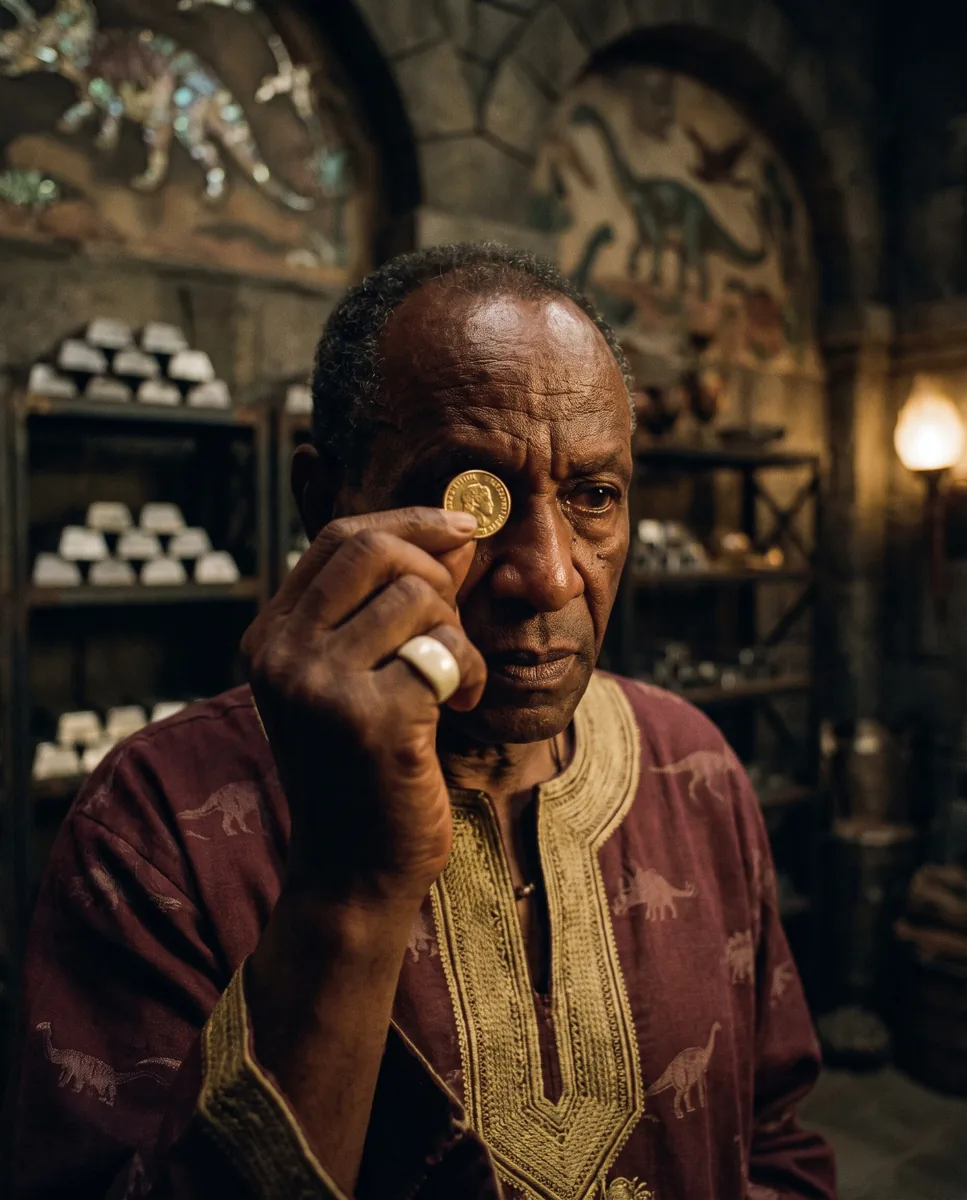
The Draco and the Gold Scale
The Draco (DR) is the fiat currency of the known world. The Gold Scale is the coin issued by Urnok’s Imperial Bank and backed by the Empire’s stocks.
A fiat unit of account
The Draco, abbreviated DR, is the currency of the known world. It is a fiat currency: its value rests on trust in the institution that issues it and in the guarantees behind it, not on bartering goods. The Gold Scale is the physical coin; the Draco is the unit in which sums are counted. The two names coexist without being the same thing.
The economy around it is one of registers, insurance, fodder, bloodlines and responsibility. Simple barter is not its basis: an animal, a clutch of eggs or a cargo is counted, insured and recorded.
A currency backed by grain
In Urnok, the Scale is backed by stocks. The Empire was born of a famine: its first inhabitants were starving Arkhans who settled in the fertile central plains and swore never to go hungry again. From that oath come the cathedral silos, the fodder oasis-markers, the Grand Trésor des Silos and the Compteurs-de-Fourrage, held to be half-sacred. Imperial money belongs to the same chain: it rests on what the Empire keeps in store.
Credit follows the same rule. A grain loan is pledged against declared reserves, and a guarantee depends on the use of the goods behind it: a break in circulation can reduce the ability to repay and the trust placed in a guarantee. A cut road or an emptied silo therefore also touches the currency.
What is counted in Draco
Urnok uses the Draco together with banks, credit, insurance, contracts and seizure procedures. Payment for a public work, the funding of a campaign or a company’s commitment across several duchies all go through it. A Grande Chasse costs a great deal in Draco: fodder, harnesses, bounties. Egg law uses it too: depending on the status of the clutch, a theft is settled with a fine in Draco or becomes a capital crime when the bloodline falls under imperial monopoly.
Some values are never written down. A tyrannosaur egg, which the Empire forbids anyone to trade, is worth “a kingdom’s fortune”; a brachiosaur egg is worth a farming estate. On the black market these prices are whispered in Draco, never put in writing. A legal, quoted futures market in hatchings operates in the open; it also covers that traffic, since whoever can read the futures knows where the eggs are sleeping.
Beyond the Empire
Ishtir has no domestic currency, no wages, no domestic prices and no inheritable fortune. Access to scarce resources goes through rights of use, access or priority, the Droits de la Mesure. Abroad, its orders and ports may use barter, contracts, units of account or Volonian and foreign currencies, without those instruments circulating at home as civic wealth.
Great maritime trade is settled in Draco, but Volonia holds the contracts: the Empire issues the money, Volonia controls its movement. The clans of the wild lands, who never consented to the wars of the six nations, live without the Draco, without writing and without kings.
The Réforme de l’Écaille
Imperial tradition traces the Draco back to an old reform, the Réforme de l’Écaille: an imperial decree ordered that every value in the living world be counted in a single unit. Tendon, tooth, horn, glue and grain became commensurable. Since then the imperial calendar has counted years “of the Scale”, while Arkhan counts in Pistes and Ishtir in Cycles solaires: the same year bears several names depending on who is counting.
This common measure has a downside. By turning grain into a monetary value, it made speculation on hunger possible: a shortage can become a matter of prices, then of hoarding, before it turns into war. The Silo War was the example.
Orders of magnitude
At the known world’s average rate, a 25-kg sack of grain is worth 1.10 Dracos, a week of siege rations for one person 1.70 Dracos and a week of fodder for a construction sauropod 180 Dracos. The average annual output of an inhabitant of Urnok is estimated at about 68 Dracos. The Draco is settled in Gold, Silver and Bronze Scales.
Striking, withdrawing, guaranteeing
The Imperial Bank of Scales and Roads does not strike at will. Every issue must be authorised by an agent of the Issuing Seal, who checks that it matches the declared reserves and enters it in the Great Register of Guarantee. The minting workshops work under seal: metal weighed on the way in, coins counted on the way out, scrap melted down before witnesses.
The Bank also withdraws. Worn, clipped or doubtful coins come back up through the changers and the ducal treasuries, are weighed, then melted down; a Scale that is too light is not refused at market, but it is changed at a loss. In times of shortage, when the silos run low, the Bank slows its issues, and the Draco grows scarcer in purses before grain runs short on tables.
That link is what creates trust. Foreign merchants accept the Draco because they know what supports it: the taxes, the roads, the silos, the fodder and the right of seizure of an empire of thirty million inhabitants.
The Draco in daily life
For most inhabitants of the known world, the Draco is a unit heard of more than handled. People count in Dracos and pay in bronzes. An Urnok labourer earns enough to live without saving, a trainer or a registered craftsman a little more, and the average output of an inhabitant of the Empire is around sixty-eight Dracos a year.
Taxation takes its share in two forms. The Droit de Vente strikes goods at the moment they change hands, and the Dîme de Fourrage is often paid in kind, in bales and sacks delivered to the markers and the silos, because the Empire needs fodder before it needs money. A peasant of Sarnor can thus pay his tax without ever holding a Draco.
Prices move, and everyone knows it. The Bureau des Registres et des Mesures publishes a price index every month, counted from the Reform of the Scale; in times of tension it is pushed upwards by fodder, iron, caravan services and insurance, and the markets talk about it the way others talk about the weather.
The Draco at war
A war is paid for in Dracos before it is paid for in dead. The missing fodder must be bought, the levies paid, the convoys insured, companies and animals hired, harnesses repaired and lost great beasts replaced. An imperial decision of war must therefore find its financing from the Bank, the silos and the dukes, and an order that no one pays for can remain a dead letter.
The institutions have provided for this. Karûm-Brakh delivers fodder on credit to provinces in shortage, repaid in rights of passage and labour; the advance is dear, but delivery is assured. The dukes hold rights of war that allow them to raise contributions on their lands. Volonia, for its part, lends to the belligerents, insures their cargoes and raises its premiums at every rumour of blockade.
War can also be read in prices. When a campaign begins, fodder, tendons and rivets rise; when a road is cut, the Draco loses value in the isolated provinces, where merchants prefer to be paid in grain.
Part of this article covers events of season 1. Turn spoilers on in the menu to read it.