

Families and social ties
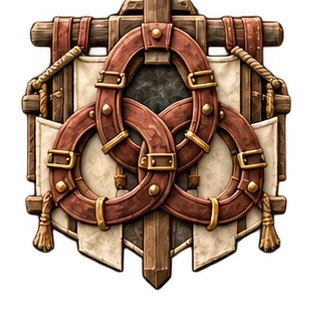
The Triple Harnesses of Qor Zaï
A heavy-harness industrial house within the march and its border trades.
Connecting body, load and animal
The Triple Harnesses make heavy saddles, straps and riding interfaces. This specialisation explains what a harness does: distribute a load, keep fastenings inspectable and enable several trades to work around a living creature.
A saddle defect becomes a problem for the march
In Qor Zaï, bone customs, counter-trails, march relays and border brokers frame movement. Harness work belongs to this landscape of control and passage: an ill-fitted piece immobilises a load, delays a convoy and engages the responsibility of those who supplied it.
A function, not a ducal house
House Drakeris holds the duchy; the Triple Harnesses perform an industrial function. The two levels do not merge. A tool is therefore no sign of family sovereignty; it carries the work of artisans, load inspectors, carers and relay workers.
Between animal, rider and road
The Triple Harnesses hold the interface between animal, rider and road. They work under civil and military contracts, to the imperial standard, and like the other tolerated houses pay a thirty per cent surtax. In the march, a noble commands an animal; the harness maker knows whether it will accept.
Odrik Vauln, Leather-Hand
The house is led by Odrik Vauln, known as Leather-Hand. The Vauln are a family of harness makers from imperial Qor Zaï, and their reputation fits in a phrase repeated across the march: a noble commands an animal, but a Vauln knows whether it will accept. Odrik wears gloves he almost never takes off, even at table, and in the march they say his hands carry the scars of forty years of leather, tendon and buckles.
Between him and Duke Sarek Drakeris, the disagreement is old and productive. Sarek wants robust; Vauln wants precise. The duke thinks of the strap that still holds after three days of patrol and a claw strike, the harness maker of the strap that does not hurt the animal and that it will agree to carry. The saddles of the march were born of that compromise, and each of the two men is convinced he won it.
Saddles, straps and collars
The Triple Harnesses make heavy harnesses, military saddles, anti-raptor straps and collars for the very large. The anti-raptor straps are reinforced with bone plates and ribbed leather where a claw would try to cut, under the belly and around the mount’s limbs, so that an attack does not bring down the rider along with the animal. The house also makes so-called “calm” bits and traction interfaces, designed to turn the strength of the living into work without driving it to panic.
Its signature animal is the strapped iguanodon, the march’s ordinary patrol mount. The house’s name comes from its three-layer strap, ribbed leather, braided tendon and fibre lining, which remains the most copied piece in the Empire. Counterfeits show themselves through wear: a false triple strap comes apart in a season, the real one lasts an animal’s lifetime.
The complete harness, a military secret
The complete harness of a very large animal is a military secret. The Triple Harnesses protect it by separating its components: one workshop makes the straps, another the buckles, a third the padding, and subcontractors in the duchies supply parts whose destination they do not know. Only a few master assemblers know the whole, and the house lets false plans circulate to mislead the curious.
This organisation rests on thousands of small suppliers, sub-component craftsmen of the kind found throughout the Empire: multi-layer padding, tension pieces, anti-chafing guards. Each holds a link and answers for his part in the register. None of them could make a titan’s harness alone, which is exactly the point. The whole makes the house the third of the tolerated houses: about 1.6 million Dracos in receipts a year, a twenty per cent margin, and some 0.22 million net once the surtax is paid.
A harness too long
In the march they say a harness too long can reveal an invasion. The phrase has a concrete meaning. A harness’s dimensions tell the size of the animal that will wear it; an unusual order, straps longer than those of patrol iguanodons, collars sized for a war sauropod announce a movement of great animals before it takes place. Border brokers, customs officers and spies on both sides therefore watch the harness makers’ order books.
The Triple Harnesses know it and protect their registers accordingly. Their military orders carry numbers rather than unit names, their deliveries leave in mixed lots, and their apprentices learn never to talk about measurements outside the workshop. In a duchy whose material is bone and intelligence, a harness house is also a house of secrets.