
Religion and rites
The Rising of the Titans
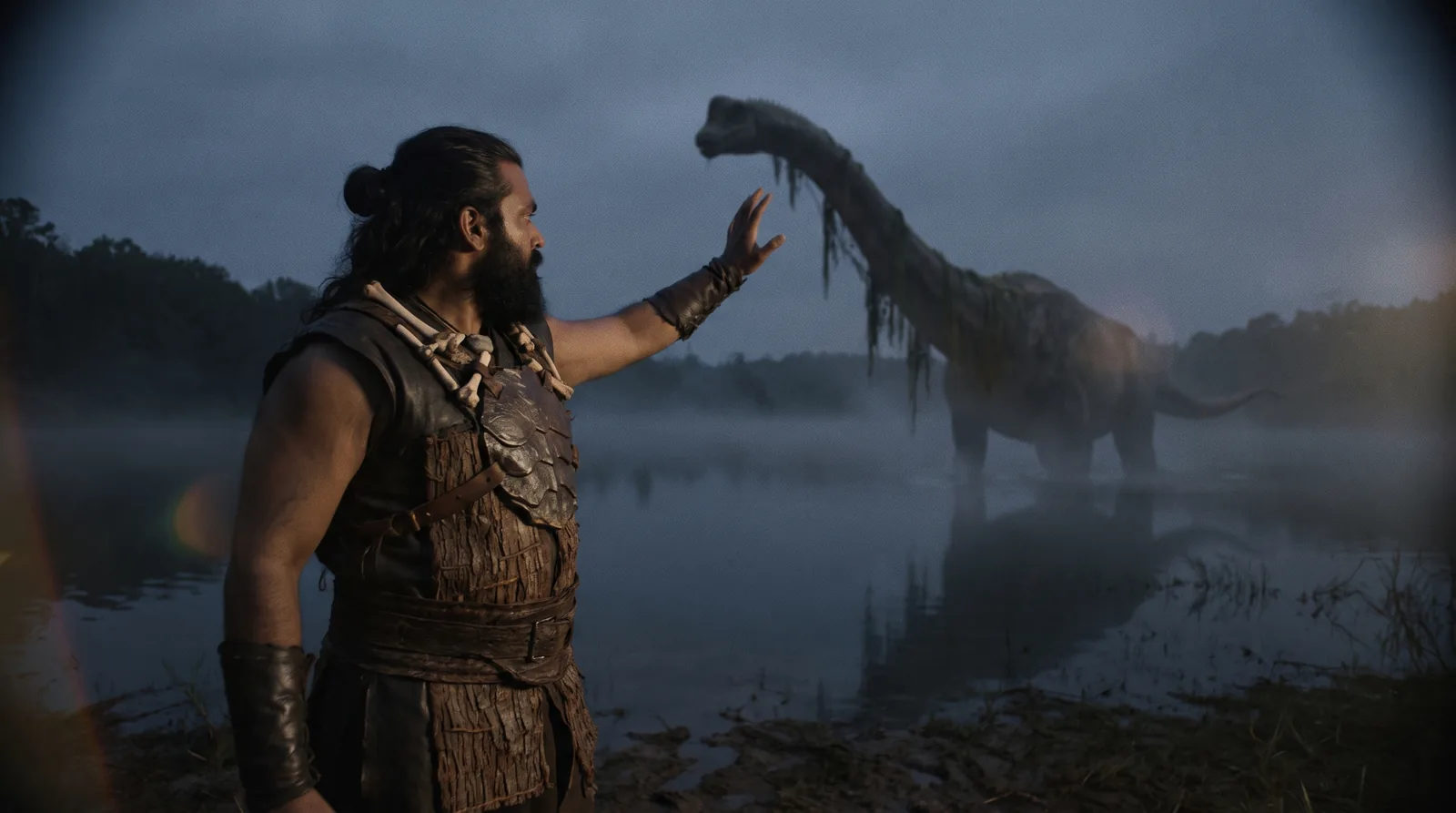
The festival of the Long Boughs: colossal animals swim up the waterways, and porterage and barges are blessed.
Shapes in the mist
The Rising of the Titans (Montée des Titans) is the festival of the Long Boughs. Colossal shapes emerge from the mist and swim upriver; laden barges settle into their wake while boatmen beat the hulls in rhythm. Beneath the high canopy the mist turns golden.
Blessing porterage
The festival blesses porterage and barges. Boatmen, porters and children stand on the pontoons; the Sap-Keepers mark the animals as they pass.
Why the titans come upriver
The festival follows a real movement. At the start of the high waters the titanids — the great sauropods of the marshes, the beasts around which, it is said, a map has to change — leave the shallows where they spent the low-water season and move up the rivers of the Long Boughs towards the upstream pastures, where the lycophyte fronds and ferns they feed on grow. They advance slowly, in single file, necks raised above the mist, and their passage lasts several days.
That passage transforms the river. Their mass tears up the mats of floating vegetation, crushes the reed beds that invaded the channels during the dry season, gouges the mud banks and opens a deep waterway before them. Behind a file of titans the current is calmer and the channel clear for weeks. That is why the barges settle into their wake: the Rising opens the carrying season, and what the boatmen celebrate is the road the beasts have made for them.
How the festival unfolds
The festival begins before the titans. When the lookouts of the High Canopy glimpse the first necks in the distance, marsh drums announce it from post to post, and the families of the Long Boughs then have two or three days to prepare. Hulls are re-varnished with resin, ropes changed, the pontoons from which children will watch the beasts go by are repaired. On the eve, barges that are changing their names are fumigated with Fumée-Douce cones of resin, amber and spores, and receive the name of their new season.
The great day is lived on the water. Laden barges wait at the confluences, then fall in behind the file at a safe distance while the boatmen strike their hulls in time; that steady beat warns the beasts of their presence and keeps them from being startled. As the titans pass, Sap-Keepers posted in canoes mark each one with a strip of resin in spore ink and note its condition — wounds, parasites, thinness — for the registers of the Circle. The main ceremony takes place at Ngiyu-Mu, holy city of the House of Vethan, where an elder pours a flask of filtered water over each barge’s prow, naming the route it will follow.
The blessed carrying
Blessing the carrying is not only a religious gesture: it is the day the season’s commitments are renewed. The master carriers of the House of Vethan, who run the living barges and the locks of the Titans’ Channel, conclude their contracts with merchants and Shedding Villages; crews take on their new members; last year’s carrying debts are settled on the quays. Many agreements are knotted on cords exchanged at the very moment the first titan passes, because a commitment made under the beasts’ eyes is held to be firmer.
The festival is also a passage for the young. A boy or girl making a first ascent in the titans’ wake, as paddler or deck hand, is celebrated that evening by the crew, and is said to have “gone up with the great ones”. For the families of the Long Boughs it is a small shedding: one sometimes receives a boatman’s nickname, which does not replace the shedding name but is added to it. In the evening, on the platforms of the suspended markets, people eat smoked fish and black-flour cakes with honey, and count the year’s titans as others count their harvests.
Dangers and prohibitions
The titans are not mounts, and no one in N’Goro claims to command them. Every year the Rising has its accidents: a barge in too much of a hurry, crushed by a tail; a swimmer caught in the eddies; a canoe overturned by a neck lowering to drink. The festival’s rules come from those deaths. No craft may go ahead of the file or come within several beast-lengths of it; no fire burns on the water during the passage; no noise drowns the beat of the hulls; no one touches a titan except the Sap-Keepers who mark it, and only from a pole.
The wake also draws predators. Great crocodilians follow the titans for the fish and the injured beasts, and water guards patrol between the barges, harpoons in hand. The elders repeat to the children the saying that sums up the festival: “Follow the titan, never go before it.” Foreigners who attend the Rising mostly remember one thing: in N’Goro you do not bless the beast, you bless what it makes possible, and you take care to stay behind it.