

Trades
Les paveurs des Grandes Sauriales
Les chaussées portantes ouvrent les routes impériales aux charges et aux grands animaux.
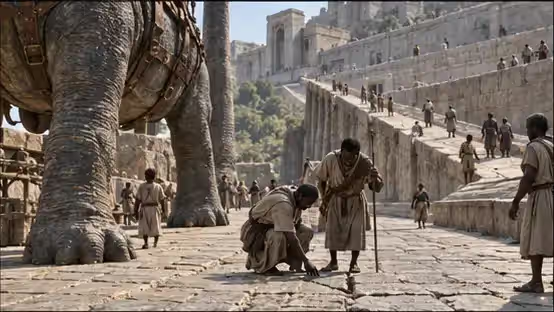
Faire une route pour le poids vivant
Le paveur de chaussées portantes rend les Grandes Sauriales utilisables par les charges lourdes. Ces routes appartiennent au réseau des voies impériales, des relais, des silos et des espaces de sauropodes. Le travail ne se réduit pas à permettre aux personnes de marcher : la chaussée doit recevoir une masse et donner accès à des haltes. Son usage associe donc la surface de passage à la continuité du réseau qui nourrit et accueille le convoi.
Une voie vérifiée avant le passage
Le passage d’une grande bête déclenche inspection, fermetures, équipes au sol et déviations des humains. Les chaussées portantes s’utilisent par créneaux de masse, avec haltes, eau et fourrage. Le paveur travaille sur une voie que d’autres équipes devront ensuite examiner et ouvrir. Une surface aménagée ne dispense donc pas du contrôle au moment du convoi : l’état du passage et les conditions d’usage continuent de compter après la construction.
Préserver les passages des habitants
Les petits passages humains contournent les voies portantes. Cette seconde circulation permet de maintenir une vie ordinaire lorsque l’avenue reçoit un animal ou une charge. La chaussée lourde doit ainsi être comprise avec ses accès et ses contournements, plutôt que comme la rue commune simplement agrandie. Le travail sur une voie atteint les trajets des habitants aussi bien que l’itinéraire du convoi, puisque l’ouverture d’un passage peut imposer la fermeture d’un autre.
Nettoyer et rouvrir une route utilisée
Le nettoyage fait partie du cycle de passage, avec l’inspection et la halte. Dans le centre impérial, la voirie lourde côtoie la filière des déjections et les autres services urbains. L’usage d’une route laisse donc du travail après lui : maintenir le passage n’est pas une opération terminée une fois le sol aménagé. Paveurs, équipes de voie et services de nettoyage participent à des moments différents d’une même continuité, entre arrivée, circulation et remise en usage.
A paving crew
A load-bearing roadway workshop looks like a small village on the move. It brings together some thirty masons and stonecutters, about eighty labourers, two engineers trained at the Synod, keepers and, to lift and lay the heaviest slabs, a construction brachiosaur that works like a living crane. The master paver answers for the whole; under him, team leaders share out the trench, the bed of stones, the tamping and the laying.
The slabs often arrive ready-made. A company in the capital crushes shells, makes the mortar and casts grooved slabs treated with shell lime, which it delivers to the sites and lays itself on the convoy rings. On the great provincial roads, stone is still cut on the spot, from the basalt or limestone of the nearest quarries. A crew advances a few dozen paces a day, and a league of new way keeps a workshop busy for a whole season.
Why the slabs are grooved
A smooth slab is dangerous for a very-large animal. Wet with rain or washing water, it becomes slippery, and a sauropod that slips can break a leg or overturn its load. The slabs of the load-bearing ways are therefore cut with grooves that give the feet a grip and carry water to the side drains. Their direction is not left to chance: on slopes they cut across the descent; on bends they follow the curve.
Pavers know how to read wear. A groove fading in the middle of the way tells of the passage of heavy convoys; a slab sinking on one side betrays a blocked drain or a badly tamped bed; a star-shaped crack marks the spot where an animal fell or stopped too sharply. A worn slab is replaced without redoing the whole section, by lifting it with a lever, reworking the bed beneath and laying the new one with flexible joints that let the roadway move.
The building season
Pavers work mostly in the dry season, when the earth settles well and the mortar sets. A section under repair is closed to heavy convoys, marked by painted wooden posts and bypassed by diversions that the ground crews stake out every morning. In the capital, the big works are done at night, between two passage slots, and the residents of the avenues fall asleep to the sound of the rammers.
Upkeep is expensive and never ends. Relaying the slabs, clearing the drains and restoring the stones of a league of load-bearing roadway costs several hundred Dracos from one year to the next. Road tolls, the Sales Duty and the Crown’s domains pay most of it, and the duchies crossed provide days of labour when a flood carries away a whole section.
The Corps of the Great Saurials
Pavers serve in the Corps of the Great Saurials, the State corps that also brings together the Living Boundary Stone setters and the load surveyors. The Corps maintains about two thousand leagues of paved roadway and three thousand leagues of strategic roads, and its maintenance depots line the great ways with their tumbrels of gravel, their hand rammers and their stacks of spare slabs.
The Corps is not alone on the roads. Karûm-Brakh builds most of the great new works, and the High Chancellery of the Living Ways certifies their conformity; the Corps’ pavers maintain what others built, and never miss a chance to remind people who repairs the bridges signed by “the Family”, as Karûm-Brakh is nicknamed. In war, their crews follow the armies with carts of ready slabs, and a paver who reopens a cut road in a night is mentioned in his legion’s orders like a soldier.