

Economy
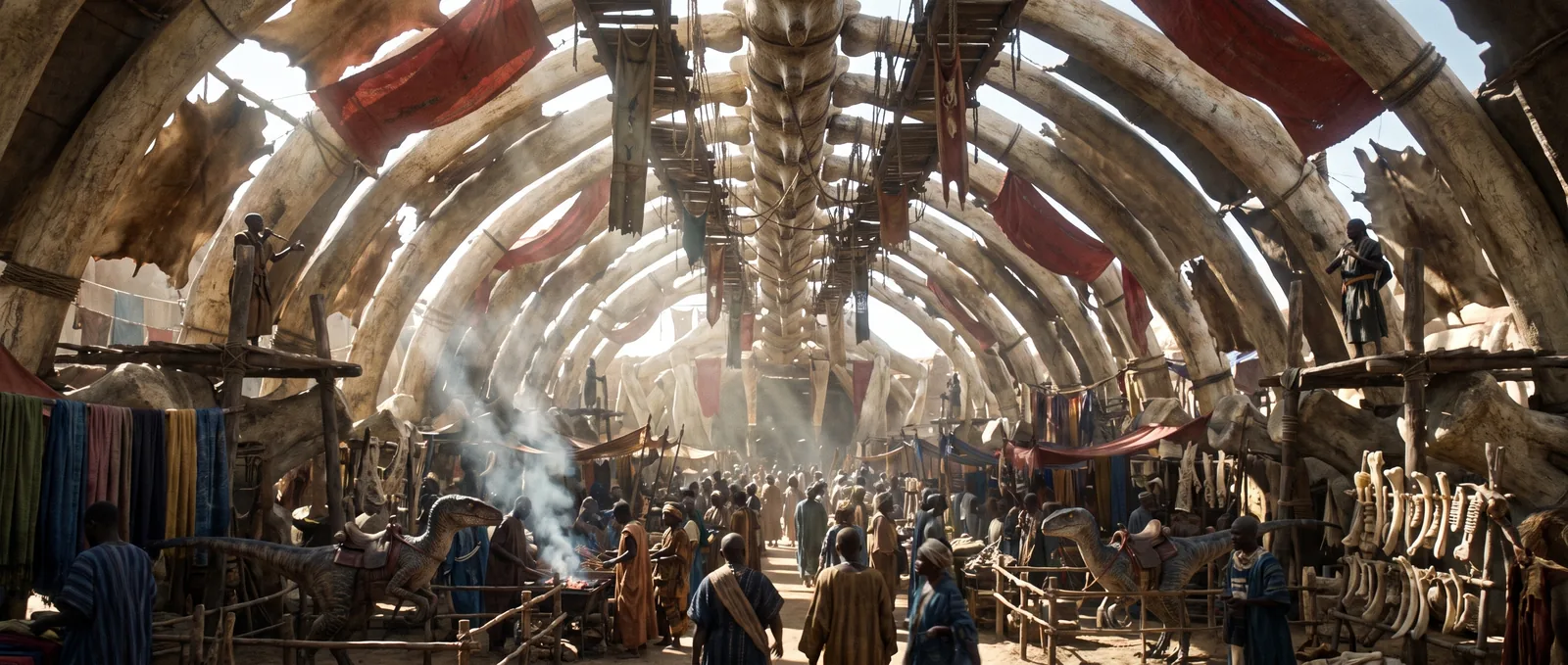
Arkhan: materials and mobile memory
Tracks, reputation and animal-bone trades shape commerce.
A light administration
Arkhan administration relies on tracks, memory and reputation. The Rule of Three organises takings; the Great Shedding transforms peoples’ relationships with their cities. Limited bureaucracy is an institutional choice. It does not mean work, the distribution of goods or the memory of obligations have no rules.
The armourer knows how to join
The bio-composite armourer works animal bone, leather, tendons, resins and metal. This profession can support several workshops and a prosperous business. Its materials require joining methods and skills distinct from iron forging. Lime, saw-teeth and preserved meat also enter these chains.
Reading a track through water and wind
An Arkhan track is read through what is missing, what drinks, and what the wind erases. The Water Master checks the resource needed for the next stage; the wind tracer notes signs that are dispersing; the track interpreter joins this information to the memory of passages. Their conclusion can be modest: slow down, go around, wait. It keeps movement from being presented as heroic certainty when the ground promises nothing.
Harness decides a movement
The Vur-vaa trainer, asymmetric saddle master and claw cutter work on details that can alter an entire day of travel. A badly placed strap, a neglected claw or poorly distributed support can tire, injure or make a manoeuvre impossible. They assess fit before the track begins. This attention to living animals joins bio-composite workshops without erasing the absolute boundary that always separates animal bone from human remains.
Memory travels between groups
The war singer carries a memory that can accompany departure, return or mourning without replacing each group’s own account. The clan mediator seeks a form of speech that allows continuation after a debt, an injury or disputed sharing. These trades give texture to a society of reputation and tracks. They do not decree central authority: their weight comes from a word kept and listening earned on the spot.
One household combines several trades
In Arkhan, herding, recovery, craft, trade and war can meet in the same working lives. This does not mean everyone masters everything. A person often performs several tasks because the stages follow one another: tracking an animal, preparing material, repairing equipment, exchanging a lot and leaving again. Versatility reduces the need for heavy administration, but makes groups more sensitive to injury, departures and loss of local knowledge.
One carcass supplies several uses
After an animal dies, material is not reduced to meat. Leather, tendons, fat, animal bone, teeth, repair resins and harness parts can enter different circuits. Sorting, cleaning and drying determine what can still be used. Each use keeps its boundary: human remains are absolutely separated from craft. Recovery is therefore work of material, time and responsibility, not an image of indiscriminate looting.
Arkhan in figures
The average annual output of an inhabitant of Arkhan is estimated at around 50 Dracos, the lowest of the nations that count in Draco. Agriculture and fodder make up 24% of it, the army 18%, industry and crafts 18%, animal husbandry 15%, trade and finance 13%, elite rents 8% and administration and learning 4%.
The clans levy a movement tax, a toll on everything that crosses the steppe. Saddlery and raiding animals cost less than the average rate there (0.90), fine fabrics more (1.15). Part of Arkhan’s spoils becomes value in Draco at Port de Sable.
What Arkhan sells and buys
Arkhan sells above all what its beasts provide. To Korath, through the gate of Vrakhor and the Korath Defile, it supplies calibrated tendons and the fine-sinew bundles of ballistae, dried meat, short-grass hay and calibrated bones, in exchange for iron, steel, rivets and chains. At Port de Sable, the Volonians buy live raptors, transport cages, prestige teeth and blades, the velvet of Vüren, amber and jade, and take on the brokering of ransoms; they pay in Dracos, in credit, in ropes, sails and ship timber.
Toward N’Goro, in the south, go dried meat and hides; back come the anti-rot glues without which tendons, leathers and bows would rot, balms, insect flour and resins. With Urnok, through the marches, hides and tendons are exchanged for the Orlantis wood and resin of composite bows, sauropod tendons and grain, under the eye of the imperial customs. With Ishtir there is almost nothing to trade in peacetime: the border is a border of war.
Paying in meat, shares and bone
The Draco circulates at Port de Sable, at Vüren and in the cities, but much of Arkhan’s work is paid otherwise. Workers at the kilns, the leather camps and the relays receive part of their pay in meat; warriors, in shares of the booty weighed by the Butin-Kar; bands, in meat debts settled at the next hunt. The Skinners of the Longs-Os are paid in calibrated bones, the standard piece of the Horde, which serves as a currency of labour from one end of the trails to the other.
Captives receive nothing: they work mostly in the slaughter yards, the leather camps, the bone kilns and the quarries, and the ration follows their bodies. For large sums, khans prefer to chests of coins the goods that can be carried and certified, teeth, claws and prestige pieces passed through the Bone Tribunal. An Arkhan fortune fits on a saddle, and that is exactly what its owners ask of it.
Where trade happens
Arkhan trade has its fixed places, despite the Great Shedding. The great market of Qor-Zaï, behind the weighing yard and the Bone Tribunal, is the centre of the chain: cement, armour and trained mounts are sold there, and everything of value is certified there. Vüren, in the south-west, is the market of bones, teeth, amber and velvet, and the main point of contact with Korath. Port de Sable, on the south-east coast, is the Volonians’ gate and the place where a prize most directly becomes a value in Dracos.
Between these great places, trade follows the trails. The caravanserais, the halts of the Relais du Vent and the passing markets held around wells opened for the season see salt, dried meat, hides and beasts go by. The Arkhan merchant hardly keeps a shop: he follows the gatherings, the Great Race, the returns from raids, and knows that a crowd that has just divided a prize is a crowd that buys.