

Materials and resources
Corvel: what makes joining possible
Resin, sinew and ash supply a discreet link in the Orlantis economy.
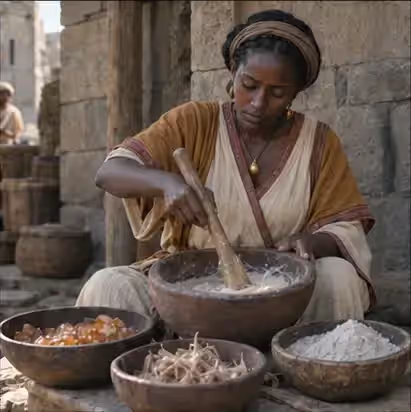
An intermediate-product Line
Corvel handles glues and sticky compounds made from resin, sinew and ash. Its output supports joints, veneers and fletched arrows. This level is distinct from finished goods: Corvel produces what allows other workshops to produce. Its work can disappear inside an object without disappearing from its accountability chain.
Several materials in one bond
A glue combines materials prepared by other chains. Resin notably belongs to Aversin; sinew also belongs to an animal economy. This intersection makes production dependent on several actions and deliveries. These ingredients do not make a recipe: proportions and formulation secrets remain unknown.
The binder contributes to durability
Biomaterials do not become durable merely because they are well designed. Binders and treatments matter in biological composites, and sinew remains sensitive to moisture and fatigue. This constraint makes maintenance visible: a joint’s quality also concerns what remains below the surface.
A family of glues
The Empire does not use one glue, but several, and each has its use. Corvel resin glue, made of boiled tendon, resin and ash, holds joints, veneers and fletchings; it stands up to damp better than the others. Hide glue and bone glue, more common, are made in every duchy and serve for ordinary joinery. Cartilage glue, drawn from the vertebral discs of sauropods, stays supple as it dries, and is used to bind ribbed leather and the limbs of bows.
Alongside these binders there are birdlimes, pastes that stick cold, sold in sealed pots, and the anti-rot preparations of N’Goro, which do not glue but preserve. A single object can combine three: a composite bow holds by cartilage glue, its fletching by Corvel’s, and it lasts thanks to N’Goro’s. Craftsmen know these differences as a cook knows his fats.
Ash-gatherers and potash makers
Beneath Corvel work humbler trades still. Ash-gatherers go from house to house buying hearth ashes, which they collect in sacks; some is used as it is to bulk out glues, some is leached with hot water and boiled down to give potash. This potash is used for soaps, dyes, certain glues and degreasing fibres; it sells for barely more than a tenth of a Draco a kilo.
The charcoal burners work in the forest, behind the Berlan fellers, turning into charcoal the branches and offcuts the other Lines do not use. Their clamps smoke for weeks in the clearings. These trades often amount to no more than a short Line, a workshop and a family, but Corvel would not make a single plate of glue without them, and the Line’s masters make sure their ash-gatherers are paid on time.
Gluing a bow
The composite bow is the most delicate work that depends on glues. It joins a wooden core, a horn belly and a tendon back, each prepared separately, and the glue must hold them together through years of drawing and release. A bow is glued only in the dry season, in heated workshops where the humidity of the air is watched, and the glue must dry for months before the bow is strung for the first time.
Archers say a bow is glued one summer and shot the next. An army that wants bows for a campaign must therefore order them more than a year in advance, and the quartermasters of Velmor, where archery is queen, place their glue orders well before their timber orders. A bow whose glue fails does not always break at once: it loses its strength little by little, and an archer who cannot understand why his arrows fall short often has a glue problem rather than an arm problem.
Storing and transporting
A dry glue keeps for a long time, provided it stays dry. Corvel’s plates are stored in varnished chests, separated by sheets of fibre, and keep for years; birdlimes travel in clay pots sealed with wax, which fear heat. Each batch carries the workshop’s mark, and downstream workshops store their glues by date, always using the oldest first.
On campaign, glue follows the armies. The mobile workshops of the Living Gears carry reserves of it, and saddlers and armourers warm it at the bivouac in small bronze pots set on the embers, to reglue a fletching, an armour plate or a handle. Overheated glue loses its strength; cold glue does not take: apprentices learn to judge the temperature with a finger, and those who burn themselves do not do it twice.