
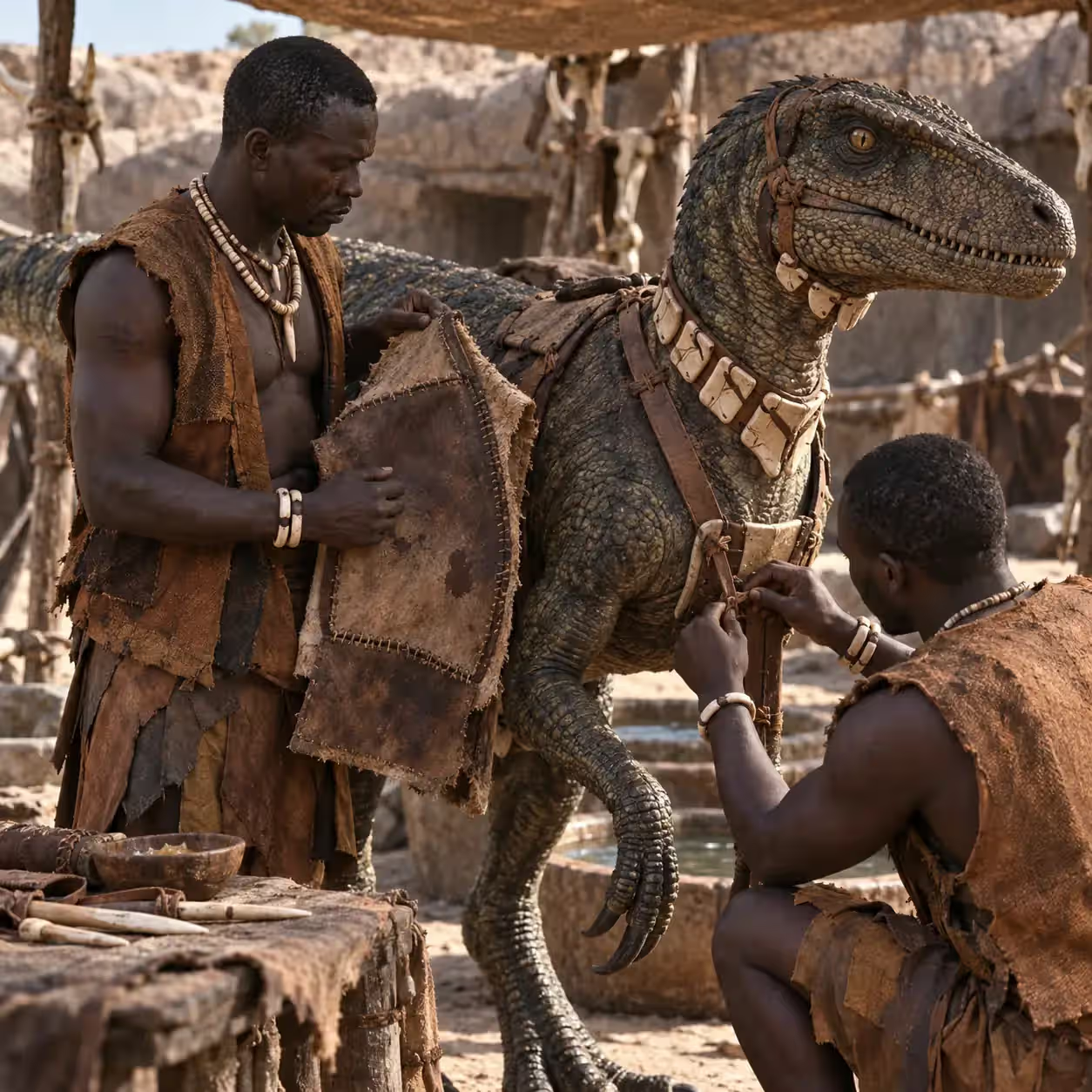
The Harness-Master
The Harness-Master answers for the interface between human and beast; in the Empire, they say a strap is worth a battle.
A strap is worth a battle
The Harness-Master works wherever a beast carries a load or a rider: the Empire, Volonia and Arkhan all know the trade. He looks after the comfort, safety and efficiency of the interface between human and beast. In the Empire, he answers for the interfaces of the great war beasts and of the very large, and the saying is well known: a badly set strap is worth a lost battle.
On the road, he adjusts the effort asked of the living. Harness care begins before departure, in the way a load is set.
Leathers that pull tons
The Harness-Master depends on particular leathers. Tendon-ribbed leather is tanned and reinforced at the same time: a lattice of tendons laid on the inner face of a still-damp hide, pressed in a ribbed mould and dried slowly in the shade. Its pieces behave like composites, light yet able to pull tons; transport guilds and the army seek them out, and they serve as the imperial standard for raptor saddles, traction harnesses and winch straps.
The houses of the harness
In the Empire, the Harnais Triplés of Qor Zaï make heavy harnesses, military saddles, anti-raptor straps and collars for the very large; they control the interface between beast, rider and road. There they say that a noble commands a beast, but a Vauln knows whether it will accept. The complete harness of one of the very large is a military secret, protected by separate components and false plans.
The house, led by Odrik Vauln, called Leather-Hand, also makes so-called “calm” bits and traction interfaces: its skill lies in translating the strength of the living into work without panic. Its signature animal is the strapped iguanodon. In the march, they say a harness too long can reveal an invasion. The Harnais Triplés are the natural allies of Karûm-Brakh, whose building sites need their interfaces.
In Arkhan, the asymmetric-saddle masters of the Cavaliers du Crâne make left-mounted saddles; in Volonia, Velasar makes marine harnesses for its sea animals.
Becoming a Harness-Master
No one becomes a Harness-Master without carrying templates for years. The apprentice starts in the workshop, preparing leathers, plaiting tendons, greasing buckles and stitching simple pieces; then he follows his master into the pens, holds the measuring cords and learns to approach an animal without alarming it. As a journeyman, he fits the harnesses of ordinary draught animals on his own and goes with the convoys to see how his pieces behave under strain.
The master’s test is taken before peers. The candidate is given an animal he does not know, takes its measurements, makes and fits its harness, and then the animal works a whole day under the examiners’ eyes; in the evening they unharness it and look for the slightest trace of rubbing. A single sore is enough to fail. In the Empire, the title is then entered in the Register of Trades, and the new master answers from then on, in his own name, for every harness he signs.
Fitting to the inch
The great pieces of the craft are fitted to the inch. The neck yoke of a draught sauropod, which on its own weighs as much as two men, rests on the shoulder and the base of the neck: a few fingers too high and it squeezes the throat; a few fingers too low and it crushes the shoulder, and the animal wears out in a season instead of working twenty years. The full harness of a very-great one weighs nearly a tonne, in leather, tendons, chains and horn, and each of its pieces is fitted separately.
The Harness-Master keeps for every great animal a record of measurements that he updates throughout its life. An animal grows thin on campaign, fills out at rest, changes its gait with age or after an injury; the harness must follow. Before a long road the master takes all the measurements again, and he may remake a piece the day before departure because the animal has gained or lost a finger’s breadth around the chest.
The world’s harnesses
Every nation has solved the problem of the harness in its own way. In Ishtir, the charge harness of the Cornes d’Argent sets the ceratopsian’s cadence and transmits the shock of the charge; its pieces come from separate workshops, and none sees the complete harness. Korath yokes its ankylosaurs with a collar and chain traces sheathed in ankylosaur leather, strong enough to haul an armoured convoy up a pass. In Arkhan, the carnosaur harness has three girths: one for the charge, one for panic, one for the return.
In the Hautes Jungles, the plaited glide harness, fitted with runners and a bronze brake, makes it possible to go down the runs of the Falls. In N’Goro, the towing collar of a spinosaurid stays loose, of hide and chitin: the animal pulls only if the smell and the route suit it, never on command, and the harness-maker knows he commands nothing. Volonia, lastly, fits its fishing plesiosaurs with harnesses on safety lines, released in one movement if the animal dives.
The right to say no
The Harness-Master holds a power that people outside the craft poorly appreciate: the power to say no. Before a convoy or a column sets off, he inspects the teams, and a harness he refuses does not leave. In the Empire, the harness inspector can hold back an animal, a wagon or an entire convoy, and no merchant, no officer can override him without taking on himself the responsibility for the accident. Few take the risk: when a girth snaps after a refusal, whoever forced the departure answers alone for what follows.
This power ends where action begins. In battle the master does not command; he advises, he repairs, he says what the animal and its equipment can still do, but the decision lies with the commander. Harness-masters know it and say so: their battle is won the day before, in the workshop.