

Armies
Bralnor — le Pas-Ascendant
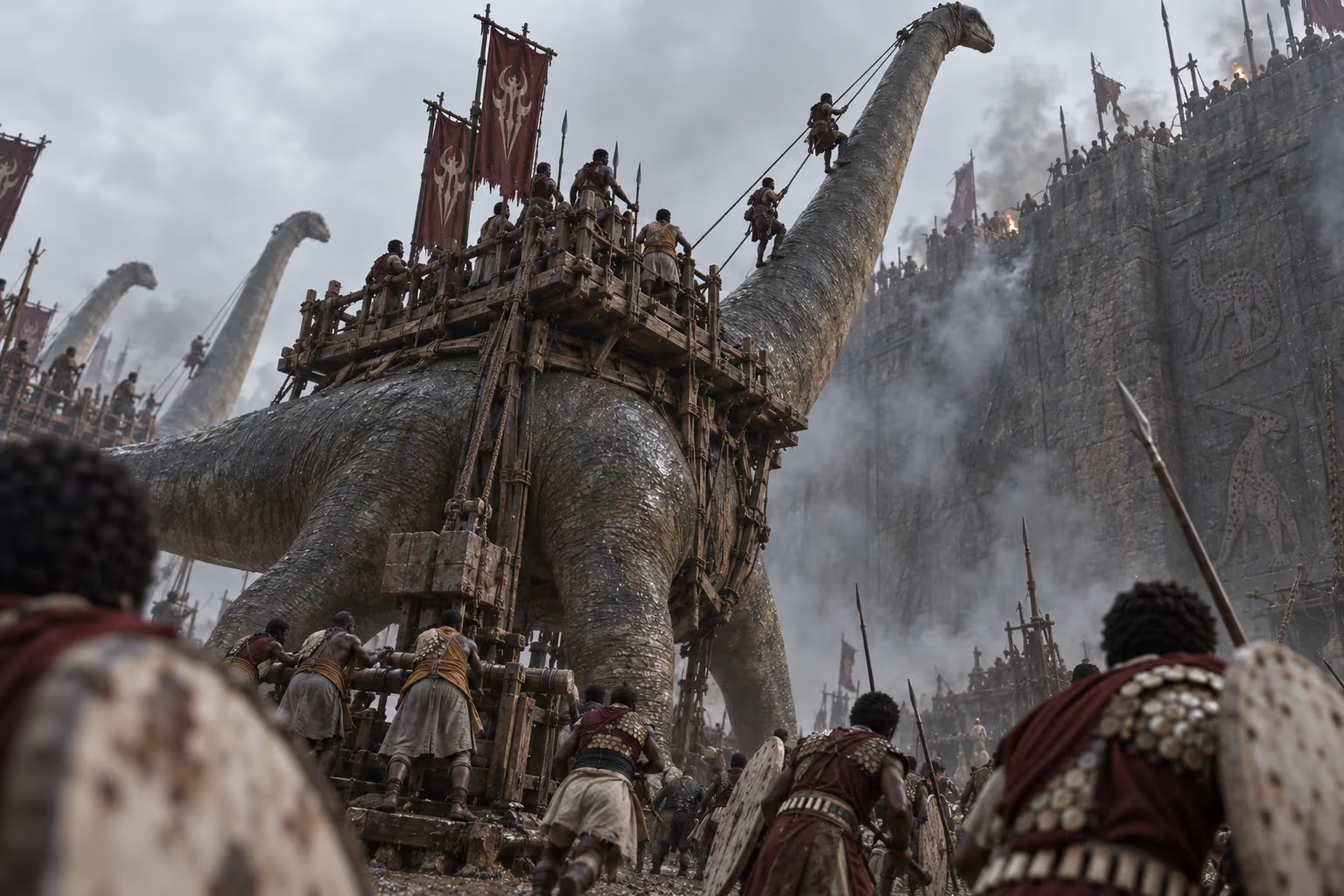
Le Mamenchisaurus d’assaut ouvre une voie vers le parapet. Du pas qui charge la machine au flux des hommes sur le pont, dix scènes donnent corps à la technique de Bralnor.
Le pas et la machine
Le Pas-Ascendant repose sur la dalle de charge, les transmissions et les câbles-guides. Le Mamenchisaurus appartient à la force d’assaut de Bralnor.
Le poste d’assaut
Bralnor · Maison Eralis · commandement sur le pont d’assaut.
Du pont d’assaut au parapet
La paire d’assaut suit le câble-guide puis atteint le sommet. Le cou reste celui d’un grand herbivore à petite tête : sa longueur fournit la hauteur, tandis que les hommes assurent la prise du passage.
Observe gestures and materials · 2 images
À hauteur du parapet
Bralnor · Maison Eralis · arrivée au parapet.
Le pont prend tension
Bralnor · Maison Eralis · mise en tension du pont.
Le passage devient un front
Le pont prend tension et les unités progressent : le passage devient un front de siège.
Observe gestures and materials · 3 images
Le front des tours vivantes
Bralnor · Maison Eralis · front d’assaut.
La prise du rempart
Bralnor · Maison Eralis · prise du rempart.
Le mur cesse d’être une limite
Bralnor · Maison Eralis · forces réunies devant le rempart.
A neck for a ladder
The Pas-Ascendant rests on a beast: the mamenchisaur, a sauropod with a tiny head whose neck, fourteen to fifteen metres long, is more than half the length of its body. Raised, that neck carries the head to the height of a rampart, and it is this height that Bralnor’s engineers have learned to use. The body, more modest, stands on four columnar legs, steady enough for the animal to stay still while men work along its neck.
These beasts are rare. Bralnor raises a few for its assault forces, in the yards where the quarry brachiosaurs are also kept, and each needs years of training before it will tolerate men clinging to its neck, the noise of a siege and the arrows. Elsewhere in the Empire the mamenchisaur is better known as a beast of the long roads, and many people in the duchies have never seen Bralnor’s except in paintings.
The machine of the step
The machine itself stays on the ground. It is a large timber frame set before the wall, carrying a drum wound with tendon cable and a set of basalt counterweights, cut and weighed against the master weight in Bralnor’s halls. In front of the frame a wooden load plate receives the animal’s forefoot. When the mamenchisaur presses down, its weight releases the counterweights, which turn the drum and slowly draw along the neck the guide cables to which the men are attached.
The movement is slow and controlled: there is nothing of a catapult about it. The driver has the beast press, release, press again, and each step raises the men a few metres. The Pas-Ascendant is assembled by Bralnor’s Corps of Masses, the Empire’s siege engineers, in the hall where they also build their counterweight towers, rams and bridge sections; its tendon-workers inspect it before each use, cable by cable.
The pair and the bridge
The first to climb are two. This pair of sappers travels in chest-and-hip harnesses fixed to the guide cables running along either side of the neck; at the parapet they drive hooks into the masonry and anchor the first ropes while the assault archers keep the defenders under cover. The sappers wear engineer’s dress, a stone-grey woven wrap and an ochre sash, arms bare for the work.
Once the anchoring is done, the assault bridge is stretched out. It is a heavy rope bridge, fastened to the animal’s breast harness and not to its neck, which then carries the legionaries. The beast settles back, the bridge takes the strain, and the infantry, in bronze and bone scales over quilted crimson garments, climb in waves towards the rampart. The neck carries only the first men; the body carries the rest.
Protecting the neck
The neck is both the ladder and the weak point. Its armour is therefore graduated: the base third, the most exposed and the strongest, is covered with thick overlapping lamellae of leather and bone, with a net against arrows; the middle third receives only light bands laid lengthwise; the last third is almost bare, with a small frontal guard, because any weight added at the top tires the animal and unbalances it.
The beast must never stay long beneath the rampart. Defenders aim at its neck, its eyes and its drivers, and try to cut the cables and throw down the bridge. Underguards protect its feet, pavises cover the frame of the Pas, and the assault archers shoot without pause during the few minutes of each wave. When a wave has gone through, the animal is backed off to catch its breath, and it all begins again.
The front of living towers
A single mamenchisaur opens a breach; several open a front. When the Corps of Masses has several beasts, it lines them up along the same stretch of wall, up to ten side by side, so that the defenders cannot cut all the cables at once. The rampart then ceases to be a limit: it becomes a front, where the legionaries arrive at several points at the same time.
Such an assault is decided at a high level, because each beast is precious and its loss is counted in years of training. The drivers prepare for it in Bralnor’s quarries, where terraces cut into the limestone serve as practice walls, and the quarrymen’s families watch the beasts and men training there go by. In the duchy these exercises are called “climbing the stone”, and a bold scheme is said to “need a long neck”.