

Places and landscapes
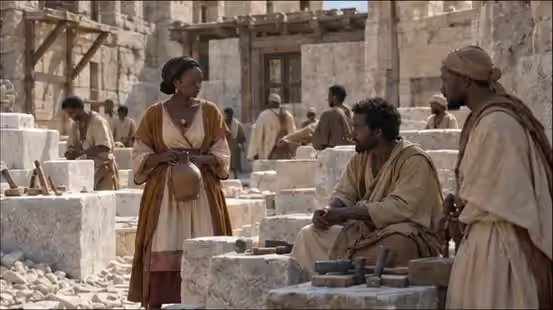
Bralnor: stone passes through hands
Quarries, lifting and heavy hauling make Bralnor a territory where useful stone is always prepared and accompanied.
Extraction is not enough
At Bralnor, a block passes through cutting, preparation and checking before it can be lifted or rolled. The quarry is therefore a place of linked trades: cutters, counterweight crews, winch repairers, load stewards and road workers depend on one another. Monumental stone appears at the end of this chain, not at its start.
The journey starts in the quarry
A stone load requires preparation space, legible access and periods when other traffic moves aside. Crews do not merely move a block: they make its path usable, signal manoeuvres and preserve neighbourhood access. The worksite thus extends into paths, stops and works that receive the stone.
Des ouvriers inspectent les rouleaux et les joints du pavage pendant qu’un sauropode attend au-delà d’un seuil marqué.
Lifting is shared work
The construction brachiosaur is Bralnor’s emblem, but an emblem does not replace the people around it. Harnessing, checking, water, rest, clearance and repair are all part of the operation. The relation to animals is therefore one of coordination: the animal increases lifting capacity while the territory must feed, guide and provide safe ways for it.
Roche du Nord, from the face to the road
The duchy’s capital, Roche du Nord, reads like a quarry descending towards its road. At the top, the quarry faces and the brachiosaurs’ lifting ground; lower down, the sawing and cutting yards, built downwind because of the dust; then the counterweight hall and the winch workshops; finally the wagon park at the start of the bearing road. The brachiosaur yards lie outside the walls, between the quarries and the road, with their troughs and fodder stores.
The duchy has two great quarries, worked by House Eralis for centuries, and many small ones, opened and closed as the Empire’s building sites require. The white dust of the cutting covers everything, roofs, trees, clothes; a man coming back from Roche du Nord is recognised by that dust.
What the mountain gives
Bralnor’s quarries yield several stones, each with its use. Dark basalt makes counterweights, paving stones and millstones; noble limestone, the blocks of the cathedral granaries, markers and lime; white veined marble, the statues of brachiosaurs, the stelae and the façades of the capital’s heights. Gravel goes out to every road, and cutting powder, sandstone ground under millstones, is used to saw and polish the blocks.
Two humbler products travel just as far. Gizzard stones, sorted pebbles that sauropods swallow to grind their fodder, go out to every yard in the Empire. Garnets, picked out of the spoil, end up as cabochons on scribes’ rings.
The master weight
The counterweight hall is the most exact place in the duchy. Basalt masses are cut there, then weighed against the master weight, the imperial load standard, and their weight is engraved in the stone. The great five-tonne counterweights serve the towers and building-site cranes, the half-tonne ballasts the fodder hoists of the towns. An engraving error is a serious fault: a counterweight that lies brings a load down.
The winches come from neighbouring workshops, where tendon is braided, bone pulleys are cut and every cable is tested under traction before delivery. Counterweights and winches leave together for the Empire’s building sites, and often with them the men who know how to rig them.
Water, winter and the High Moors
Bralnor lacks water. The duchy has no great river and depends on two lakes, wells and cisterns, while a single brachiosaur drinks nearly three thousand litres a day. Water limits the size of yards and building sites far more than stone does, and a dry summer slows the quarries as surely as a cutters’ strike.
Winters are hard on these uplands: snow closes the faces and makes the quarry road dangerous, where a slab collapsing under a wagon remains the most feared accident. To the north, in the High Moors, live wild tribes who sometimes raid the convoys, and the duchy also serves as a frontier. In war, the Empire requisitions its engineers and crews: the Corps of the Masses of Bralnor supplies the armies with blocks, counterweights and siege towers.