

Economy
Fodder is infrastructure
Animal provisions determine what a road, worksite or convoy can actually sustain.
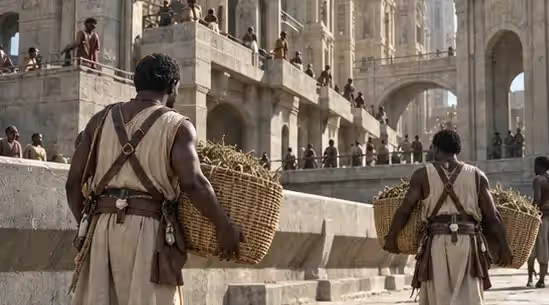
From field to water point
Fodder passes through reserves, convoys and stops before becoming working capacity. This chain links agricultural land to work sites and roads without confusing human food, seed reserves and animal feed. A local shortage can immobilise an otherwise well-equipped effort.
Foin et sacs dans un abri de bois
Vue de détail.
Feeding grants no universal right
Holding a reserve or moving a ration grants no general right over the animals that consume it. Storage, transport and responsibility for use are distinct tasks. This separation makes the economy legible: the same convoy can depend on several trades and decisions.
An empire that eats
Imperial ideology describes the Empire as an organism that eats. Fodder is a matter of sovereignty: a State’s capacity is measured by what it can feed, move and set to work. Urnok counts some seventy-eight thousand sauropods, whose pulling power equals the labour of several million people; this immense capital is swallowed up, day after day, by fodder, water, care and road upkeep.
The principle goes back a long way. The Empire was born of a famine, and the phrase that sums up its power, “whoever holds the living holds power”, descends from an older one: whoever held the grain survived. A break in a silo or a road is therefore, for Urnok, the equivalent of a wound: it paralyses a whole body.
The fodder tithe
Part of the Empire’s fodder enters the public reserves through tax. The fodder tithe is paid in kind: farms hand over bales and grain, which the Counters weigh, sort and seal before sending them to the nearest imperial silo. This fodder, of uneven quality, feeds State animals and the relays first; whatever does not suit road animals is resold or ensiled.
The collection is farmed out to a register company, which keeps the cadastre of pastures, sets the quotas and carries out the checks. In bad years the tithe can be suspended on the advice of the Diet of the Great Silos, and farmers then pay it in days of labour or carting. In Sarnor they say the tithe is paid in bundles, and everyone knows that a badly weighed bundle ends up in the register one day.
Grades and a secret
Not all fodder is equal. Road silage, handed out at the posts, is of ordinary quality but identical from one post to the next, which convoy drivers value more than richness. Crown-grade silage, fermented with gut starter, sealed and numbered by lot, lets animals cover longer distances. Reserve grade, packed very tight and salted, sleeps in the cathedral silos for the years of dearth, under the certification of the Diet, which judges its smell, colour and volume.
Above them all stands the campaign ration of the very large, whose composition the Crown and the Bank keep secret. It allows a titan to sustain a long campaign far from the silos. This secret is one of the best kept in the Empire, because it tells how far the army can go: to know the ration would be to know the reach.
When fodder runs short
In a shortage the Empire follows a written order of priority. Seed is untouchable; next come the draught animals, without which nothing is sown or carried, then the garrisons and the towns, and finally the markets. Relays are served before private warehouses, because an empty road starves everything it serves. If the dearth lasts, the rations of the least useful animals are cut, old animals are retired and slaughtered, and the sale of fodder outside the Empire is forbidden.
These decisions are among the most unpopular there are. A breeder who has to slaughter a lineage animal for want of fodder loses years of work, and towns that see their fodder leave for the relays accuse the centre. Stewards know it: in a dearth one never chooses between good and evil, but between what will cost this year and what will cost in ten years.
A trade weapon
Fodder is also an instrument of foreign policy. Urnok sells it to Volonia and to Korath, and these sales give the Empire a quiet lever: a price rise, a delayed convoy or a temporary ban are felt in the ports and the passes within a few weeks. The Crown seldom uses it, because its own merchants suffer from it and its neighbours hold other levers: Korath’s metal, N’Goro’s glues, Volonia’s insurance.